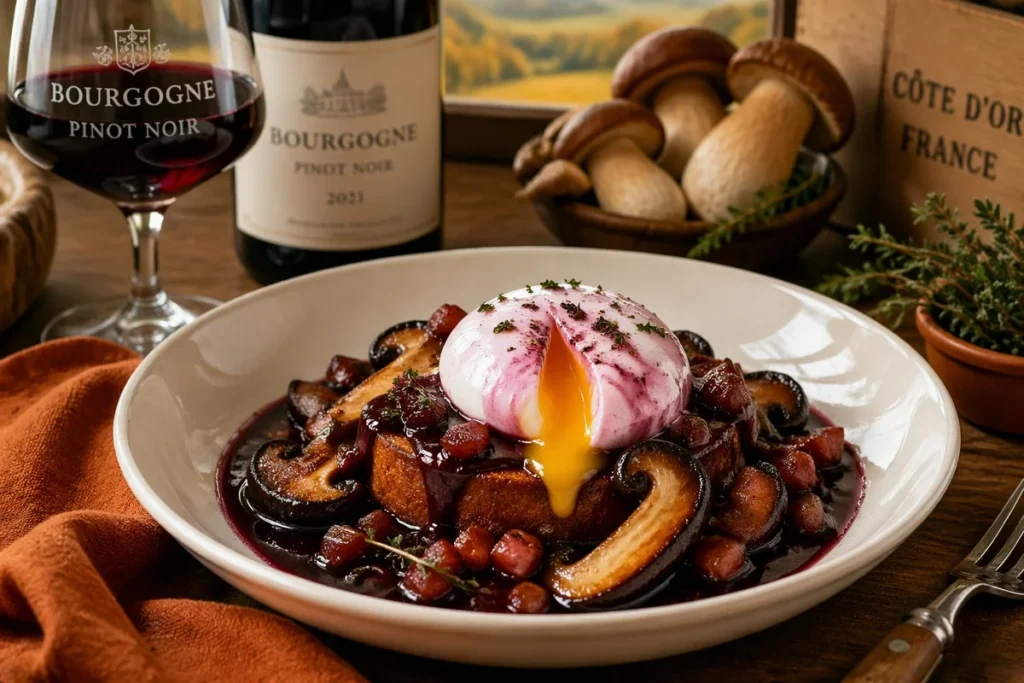
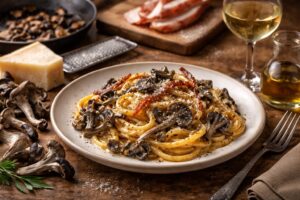
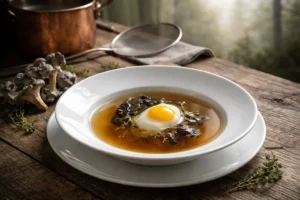
A Burgundian masterpiece featuring perfectly poached eggs in a rich Pinot Noir reduction, garnished with butter-seared wild Boletus edulis and smoked salt-cured lardons.
Porcini “Oeufs en Meurette”
A Burgundian Ritual of Wine, Earth, and the Golden Yolk
The Historical Prelude: The Vignerons’ Harvest Breakfast
In the storied vineyards of the Côte d'Or, the Oeufs en Meurette is the soul of Burgundian hospitality. Historically, this dish was the robust "breakfast of champions" for the vineyard workers (vignerons) during the exhausting days of the grape harvest. The "Meurette" sauce—a complex reduction of red wine, aromatics, and butter—was originally a way to utilize the "must" of the previous year's vintage.
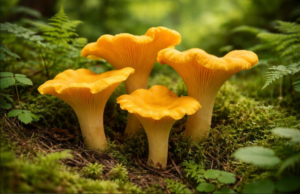
The inclusion of Boletus edulis marks the transition into late autumn, when the damp woods bordering the vineyards of Gevrey-Chambertin and Vosne-Romanée erupt with fungal treasures. While the classic recipe relies on button mushrooms, the high-end Heritage variation replaces them with wild Porcini. The mushroom provides a "meaty" resistance that complements the soft, velvet texture of the poached egg, creating a dish that feels like a full-bodied red wine in solid form. To eat En Meurette is to taste the very terroir of Burgundy: the acidity of the limestone-grown grapes and the musky dampness of the forest floor.
⏱ Time: 50 Minutes
📊 Difficulty: Intermediate / Classic French
🔥 Calories: 390 kcal / Serving
🍄 Type: Freshly Foraged Porcini
Culinary Philosophy: The Pinot Noir Extraction
The philosophy of the Meurette sauce is Reduction and Emulsion. We treat the red wine not as a liquid, but as a spice. By reducing a full bottle of Pinot Noir down to a mere glaze, we concentrate the anthocyanins and tannins into a powerful flavor agent. The Porcini are then sautéed separately to preserve their distinct texture, only meeting the sauce at the final assembly to prevent them from becoming "wine-stained" and mushy.
Sensory & Foraging Profile: The Limestone & Marl Terroir
Latin Nomenclature:Boletus edulis (The Burgundy phenotype). Terroir Analysis: Burgundy's forests are characterized by a mix of limestone and clay marl. Porcini found here, especially near oak (Quercus robur) and hornbeam (Carpinus betulus), develop a particularly high concentration of **nucleotides**, giving them an intense savory depth that can withstand the high acidity of a reduced Pinot Noir sauce.
Selection Protocol: We select "Intermediate Buttons"—mushrooms where the cap is starting to expand. The firm, white pores are essential here, as they act as microscopic brushes that catch the thick red wine sauce, ensuring every bite is saturated with flavor.
Essential Equipment
🔸 Sautéuse Pan: For the wide-surface reduction of the red wine.
🔸 Deep Saucepan: To create a gentle vortex for perfectly shaped poached eggs.
🔸 Fine-Mesh Sieve: To ensure the Meurette sauce is perfectly smooth and glossy.
The Master Recipe: The Burgundian Reduction
Stage 1: The Meurette Base
Reduce 500ml of a robust Pinot Noir with 2 shallots, a carrot, and a bouquet garni by two-thirds. Strain through a fine sieve. In a separate pan, create a beurre manié (equal parts flour and butter) and whisk into the wine reduction until it achieves a glossy, syrupy consistency.
Stage 2: The Forest Garnish
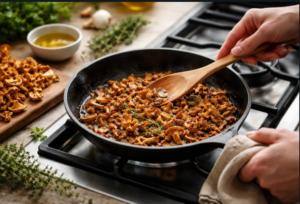
Sauté 100g of smoked lardons (pork belly) until crispy. Remove and use the rendered fat to sauté 300g of thickly sliced Porcini. The mushrooms must be "hard-seared" until they have a golden-brown crust. Season with black pepper and a touch of thyme.
Stage 3: The Poaching Ritual
Bring a pot of water with a splash of white vinegar to a bare simmer. Create a gentle whirlpool and drop in 4 ultra-fresh eggs. Poach for exactly 3 minutes. The whites must be set, but the yolks must remain liquid gold.
Stage 4: The Assembly
Place a thick slice of butter-toasted sourdough bread at the bottom of a shallow bowl. Place the poached egg on top. Surround with the Porcini and lardons, and generously pour over the dark, lustrous Meurette sauce.
Chef’s Secret: The “Wine-Poach” Technique
For a truly professional, 3-star finish, do not poach your eggs in water. Poach them directly in a mixture of water and the same red wine you used for the sauce. This gives the exterior of the egg a beautiful, "antique rose" hue and ensures that the very first contact of the yolk with the palate is infused with the subtle tannins of the Pinot Noir.
The Umami Secret: The Red Wine Synergist
Red wine, specifically aged Pinot Noir, is rich in **Tannins** and **Acids**. When these meet the **Glutamates** of the Porcini and the **Lecithin** of the egg yolk, a complex emulsion forms on the palate. The lecithin acts as a bridge, binding the water-soluble wine volatiles to the fat-soluble mushroom aromas, resulting in a flavor that is perceived as "thicker" and more multi-dimensional than a standard mushroom sauce.
The Art of Pairing
Sommelier's Selection: A **Bourgogne Rouge** (Pinot Noir) from the same sub-region as the mushrooms. The wine's acidity will cut through the richness of the yolk and the sauce, while its earthy "forest floor" notes will mirror the Porcini.
Non-Alcoholic: A warm, unsweetened cranberry and hibiscus tea reduction.
Micro-FAQ
Q: Can I use white wine for the sauce? A: You can (this is called *Oeufs à la Beaujolaise* if using white), but the traditional *Meurette* is strictly red. The red wine provides a much deeper, more "fungal" color and tannins that white wine lacks.
Q: My poached eggs are messy! A: Use the "strainer trick": crack the egg into a fine-mesh sieve first to remove the watery part of the white before dropping it into the poaching water. This results in a perfectly clean, oval shape.
The Porcini Directory: Global Names for Boletus edulis
The King Bolete, or simply Porcini, is arguably the most recognized wild mushroom in the culinary world. Its linguistic variety reflects its presence in forests from the Alps to the Himalayas:
Language
Regional & Folk Names
Expert Insights
Italian
Porcino, Brisa, Fungo di faggio
"Porcini" (little pigs) is the global trade name.
French
Cèpe de Bordeaux, Gros pied, Polonais
"Cèpe" comes from the Gascon word for trunk/stump.
German
Steinpilz, Herrenpilz, Edelpilz
"Steinpilz" (Stone mushroom) refers to its firm flesh.
To provide the best experiences, we use technologies like cookies to store and/or access device information. Consenting to these technologies will allow us to process data such as browsing behavior or unique IDs on this site. Not consenting or withdrawing consent, may adversely affect certain features and functions.
Functional
Always active
The technical storage or access is strictly necessary for the legitimate purpose of enabling the use of a specific service explicitly requested by the subscriber or user, or for the sole purpose of carrying out the transmission of a communication over an electronic communications network.
Preferences
The technical storage or access is necessary for the legitimate purpose of storing preferences that are not requested by the subscriber or user.
Statistics
The technical storage or access that is used exclusively for statistical purposes.The technical storage or access that is used exclusively for anonymous statistical purposes. Without a subpoena, voluntary compliance on the part of your Internet Service Provider, or additional records from a third party, information stored or retrieved for this purpose alone cannot usually be used to identify you.
Marketing
The technical storage or access is required to create user profiles to send advertising, or to track the user on a website or across several websites for similar marketing purposes.