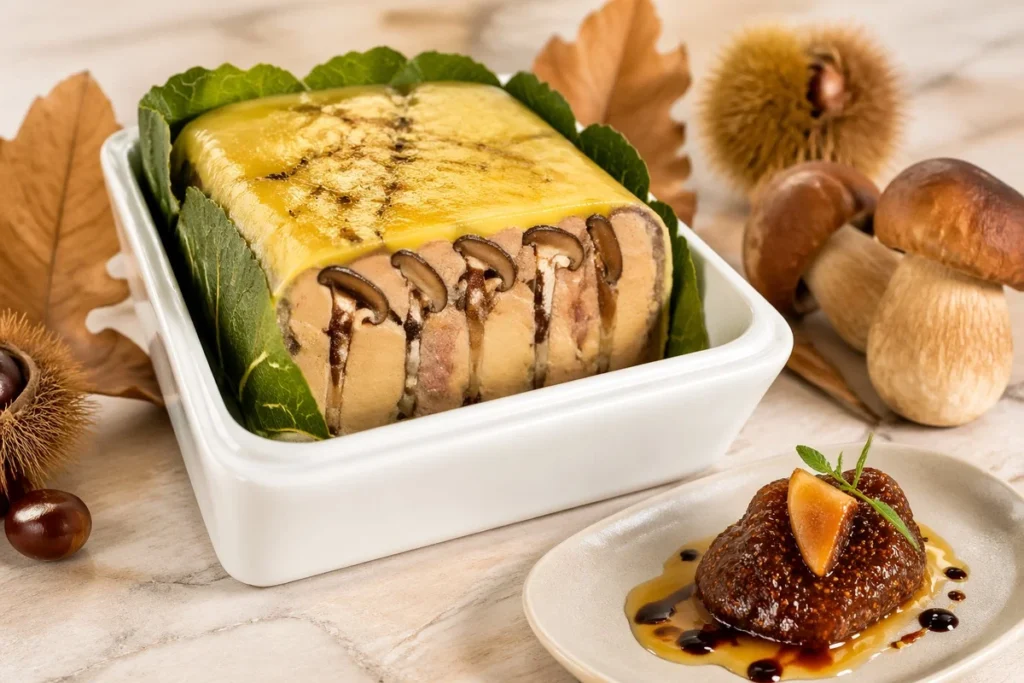
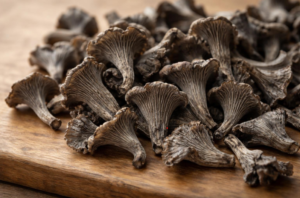
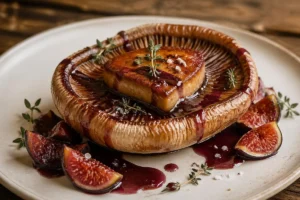
A legendary preparation of the Perigord region, layering butter-soft Foie Gras d'Oie with sautéed wild Boletus edulis, balanced by the honeyed acidity of a mission fig compote.
Porcini & Foie Gras Terrine
The Périgordian Union: A Symphony of Fat, Earth, and Fruit
The Historical Prelude: The Gilded Age of the Périgord
In the lush, limestone-rich valleys of the Périgord (Dordogne), the culinary calendar is divided by two supreme harvests: the winter truffle and the autumn **Cèpe** (Porcini). Historically, the Terrine served as the ultimate preservation vessel for the region's two greatest exports: the fatty liver (Foie Gras) of the Gascon goose and the wild **Boletus edulis**. This combination was famously championed by the "Prince of Gastronomes," Curnonsky, who considered the earthy porcini the only ingredient capable of cutting through the velvet richness of foie gras without diminishing its status.
The Fig Compote is a later refinement, drawing from the medieval tradition of pairing game and rich fats with dried fruits to manage the heavy lipid profile. By the 19th century, this terrine became a staple of the *Grand Hôtels de France*, where it was served as a cold starter (entrée froide) to signify the transition from the light summer months to the deep, complex flavors of the hunting season. This recipe represents the zenith of French technical balance—a dish where every gram of fat is accounted for by a corresponding unit of fungal umami and fruit acidity.
⏱ Time: 3 Hours + 24h Chilling
📊 Difficulty: Professional / Master
🔥 Calories: 580 kcal / Serving
🍄 Type: AAA Grade Wild Porcini
Culinary Philosophy: The Architecture of Lipid Density
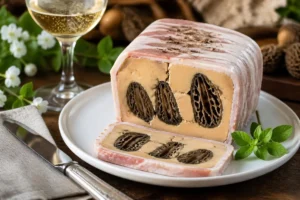
The philosophy of this terrine is Controlled Saturation. Foie Gras is over 80% fat, while the Porcini is primarily moisture and fiber. In the Périgordian school, the chef uses the mushroom as a "biological wick." During the gentle poaching of the terrine, the porcini fibers absorb the rendered fat of the foie gras, effectively becoming "mushroom-shaped foie gras." We seek a mosaic-like cross-section where the bronze of the mushroom and the ivory of the liver form a perfect visual and textural map.
Sensory & Foraging Profile: The Oak & Chestnut Fringe
Latin Nomenclature:Boletus edulis (The Cèpe de Bordeaux). Terroir Analysis: The Dordogne features reddish, iron-rich clay soils. Porcini found here under **chestnut trees** possess a distinct sweetness and a density that prevents them from "melting" into the liver during the terrine's long, low-temperature bake.
Selection Protocol: We only utilize "Grade A" specimens with perfectly white, tight pores. Any specimen with yellowing or "spongy" pores will absorb too much fat, causing the terrine to lose its structural definition. We use large, vertical slices to maintain the iconic "mushroom silhouette" in the final cut.
Essential Equipment
🔸 Porcelain Terrine Dish: For slow, gentle heat conduction that prevents the liver from "breaking" (rendering too much oil).
🔸 Terrine Press / Weight: To ensure the layers fuse into a solid block during the chilling phase.
🔸 Digital Temperature Probe: The core must not exceed 52°C to maintain the silken texture.
The Master Recipe: The Perigordian Mosaic
Stage 1: The Foie Gras Preparation
Devein a 600g raw duck or goose liver. Marinate for 2 hours in a mix of salt, white pepper, a pinch of sugar, and 30ml of aged **Sauternes**. This "pre-seasoning" is essential for the liver to hold its flavor during the bake.
Stage 2: The Porcini Core
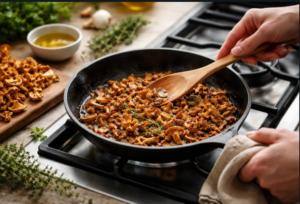
Slice 3 large Porcini vertically (5mm thick). Sauté in a dry pan for 2 minutes per side to expel moisture, then quickly deglaze with a drop of Cognac. The mushrooms must be "firm-cooked" before being layered.
Stage 3: The Assembly & Poach
Layer the foie gras and porcini in the terrine dish, ensuring no air pockets remain. Cover with a lid and place in a Bain-Marie (water bath). Bake at 100°C until the core reaches 50-52°C. Remove immediately.
Stage 4: The Compression & Rest
Place a weight (approx. 500g) on top of the terrine. Chill in the refrigerator for at least 24 hours. This "Cold-Press" is what creates the legendary texture. Serve with a compote of fresh figs, balsamic vinegar, and honey.
Chef’s Secret: The “Fig-Leaf Wrap”
For a professional, heritage presentation, line the terrine dish with **blanched fresh fig leaves** before adding the liver and mushrooms. The leaves provide a subtle, coconut-like aroma that bridges the gap between the fruity compote and the earthy fungi, while also acting as a natural protective barrier against the heat.
The Umami Secret: Fatty-Acid Umami Amplification
Foie gras is rich in monounsaturated fats, which are highly efficient solvents for the lipophilic volatiles in Porcini. When the mushroom fibers are saturated with these fats, the **glutamates** in the fungi are released more slowly on the tongue, creating a "sustained umami" effect. The sugar and acid in the figs trigger a "Contrast Response" in the brain, which resets the palate and makes every bite of the rich terrine taste as intense as the first.
The Art of Pairing
Sommelier's Selection: A classic **Sauternes** or a late-harvest **Chenin Blanc**. The high residual sugar and acidity of these "Noble Rot" wines are the only things capable of standing up to the sheer decadence of this terrine.
Non-Alcoholic: A chilled, sparkling infusion of white peach and verjuice.
Micro-FAQ
Q: Why is there yellow fat on top of my terrine? A: This is perfectly normal! It is the rendered "liquid gold" of the foie gras. Do not discard it; it protects the terrine from oxidation. You can scrape it off before serving or spread it on the toast.
Q: My terrine is crumbly, not smooth. A: You likely overcooked the liver or didn't use enough weight during the pressing phase. The liver must stay under 54°C to maintain its silken structure.
The Porcini Directory: Global Names for Boletus edulis
The King Bolete, or simply Porcini, is arguably the most recognized wild mushroom in the culinary world. Its linguistic variety reflects its presence in forests from the Alps to the Himalayas:
Language
Regional & Folk Names
Expert Insights
Italian
Porcino, Brisa, Fungo di faggio
"Porcini" (little pigs) is the global trade name.
French
Cèpe de Bordeaux, Gros pied, Polonais
"Cèpe" comes from the Gascon word for trunk/stump.
German
Steinpilz, Herrenpilz, Edelpilz
"Steinpilz" (Stone mushroom) refers to its firm flesh.
To provide the best experiences, we use technologies like cookies to store and/or access device information. Consenting to these technologies will allow us to process data such as browsing behavior or unique IDs on this site. Not consenting or withdrawing consent, may adversely affect certain features and functions.
Functional
Always active
The technical storage or access is strictly necessary for the legitimate purpose of enabling the use of a specific service explicitly requested by the subscriber or user, or for the sole purpose of carrying out the transmission of a communication over an electronic communications network.
Preferences
The technical storage or access is necessary for the legitimate purpose of storing preferences that are not requested by the subscriber or user.
Statistics
The technical storage or access that is used exclusively for statistical purposes.The technical storage or access that is used exclusively for anonymous statistical purposes. Without a subpoena, voluntary compliance on the part of your Internet Service Provider, or additional records from a third party, information stored or retrieved for this purpose alone cannot usually be used to identify you.
Marketing
The technical storage or access is required to create user profiles to send advertising, or to track the user on a website or across several websites for similar marketing purposes.