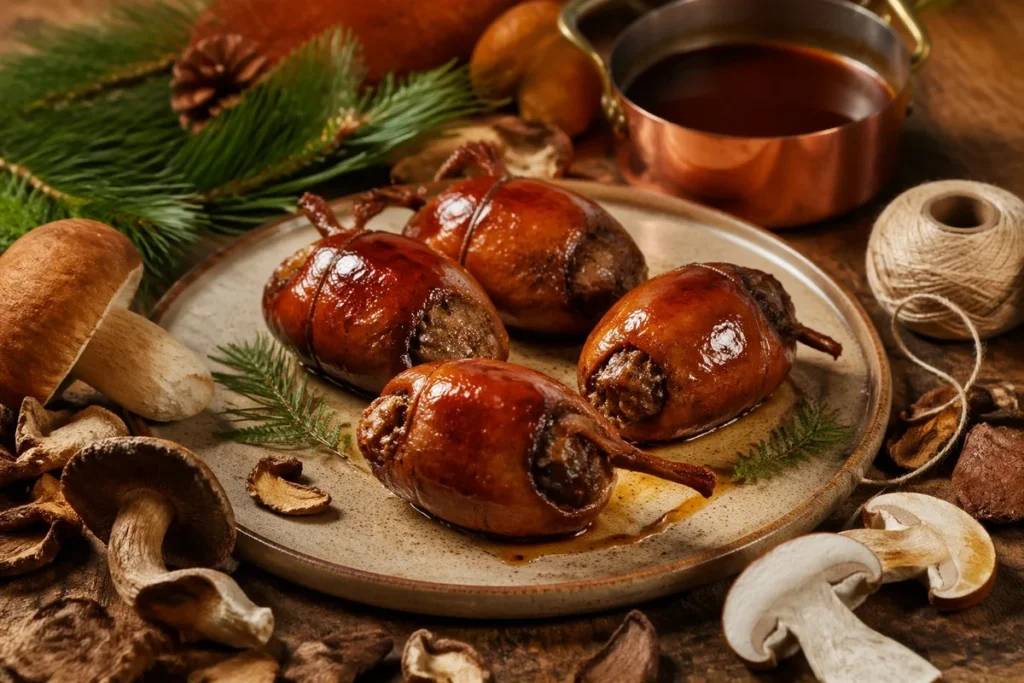
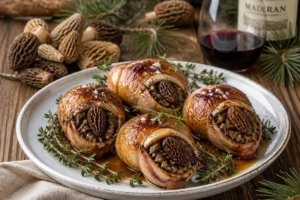
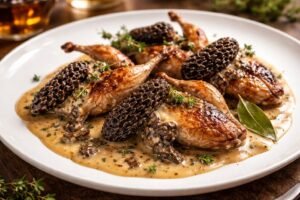
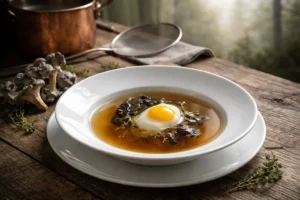
An elite preparation featuring semi-boned wild quails stuffed with a concentrated Boletus edulis and chestnut farce, finished with a lacquer of aged Armagnac and forest honey.
Porcini-Stuffed Quail & Armagnac Glaze
The Gascon Wild: A Trilogy of Game, Fungus, and Fire
The Historical Prelude: The Hunting Lodges of the Landes
In the vast pine forests of the Landes de Gascogne, the autumn months are defined by two sights: the migration of the wood-quail and the sudden, silent eruption of the Cèpe (Porcini). Historically, the Caille (Quail) was a bird of the nobility, prized for its delicate, iron-rich flesh. This specific preparation, where the bird is stuffed with the very mushrooms it sought shelter under, represents the "Culinary Circle of Life."
The use of **Armagnac**—France's oldest brandy—is the defining Gascon signature. Unlike the cleaner, twice-distilled Cognac, Armagnac is distilled only once, preserving the "impurities" and rustic esters of the grape. When used to glaze a bird stuffed with wild Boletus edulis, the spirit acts as a bridge, its notes of prune, leather, and vanilla amplifying the mushroom's nut-like qualities. This dish was the traditional centerpiece of the *Dîner de Chasse* (Hunter's Dinner), where the aroma of searing quail fat and evaporating brandy signaled the true arrival of the winter season.
⏱ Time: 2 Hours
📊 Difficulty: Elite Technical (Boning)
🔥 Calories: 410 kcal / Serving
🍄 Type: Wild-Harvested Porcini
Culinary Philosophy: The “Scent-Bomb” Farce
The philosophy of the stuffed quail is Internal Infusion. Because quail is small and cooks rapidly, we use the stuffing (farce) as a moisture-reservoir. By sautéing the Porcini to a concentrated paste before stuffing, we ensure that the mushroom's volatile oils are forced outward into the quail breast during roasting. We don't just put mushrooms inside the bird; we use the bird as a thermal chamber to "distill" the mushroom flavor into the meat.
Sensory & Foraging Profile: The Pine & Fern Fringe
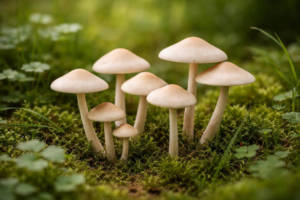
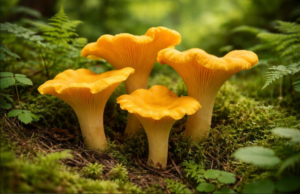
Latin Nomenclature:Boletus edulis (The Maritime Pine phenotype). Terroir Analysis: The Landes region features sandy, acidic soils. Porcini found here often grow under Maritime Pine (Pinus pinaster). These mushrooms possess a distinct resinous, "mentholated" top-note that is absent in those from oak forests. This resinous quality is the perfect structural partner for the heavy, spirituous notes of the Armagnac glaze.
Harvesting Protocols: For stuffing, we prioritize "Small-Cap" buttons. Their tight structure allows them to be finely minced without losing their textural identity (becoming mushy). We also utilize the dried skins of Porcini, powdered and added to the farce, to provide a darker color and a deeper umami profile.
Essential Equipment
🔸 Professional Boning Knife: For the "semi-boning" process (removing the ribcage but leaving the wings and legs intact).
🔸 Kitchen Twine: To truss the birds into a uniform "egg" shape for even roasting.
🔸 Small Copper Saucepan: For the precision reduction of the Armagnac lacquer.
The Master Recipe: The Gascon Roasting
Stage 1: The semi-Boning
Semi-bone 4 wild quails. Carefully remove the spine and ribcage, leaving the skin intact. This creates a large internal cavity for the Porcini farce. Season the interior with salt and a touch of quatre-épices.
Stage 2: The Porcini Farce
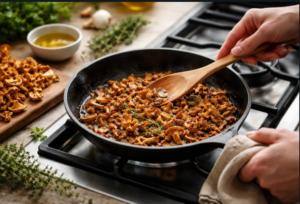
Finely mince 300g of fresh Porcini and 100g of roasted chestnuts. Sauté in duck fat until all moisture is gone. Mix with 1 tablespoon of minced foie gras (optional) and a splash of Armagnac. This should be a thick, intensely fragrant paste.
Stage 3: The Assembly & Truss
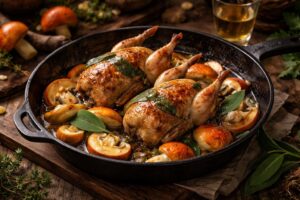
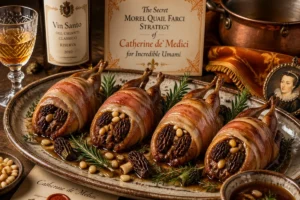
Stuff each quail with the Porcini farce. Truss tightly with twine. Rub the skin with softened butter. Roast at 200°C for 12–15 minutes. The quail should remain slightly pink at the bone (à point).
Stage 4: The Armagnac Lacquer
In a small pan, reduce 100ml of **Armagnac VSOP** with a tablespoon of forest honey and the resting juices of the birds. Once syrupy, brush the glaze over the hot quails. The heat of the bird will "set" the lacquer into a mirror-like finish.
Chef’s Secret: The “Flash-Flambé”
Just before serving, take a tablespoon of warm Armagnac, light it with a match, and pour it over the birds at the table. This "Flash-Flambé" doesn't just look spectacular; it provides a final, high-temperature "singe" to the mushroom-stuffed interior, releasing a burst of volatile aromatics that would otherwise stay trapped inside the bird.
The Umami Secret: The Ethanol-Lipid Carrier
Armagnac contains long-chain esters and residual ethanol. Ethanol is a more powerful flavor solvent than water or fat. When the Armagnac glaze meets the **Glutamates** of the Porcini farce and the **Iron** of the quail meat, the alcohol "unlocks" flavor molecules that are usually inaccessible. This results in a "3D Flavor" sensation, where the taste is perceived not just on the tongue, but throughout the entire oral cavity and retro-nasal passage.
The Art of Pairing
Sommelier's Selection: A robust red from **Cahors** (Malbec) or a **Madiran**. The heavy tannins are necessary to stand up to the spirituous glaze and the richness of the farce.
Non-Alcoholic: A warm, spiced prune and lapsang souchong tea reduction.
Micro-FAQ
Q: My quail is dry! A: Quail is extremely easy to overcook. Ensure the oven is very hot so the skin browns before the lean breast meat dries out. Always let the birds rest for 5 minutes before serving.
Q: Can I use brandy instead of Armagnac? A: You can use Cognac, but it will be much "cleaner" and thinner. Armagnac is essential for that specific, rustic "forest floor" character that defines this Gascon heritage dish.
The Porcini Directory: Global Names for Boletus edulis
The King Bolete, or simply Porcini, is arguably the most recognized wild mushroom in the culinary world. Its linguistic variety reflects its presence in forests from the Alps to the Himalayas:
Language
Regional & Folk Names
Expert Insights
Italian
Porcino, Brisa, Fungo di faggio
"Porcini" (little pigs) is the global trade name.
French
Cèpe de Bordeaux, Gros pied, Polonais
"Cèpe" comes from the Gascon word for trunk/stump.
German
Steinpilz, Herrenpilz, Edelpilz
"Steinpilz" (Stone mushroom) refers to its firm flesh.
To provide the best experiences, we use technologies like cookies to store and/or access device information. Consenting to these technologies will allow us to process data such as browsing behavior or unique IDs on this site. Not consenting or withdrawing consent, may adversely affect certain features and functions.
Functional
Always active
The technical storage or access is strictly necessary for the legitimate purpose of enabling the use of a specific service explicitly requested by the subscriber or user, or for the sole purpose of carrying out the transmission of a communication over an electronic communications network.
Preferences
The technical storage or access is necessary for the legitimate purpose of storing preferences that are not requested by the subscriber or user.
Statistics
The technical storage or access that is used exclusively for statistical purposes.The technical storage or access that is used exclusively for anonymous statistical purposes. Without a subpoena, voluntary compliance on the part of your Internet Service Provider, or additional records from a third party, information stored or retrieved for this purpose alone cannot usually be used to identify you.
Marketing
The technical storage or access is required to create user profiles to send advertising, or to track the user on a website or across several websites for similar marketing purposes.