A professional technical guide to molecular flavor extraction, creating ultra-concentrated wild Boletus edulis oils and balsamic reductions for elite culinary finishing.
Porcini Extraction Masterclass
The Molecular Essence: Cold-Infused Oils and Noble Reductions
The Historical Prelude: The Apothecaries of Flavor
Long before the advent of modern food science, the 17th-century apothecaries of **Florence** and **Lyon** were the guardians of flavor extraction. They understood that the most precious aromatic compounds of the Boletus edulis were not always soluble in water. To capture the fleeting scent of the forest, they turned to the ancient arts of infusion used in perfumery. Historically, Porcini Oil was a "secret weapon" of the Medici kitchens, used to provide an invisible depth to dishes where physical mushrooms were absent.
The transition from simple infusion to the **Masterclass Reduction** occurred in the 20th century, as chefs like Alain Ducasse and Gualtiero Marchesi sought ways to deconstruct and reconstruct the mushroom's profile. They realized that by separating the lipid-soluble aromas (in oil) and the acid-soluble umami (in vinegar), they could manipulate the diner's perception of "Forestness" with surgical precision. This guide represents the pinnacle of that evolution—a method to distill the raw, wild power of the Porcini into a liquid concentrate that possesses the shelf-life of a vintage wine and the aromatic intensity of a truffle.
⏱ Time: 48 Hours (Infusion)
📊 Difficulty: Elite Technical / Lab-Grade
🔥 Calories: 90 kcal / 10ml
🍄 Type: Dehydrated Porcini Concentrates
The Culinary Philosophy: Molecular Solvent Partitioning
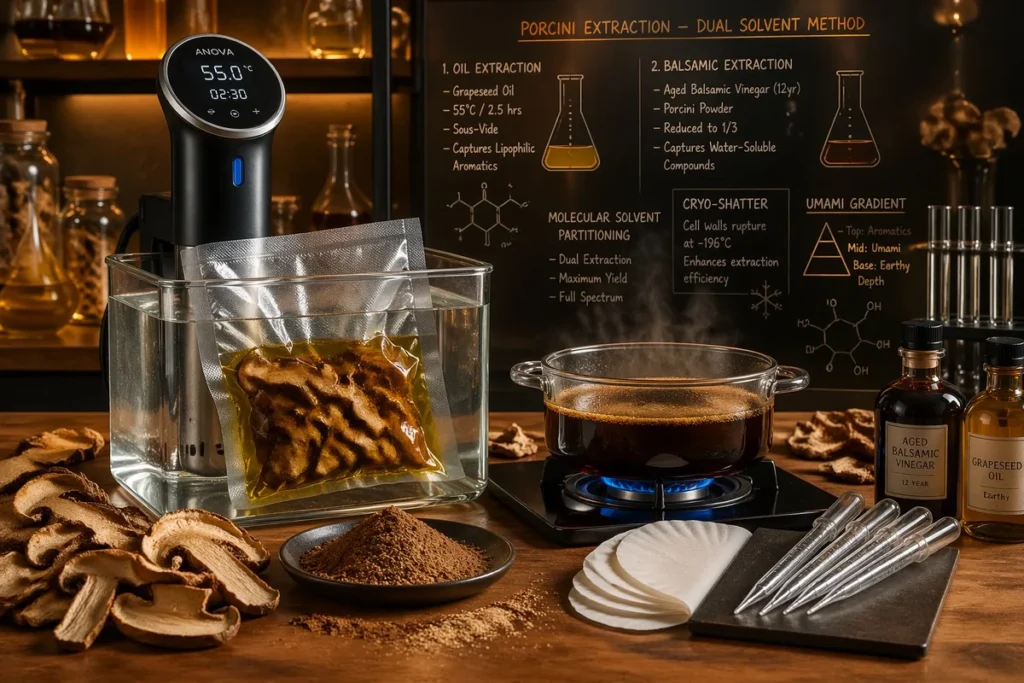
In high-end mycological research, the philosophy is Total Extraction. We do not waste. The mushroom is a complex matrix of flavor compounds. We utilize two different "solvents" to extract different parts of its soul: **Neutral Oil** (to capture the volatile, earthy esters) and **Aged Balsamic Vinegar** (to capture the deep, water-soluble glutamates). This dual approach allows the chef to control the "Umami Gradient" of a dish, adding either high-frequency scent or low-frequency savory depth.
Sensory & Foraging Profile: The Dehydrated Core
Latin Nomenclature:Boletus edulis (Concentrated Dehydrate). Terroir Analysis: For extraction, the origin must be a "Hardwood Terroir" (Oak/Beech). These mushrooms possess a higher concentration of **1-octen-3-ol** (the primary mushroom alcohol). When dehydrated, these compounds become concentrated tenfold, making them ideal for high-yield infusions.
Selection Protocol: We utilize "B-Grade" dried slices for the oil (as visual perfection is unnecessary) and "Powdered Fines" for the vinegar. The increased surface area of the powder allows for a rapid enzymatic exchange with the acetic acid of the vinegar.
Essential Equipment
🔸 Sous-Vide Circulator: To maintain a constant 55°C—the "Golden Temperature" for aromatic extraction without scorching.
🔸 Ultra-Fine Coffee Filters: To ensure the final oil is crystal clear and free of any particulate matter.
🔸 Glass Pipettes: For the surgical application of the concentrates during plating.
The Master Recipe: The Dual Extraction
Stage 1: The Cold-Infused Porcini Oil
Combine 100g of high-quality dried Porcini with 500ml of neutral Grapeseed oil. Vacuum seal the bag and place in a water bath at 55°C for 6 hours. Then, let it sit at room temperature for 48 hours. Strain through a coffee filter. The resulting oil will be dark amber and intensely nutty.
Stage 2: The Mycological Balsamic Reduction
Simmer 200ml of Aceto Balsamico di Modena with 30g of Porcini powder. Reduce over very low heat until the liquid has lost 60% of its volume. The acidity will mellow, and the mushroom umami will become syrupy and dense.
Stage 3: The Clarification
Pass the balsamic reduction through a fine Chinois. Combine the oil and the reduction only at the moment of plating to create a "Broken Vinaigrette" effect that showcases both extractions visually.
Stage 4: The Storage Protocol
Store in dark glass bottles away from sunlight. The oil will maintain its peak aroma for 3 months, while the vinegar reduction is practically immortal due to its sugar and acid content.
Pro Technique: The “Cryo-Shatter” Extraction
To achieve "Michelin-grade" intensity, use the Cryo-Shatter method: Freeze dried Porcini slices with liquid nitrogen (or in a deep freezer at -20°C) and then pulverize them instantly. The cold prevents the volatile oils from evaporating during grinding. Adding this "cryo-dust" to the oil increases the aromatic yield by 25% compared to standard room-temperature grinding.
The Umami Secret: Solubility and Persistence
The science of the "Long-Finish" in professional cooking relies on **Solubility**. Water-based flavors (like in a soup) hit the tongue fast and fade fast. Fat-based flavors (like Porcini Oil) hit slowly but persist because they coat the lipid-loving receptors. By using both an oil and a vinegar reduction, the chef ensures a "Flavor Wave" that starts sharp and acidic and ends with a deep, lingering mushroom bass-note that stays for several minutes.
The Art of Pairing
Usage: Use these extractions to "finish" a simple Risotto, a grilled steak, or even a vanilla bean gelato (for an avant-garde dessert). They are the "Liquid Spices" of the modern mycological kitchen.
Ancestral Nutrition
Infusing Porcini into oil preserves the **Vitamin D** and **Ergothioneine** in a bioavailable form. Just a few drops provide a concentrated dose of forest-derived antioxidants that are easily absorbed by the body alongside healthy fats.
Micro-FAQ
Q: Why use neutral oil instead of olive oil? A: High-quality olive oil has its own strong polyphenols (peppery/grassy) that compete with the delicate Porcini scent. Grapeseed oil is a "blank canvas" that lets the mushroom speak for itself.
Q: Can I use fresh mushrooms for the oil? A: It is dangerous. Fresh mushrooms contain water, which can lead to bacterial growth (Botulism) in an anaerobic oil environment. **Always use fully dehydrated mushrooms for oil infusions.**
The Porcini Directory: Global Names for Boletus edulis
The King Bolete, or simply Porcini, is arguably the most recognized wild mushroom in the culinary world. Its linguistic variety reflects its presence in forests from the Alps to the Himalayas:
Language
Regional & Folk Names
Expert Insights
Italian
Porcino, Brisa, Fungo di faggio
"Porcini" (little pigs) is the global trade name.
French
Cèpe de Bordeaux, Gros pied, Polonais
"Cèpe" comes from the Gascon word for trunk/stump.
German
Steinpilz, Herrenpilz, Edelpilz
"Steinpilz" (Stone mushroom) refers to its firm flesh.
To provide the best experiences, we use technologies like cookies to store and/or access device information. Consenting to these technologies will allow us to process data such as browsing behavior or unique IDs on this site. Not consenting or withdrawing consent, may adversely affect certain features and functions.
Functional
Always active
The technical storage or access is strictly necessary for the legitimate purpose of enabling the use of a specific service explicitly requested by the subscriber or user, or for the sole purpose of carrying out the transmission of a communication over an electronic communications network.
Preferences
The technical storage or access is necessary for the legitimate purpose of storing preferences that are not requested by the subscriber or user.
Statistics
The technical storage or access that is used exclusively for statistical purposes.The technical storage or access that is used exclusively for anonymous statistical purposes. Without a subpoena, voluntary compliance on the part of your Internet Service Provider, or additional records from a third party, information stored or retrieved for this purpose alone cannot usually be used to identify you.
Marketing
The technical storage or access is required to create user profiles to send advertising, or to track the user on a website or across several websites for similar marketing purposes.