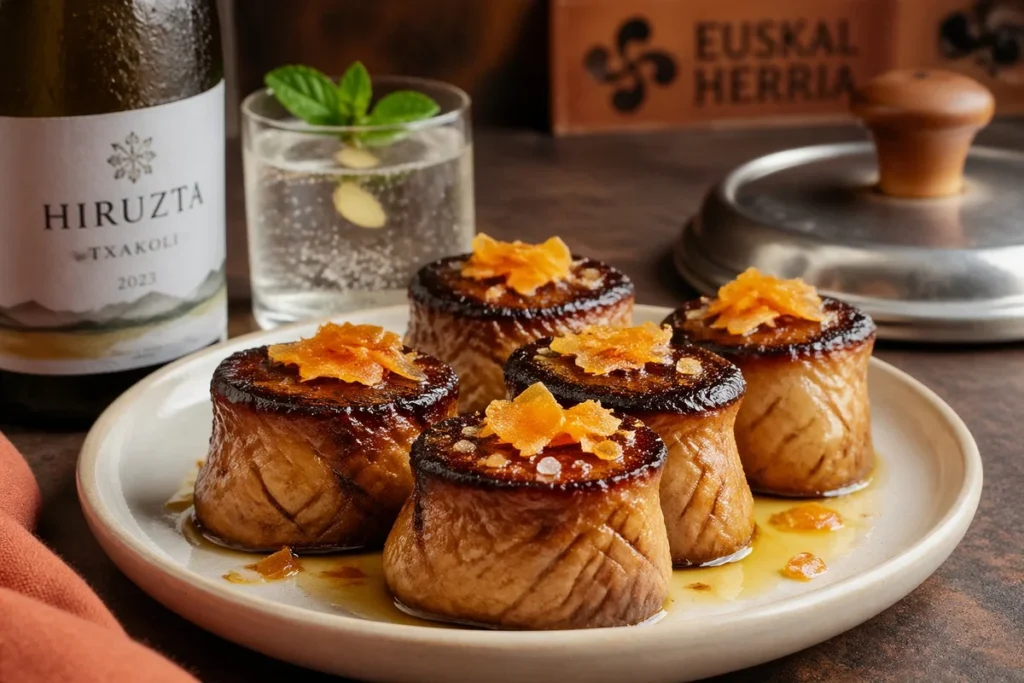
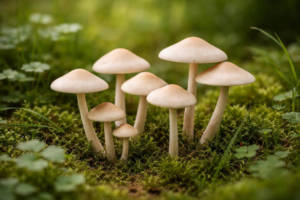
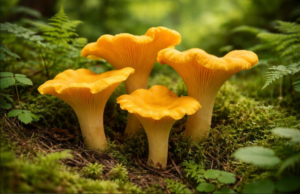
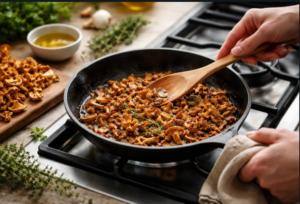
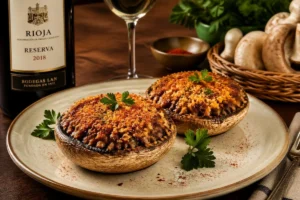
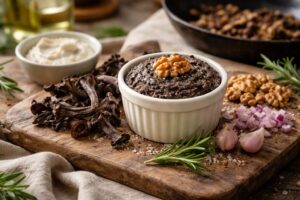
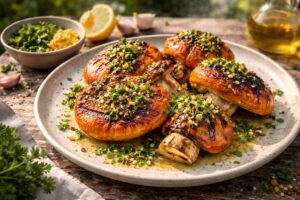
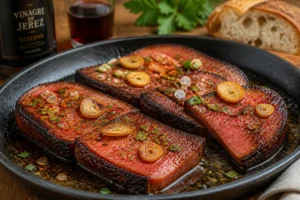
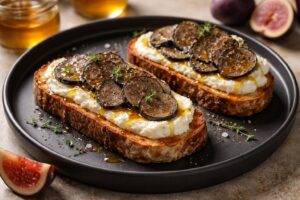
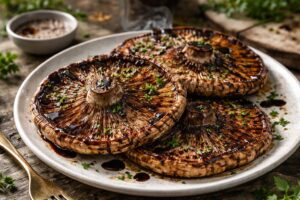
A minimalist yet elite Basque preparation of wild Boletus edulis seared on a high-heat plancha, served with a 24-hour salt-cured egg yolk and smoked sea salt.
Basque “Boletus a la Plancha”
The Fire of San Sebastián: A Study in Sear and Cured Gold
The Historical Prelude: The Gastronomic Societies of Donostia
In the narrow, cobblestone streets of Donostia (San Sebastián), the Sociedades Gastronómicas (private cooking clubs) have guarded the secrets of the Basque kitchen for over a century. Unlike the butter-rich traditions of the North, Basque luxury is built on the mastery of the **Plancha**—a heavy, flat iron grill that reaches searing temperatures. Historically, the **Boletus edulis**, known locally as Onddo Zuri, was the ultimate prize of the autumn harvest in the Pyrenean foothills of Gipuzkoa.
The pairing with a **Cured Egg Yolk** is a contemporary evolution of the traditional Revuelto, a nod to the Michelin-starred revolution led by Juan Mari Arzak. While the old guard preferred their eggs scrambled, the modern Basque masters realized that a salt-cured yolk—transformed into a dense, translucent amber sphere—provides a far more concentrated fat source to coat the charred surfaces of the wild fungi. This dish represents the "Modern Basque" philosophy: take a wild ingredient, apply extreme heat, and finish it with a single, technically complex element that amplifies its natural umami.
⏱ Time: 20 Mins + 24h Curing
📊 Difficulty: Precision Timing
🔥 Calories: 210 kcal / Serving
🍄 Type: Basque Wild "Onddo"
Culinary Philosophy: The Maillard Peak
Basque philosophy centers on Thermal Aggression. We do not want a gentle sauté; we want a violent, rapid searing of the mushroom's surface. This creates a "crust" of caramelized sugars while leaving the interior almost raw and succulent. The egg yolk acts as the "sauce," but it is a sauce of the highest viscosity, designed to cling to the Porcini's pores and bridge the gap between the smoke and the soil.
Sensory & Foraging Profile: The Cantabrian Maritime Terroir
Latin Nomenclature:Boletus edulis (The Basque "Onddo"). Terroir Analysis: Sourced from the ancient oak and beech forests of the Aralar Range. The soil is rich in clay and flint, and the proximity to the Cantabrian Sea means the mushrooms are often bathed in "Sirimiri" (fine Basque mist). This leads to a mushroom with a higher mineral salinity and a cap that is notably stickier—perfect for catching the char of the plancha.
Selection Protocol: We use only "King" buttons. The stems must be exceptionally thick and the caps tight. In Basque cuisine, the stem is just as valuable as the cap; we slice it into thick rounds (medallions) to provide a steak-like resistance on the plate.
Essential Equipment
🔸 Heavy Cast-Iron Plancha / Skillet: Must be able to withstand temperatures above 250°C.
🔸 Metal Press / Burger Weight: To ensure maximum surface contact between the mushroom and the heat.
🔸 Micro-plane: For grating the cured yolk over the finished mushrooms.
The Master Recipe: The Basque Sear
Stage 1: The Cured Gold (24 Hours Prior)
Mix 200g of sea salt and 200g of sugar. Create small wells in the mixture and carefully drop in 4 fresh organic egg yolks. Cover with more salt/sugar and refrigerate for 24 hours. The yolk will become firm and sliceable. Rinse gently before use.
Stage 2: The Plancha Preparation
Clean the Porcini and slice them vertically into 1.5cm thick "steaks." Brush each side with a high-smoke-point neutral oil (not olive oil yet, as it will burn at these temperatures).
Stage 3: The Thermal Strike
Heat the plancha until it is smoking. Place the Porcini steaks down. Use the metal weight to press them for exactly 90 seconds. Flip. They should have a deep, uniform dark brown crust. Sear the other side for 60 seconds.
Stage 4: The Final Embellishment
Remove to a warm plate. Drizzle with Basque Picual Olive Oil and a sprinkle of Maldon smoked salt. Grate the cured egg yolk over the top—it will fall like orange snow, melting slightly into the hot mushrooms.
Pro Technique: The “Scoring” Secret
Before searing, take a sharp knife and score a cross-hatch pattern (3mm deep) into the flat surface of the Porcini stems. This allows the intense heat to penetrate the core more quickly and provides "valleys" where the olive oil and the melting cured yolk can pool, ensuring every bite is an explosion of flavor.
The Umami Secret: Maillard & Lecithin Synergy
The extreme heat of the plancha triggers a massive **Maillard Reaction** on the mushroom's surface, creating new aromatic molecules. When these meet the **Lecithin** and **Fatty Acids** of the cured yolk, the fat acts as a "long-term carrier" for the smoky volatiles. This results in a flavor that doesn't just hit the palate—it coats it, extending the umami duration by nearly 50% compared to a traditional sauté.
The Art of Pairing
Sommelier's Selection: A dry, acidic **Txakoli** from Getaria. The wine's slight effervescence and saline "sea spray" notes are the traditional palate cleanser for rich, charred Porcini.
Non-Alcoholic: A chilled, sparkling water with a drop of apple cider vinegar and a sprig of fresh mint.
Micro-FAQ
Q: Why use a salt/sugar mix for the yolk? A: The salt cures the yolk (extracts moisture), while the sugar balances the intensity and preserves the vibrant orange color. Pure salt curing can make the yolk too bitter.
Q: My mushrooms stuck to the plancha! A: This means the plancha wasn't hot enough or you didn't use enough oil. The plancha must be smoking hot before the mushroom touches it.
The Porcini Directory: Global Names for Boletus edulis
The King Bolete, or simply Porcini, is arguably the most recognized wild mushroom in the culinary world. Its linguistic variety reflects its presence in forests from the Alps to the Himalayas:
Language
Regional & Folk Names
Expert Insights
Italian
Porcino, Brisa, Fungo di faggio
"Porcini" (little pigs) is the global trade name.
French
Cèpe de Bordeaux, Gros pied, Polonais
"Cèpe" comes from the Gascon word for trunk/stump.
German
Steinpilz, Herrenpilz, Edelpilz
"Steinpilz" (Stone mushroom) refers to its firm flesh.
To provide the best experiences, we use technologies like cookies to store and/or access device information. Consenting to these technologies will allow us to process data such as browsing behavior or unique IDs on this site. Not consenting or withdrawing consent, may adversely affect certain features and functions.
Functional
Always active
The technical storage or access is strictly necessary for the legitimate purpose of enabling the use of a specific service explicitly requested by the subscriber or user, or for the sole purpose of carrying out the transmission of a communication over an electronic communications network.
Preferences
The technical storage or access is necessary for the legitimate purpose of storing preferences that are not requested by the subscriber or user.
Statistics
The technical storage or access that is used exclusively for statistical purposes.The technical storage or access that is used exclusively for anonymous statistical purposes. Without a subpoena, voluntary compliance on the part of your Internet Service Provider, or additional records from a third party, information stored or retrieved for this purpose alone cannot usually be used to identify you.
Marketing
The technical storage or access is required to create user profiles to send advertising, or to track the user on a website or across several websites for similar marketing purposes.