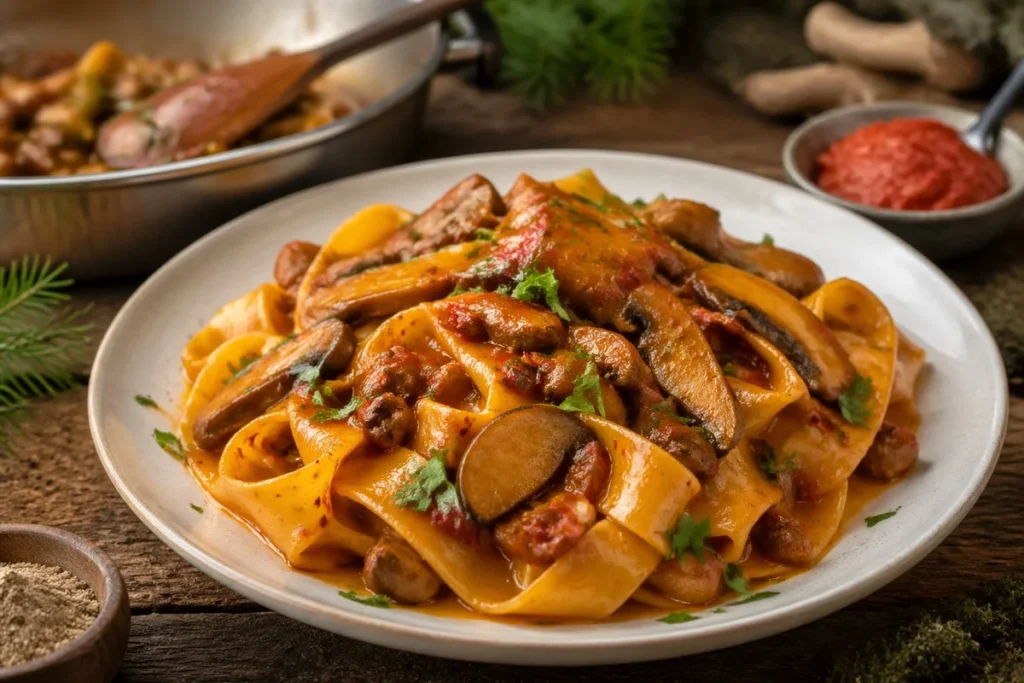
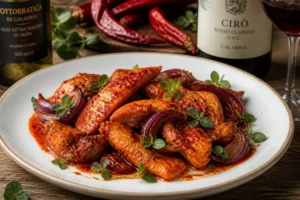
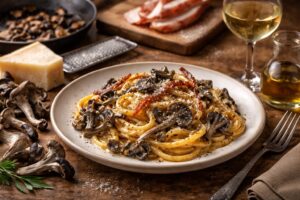
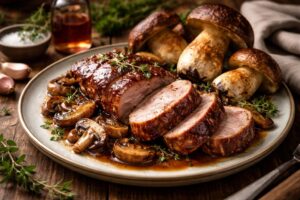
A bold, high-contrast masterpiece from Southern Italy, combining the spicy, spreadable heat of artisanal Nduja pork with the meaty, earth-bound intensity of wild Boletus edulis.
Calabrian Nduja & Porcini Pappardelle
The Fire and the Forest: A Southern Italian Powerhouse
The Historical Prelude: The Sila Massif and the Peasant’s Spice
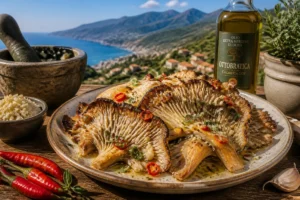
In the heart of Calabria lies the Sila Massif, a high-altitude plateau covered in ancient pine and beech forests. Historically, this region provided a sharp contrast between the "mountain people" and the coastal villages. The mountain dwellers were master foragers of the Boletus edulis (locally celebrated in the town of Camigliatello Silano), while the coast specialized in the preservation of meat with the region's famous red chili peppers.
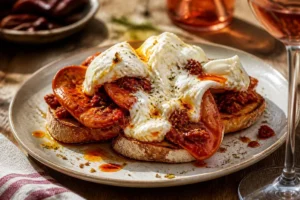
'Nduja—the spreadable, spicy pork salume—was born from the "Cucina Povera" tradition, using off-cuts and high concentrations of Peperoncino di Calabria to act as a natural preservative. The marriage of 'Nduja and Porcini occurred in the high-altitude hunting lodges where the fatty, fermented heat of the pork was found to be the perfect structural partner for the musky, mineral-heavy mushrooms. Unlike the cream-based mushroom pastas of the North, this Calabrian variant uses the melting fat of the 'Nduja to create a vibrant, orange-hued emulsion that "clings" to the wide ribbons of Pappardelle, offering a sensory experience that is simultaneously rustic and explosive.
⏱ Time: 35 Minutes
📊 Difficulty: Intermediate / High-Flavor
🔥 Calories: 520 kcal / Serving
🍄 Type: Sila Wild Porcini
Culinary Philosophy: The Lipid-Spice Bridge
Calabrian philosophy is centered on Aggressive Harmony. 'Nduja is not just an ingredient; it is a flavor delivery system. Because it is nearly 50% fat, it acts as a solvent for the mushroom's aromatics. We do not use cream here. Instead, we create a "Mushroom-Chili Emulsion" using the starchy pasta water. The goal is a sauce that feels heavy and luxurious but contains the electric "bite" of the Southern sun.
Sensory & Foraging Profile: The Sila Pine Terroir
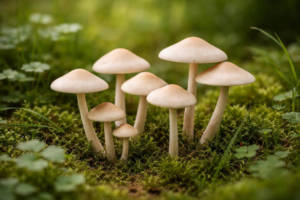
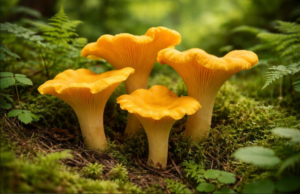
Latin Nomenclature:Boletus edulis (Group Silano). Terroir Analysis: The Sila plateau features granite-rich soil and high-altitude exposure. Porcini found here are exceptionally firm and have a skin that is slightly thicker to protect against the mountain wind. They possess a distinct "piney" or resinous undertone that cuts through the fermentation notes of the 'Nduja.
Professional Protocols: For this pasta, we use "Cubes and Caps." We dice the stems into 1cm cubes to mimic the texture of meat chunks, while keeping the caps in large slices to provide that unmistakable Porcini visual. This ensures a consistent "bite" throughout the dish.
Essential Equipment
🔸 Large Stainless Steel Skillet: For rapid evaporation and to properly "toss" (saltare) the pasta.
🔸 Pasta Tong: To handle the delicate, wide Pappardelle ribbons without tearing.
🔸 Wooden Spatula: To "melt" the 'Nduja into the base of the sauce.
The Master Recipe: The Silano Fusion
Stage 1: The Porcini Extraction
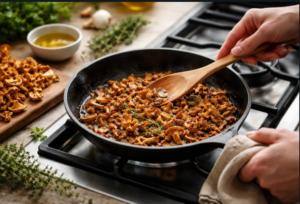
Sauté 400g of sliced Porcini in extra virgin olive oil over high heat. Do not add salt yet—wait for them to brown and develop a crust. Once golden, remove them and set aside. This prevents them from becoming "boiled" in the 'Nduja fat.
Stage 2: The ‘Nduja Foundation
In the same pan, add 80g of artisanal 'Nduja di Spilinga. Use a spoon to break it down. As the fat renders, add 1 finely minced red onion (Cipolla di Tropea) and a splash of dry white wine. Simmer until the wine has evaporated and you have a thick, spicy orange paste.
Stage 3: The Starchy Emulsion
Boil fresh Pappardelle (320g) until 2 minutes before al dente. Reserve 150ml of the cloudy pasta water. Add the water to the 'Nduja pan and whisk vigorously to create a creamy, spicy emulsion.
Stage 4: The Final Toss (Mantecatura)
Add the pasta and the sautéed Porcini to the pan. Toss over high heat for 60 seconds until the sauce coats every ribbon. Finish with a handful of fresh parsley and a drizzle of raw olive oil. No cheese is required; the 'Nduja provides all the richness necessary.
Chef’s Secret: The “Tomato Skin” Illusion
'Nduja is so red that it often makes the dish look like it has a tomato base. To enhance the "Forest" feel, add a teaspoon of **Porcini Powder** (dried and ground) to the 'Nduja while it is melting. This darkens the sauce and ensures that the mushroom aroma is the very first thing that hits the nose, even before the chili heat registers on the tongue.
The Umami Secret: Capsaicin & Glutamate Synergy
Capsaicin (the heat in chili) is a known flavor enhancer that increases the sensitivity of the tongue's receptors. When these "hyped-up" receptors are hit by the high levels of **Glutamate** in the Porcini, the umami flavor is perceived as being much more intense and satisfying. The fermentation of the 'Nduja also adds a third layer of **Nucleotides**, completing the "Umami Triple-Play."
The Art of Pairing
Sommelier's Selection: A robust Calabrian red like a **Cirò Rosso Classico** (Gaglioppo grape). The tannins are soft enough not to clash with the chili, but the structure is strong enough to handle the 'Nduja fat.
Non-Alcoholic: A chilled, sparkling blood orange juice with a pinch of sea salt.
Micro-FAQ
Q: Is 'Nduja too spicy for Porcini? A: It can be. The trick is to use only 80g for 4 people. This provides enough fat and color without overwhelming the delicate hazelnut notes of the mushrooms.
Q: Can I add Pecorino? A: In Calabria, cheese is often avoided with 'Nduja to let the pork fat shine. However, a light grating of aged Pecorino Crotonese can be added if you prefer a sharper finish.
To provide the best experiences, we use technologies like cookies to store and/or access device information. Consenting to these technologies will allow us to process data such as browsing behavior or unique IDs on this site. Not consenting or withdrawing consent, may adversely affect certain features and functions.
Functional
Always active
The technical storage or access is strictly necessary for the legitimate purpose of enabling the use of a specific service explicitly requested by the subscriber or user, or for the sole purpose of carrying out the transmission of a communication over an electronic communications network.
Preferences
The technical storage or access is necessary for the legitimate purpose of storing preferences that are not requested by the subscriber or user.
Statistics
The technical storage or access that is used exclusively for statistical purposes.The technical storage or access that is used exclusively for anonymous statistical purposes. Without a subpoena, voluntary compliance on the part of your Internet Service Provider, or additional records from a third party, information stored or retrieved for this purpose alone cannot usually be used to identify you.
Marketing
The technical storage or access is required to create user profiles to send advertising, or to track the user on a website or across several websites for similar marketing purposes.