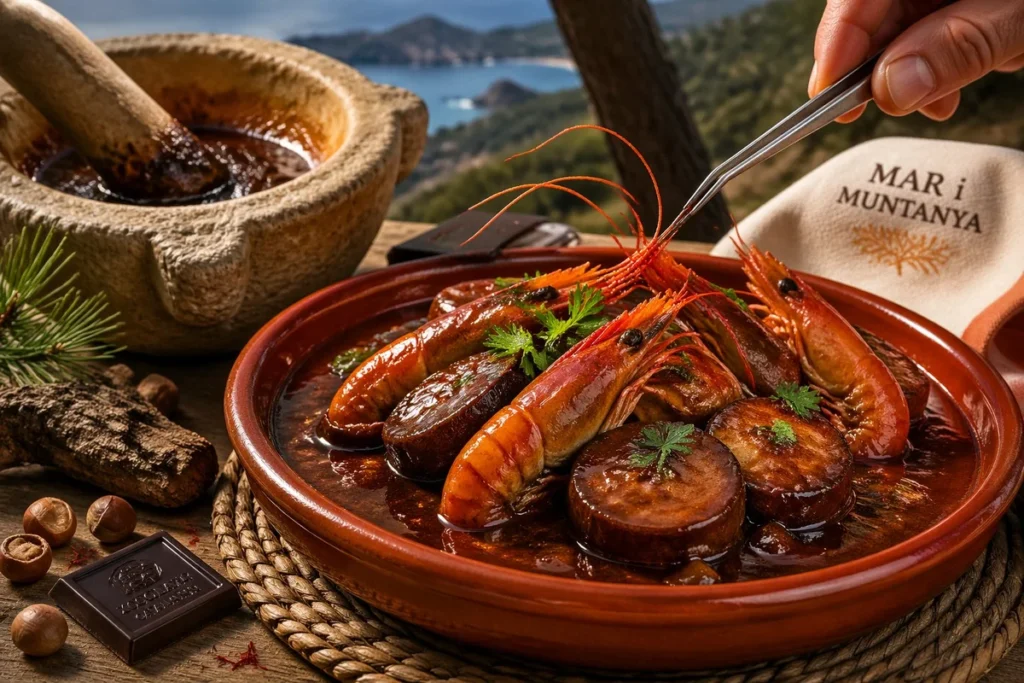
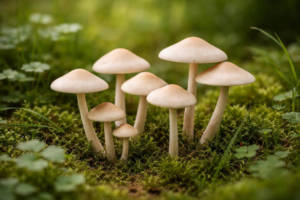
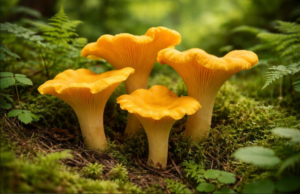
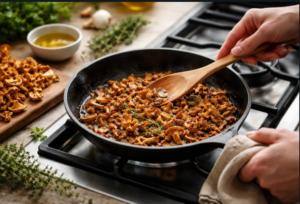
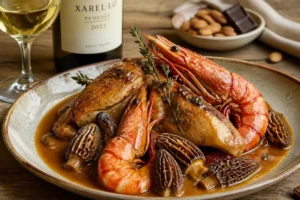
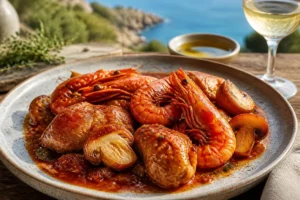
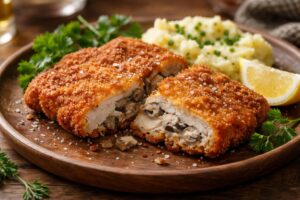
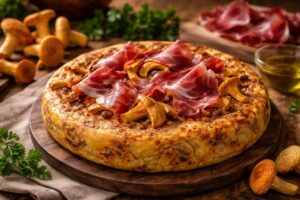
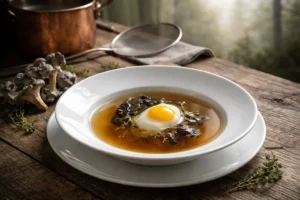
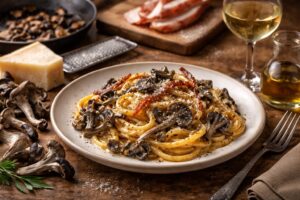
A luxurious high-contrast masterpiece featuring succulent Mediterranean langoustines and wild Boletus edulis, bound by a traditional Catalan "Picada" and a rich brandy reduction.
Catalan “Mar i Muntanya”
Porcini and Langoustines: A Dialogue Between the Depths and the Heights
The Historical Prelude: The Empordà Coast and the Forest Edge
In the Empordà region of Catalonia, the landscape is a dramatic collision of the Mediterranean Sea and the Gavarres mountains. Historically, the Mar i Muntanya culinary style was not an invention of elite chefs, but a practical reality for the farmers and fishermen of the 18th century who traded their goods at local markets. While the fisherman provided the **Escamarlans** (langoustines), the mountain foragers brought the **Rovellons** or, most prized of all, the Boletus edulis (locally known as Cep).
This specific pairing was elevated by the "Grandmother of Catalan Cuisine," Montserrat Seguí, who mastered the use of the **Picada**—a traditional thickener made of toasted nuts, bread, and chocolate. The chocolate, a legacy of Spain's colonial past, is not used for sweetness but to provide a dark, bitter-savory bridge that connects the iodine of the sea with the heavy forest glutamates. To serve this dish is to honor the Empordanès spirit: a celebration of a terroir where the salt spray and the pine needles are carried by the same wind.
⏱ Time: 50 Minutes
📊 Difficulty: Advanced / Heritage
🔥 Calories: 380 kcal / Serving
🍄 Type: Prime Catalan Ceps
Culinary Philosophy: The Picada Emulsion
The philosophy of Mar i Muntanya is Flavor Reconciliation. Usually, shellfish and mushrooms are distant relatives on the palate. The Catalan solution is the Picada. By pounding toasted hazelnuts, garlic, saffron, and dark chocolate into a mortar, we create a "molecular glue." This paste binds the volatile iodine of the langoustine to the earthy esters of the Porcini, creating a unified sauce that feels both infinitely deep and bright.
Sensory & Foraging Profile: The Cork Oak & Pine Terroir
Latin Nomenclature:Boletus edulis (The Catalan "Cep"). Terroir Analysis: The Gavarres massif is famous for its Cork Oaks (Quercus suber). Porcini found here develop a distinct, slightly metallic finish and a higher concentration of **guanylate** due to the acidic, granitic soil. This robustness allows them to stand up to the intense sweetness and salinity of the Mediterranean shellfish.
Preparation Protocols: For this dish, we use "Cylindrical Sections." We slice the large, bulbous stems into thick rounds that mimic the size and shape of the langoustine tails, creating a visual "Terre et Mer" puzzle on the plate.
Essential Equipment
🔸 Large Mortar and Pestle (Morter): To hand-grind the Picada—mechanical blenders create too much friction and ruin the delicate saffron aromas.
🔸 Terra Cotta Cazuela: The traditional vessel for even heat distribution and slow simmering.
🔸 Stainless Steel Tweezers: For the precise positioning of the delicate langoustine antennae.
The Master Recipe: The Empordà Fusion
Stage 1: The Shellfish Infusion
In a hot cazuela with olive oil, sear 8 large langoustines for 60 seconds until the shells turn bright orange. Remove and set aside. The oil is now infused with "sea-gold" (shellfish lipids).
Stage 2: The Forest Concentration
In the same oil, sauté 500g of sliced Porcini. Once the mushrooms are golden and have released their juices, add a finely minced onion and a splash of **Spanish Brandy (Solera)**. Flambé to release the spirit's oak-aged volatiles.
Stage 3: The Picada Ritual
While the mushrooms simmer, grind 10 toasted hazelnuts, 1 clove of garlic, 4 saffron threads, and 1 square of 80% dark chocolate into a paste. Loosen with a little warm fish stock and stir into the cazuela. The sauce will darken and thicken instantly.
Stage 4: The Final Union
Return the langoustines to the sauce. Simmer for 3 minutes to allow the flavors to marry. Finish with a handful of fresh parsley. The final sauce should be glossy, dark, and possess a "velvet" weight on the tongue.
Chef’s Secret: The “Head-Squeeze” Extraction
For a truly professional, high-umami Catalan finish, take two of the seared langoustines, remove their heads, and **squeeze the coral and juices** directly into the Picada before adding it to the pot. This concentrated shellfish nectar acts as an "Umami Turbo," intensifying the maritime side of the dish to perfectly match the deep fungal notes of the Ceps.
The Umami Secret: The Chocolate-Mushroom Bridge
Dark chocolate contains Theobromine and specific Polyphenols that share a similar molecular structure to the aromatic compounds found in roasted Porcini. By using chocolate in the Picada, we aren't adding "candy" flavor; we are providing a bitter-savory foundation that helps the brain perceive the mushroom's nuttiness and the langoustine's sweetness as a single, coherent flavor profile.
The Art of Pairing
Sommelier's Selection: A complex white wine from **Penedès** or a barrel-aged **Garnatxa Blanca**. The oak influence in the wine mirrors the roasted notes of the Picada and the Porcini.
Non-Alcoholic: A chilled, fermented grape juice with a touch of roasted almond extract.
Micro-FAQ
Q: Can I use shrimp instead of langoustines? A: You can, but use large, wild-caught shrimp (Gambas) with the heads on. The head-juices are essential for the sauce's depth.
Q: Is the chocolate noticeable? A: Not as a sweet element. It adds a "darkness" to the sauce and a slight bitter finish that is characteristic of authentic Catalan *Mar i Muntanya* cooking.
The Porcini Directory: Global Names for Boletus edulis
The King Bolete, or simply Porcini, is arguably the most recognized wild mushroom in the culinary world. Its linguistic variety reflects its presence in forests from the Alps to the Himalayas:
Language
Regional & Folk Names
Expert Insights
Italian
Porcino, Brisa, Fungo di faggio
"Porcini" (little pigs) is the global trade name.
French
Cèpe de Bordeaux, Gros pied, Polonais
"Cèpe" comes from the Gascon word for trunk/stump.
German
Steinpilz, Herrenpilz, Edelpilz
"Steinpilz" (Stone mushroom) refers to its firm flesh.
To provide the best experiences, we use technologies like cookies to store and/or access device information. Consenting to these technologies will allow us to process data such as browsing behavior or unique IDs on this site. Not consenting or withdrawing consent, may adversely affect certain features and functions.
Functional
Always active
The technical storage or access is strictly necessary for the legitimate purpose of enabling the use of a specific service explicitly requested by the subscriber or user, or for the sole purpose of carrying out the transmission of a communication over an electronic communications network.
Preferences
The technical storage or access is necessary for the legitimate purpose of storing preferences that are not requested by the subscriber or user.
Statistics
The technical storage or access that is used exclusively for statistical purposes.The technical storage or access that is used exclusively for anonymous statistical purposes. Without a subpoena, voluntary compliance on the part of your Internet Service Provider, or additional records from a third party, information stored or retrieved for this purpose alone cannot usually be used to identify you.
Marketing
The technical storage or access is required to create user profiles to send advertising, or to track the user on a website or across several websites for similar marketing purposes.