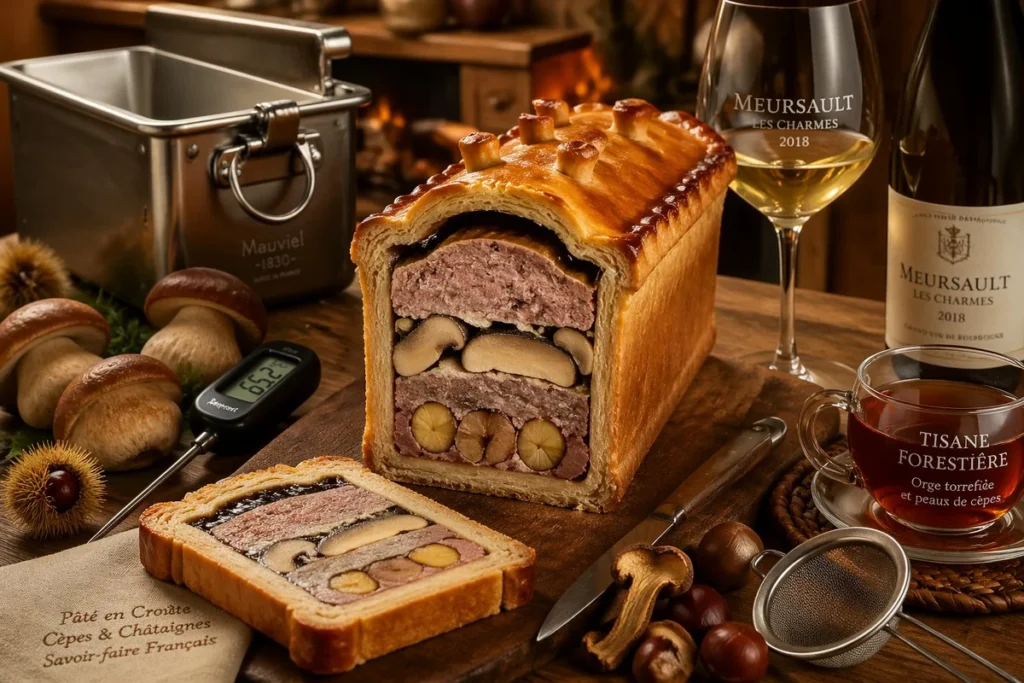
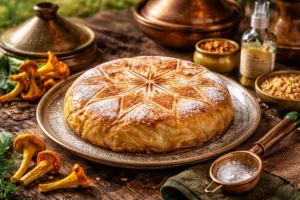
A decadent French masterpiece combining wild Boletus edulis and roasted chestnuts encased in a golden buttery pastry with roots in the royal courts of Versailles.
The Sovereign Porcini & Chestnut Pâté en Croûte
A Renaissance Symphony of Earth, Forest, and Golden Crust
The Historical Prelude: From Versailles to the Modern Table
The Pâté en Croûte is not merely a dish; it is a monument to French architectural gastronomy. While meat-based pies existed since the Middle Ages, it was during the reign of Louis XIV, the Sun King, that the refinement of the crust became a symbol of prestige. In the kitchens of Versailles, the croûte was originally designed as a protective vessel, a functional "stone" box to preserve the precious fillings. However, the royal chefs soon realized that when infused with the juices of Boletus edulis (the King of Mushrooms) and the sweetness of chestnuts from the French Alps, the pastry itself became a delicacy.
In the 18th century, legends like Antonin Carême elevated the structure of the Pâté to an art form, often mimicking the spires of cathedrals. Our specific variation—incorporating chestnuts—draws inspiration from the hunting lodges of the Haute-Savoie region. Here, the bounty of the autumn forest provided a natural synergy: the deep, musky umami of the Porcini paired with the starchy, buttery heart of the chestnut. This recipe represents the evolution from "Cucina Povera" survivalism to the "Grande Cuisine" luxury that defines Western European heritage.
⏱ Time: 4 Hours + Overnight Chilling
📊 Difficulty: Professional / Master
🔥 Calories: 485 kcal / Serving
🍄 Type: Wild-Harvested Porcini
Culinary Philosophy & Regional Folklore
In the French Alps, the arrival of the first Porcini (Cèpes) after an autumn rain is treated with the reverence of a religious event. The regional folklore suggests that a mushroom found under an ancient oak possesses a "soul" of wood. This recipe honors that philosophy by treating the mushroom as the lead architect of flavor, using the chestnut as its foundation. We follow the strict Escoffier principles: every element must serve the clarity of the primary ingredient.
Sensory & Foraging Profile
Nomenclature:Boletus edulis (King Bolete). Terroir: Specifically sourced from the high-altitude coniferous forests of the French Alps. The soil here, with a slightly acidic pH (5.5 – 6.5), imparts a distinct hazelnut finish to the fungi that is absent in lowland varieties.
Professional Harvesting Protocol: To maintain the integrity of the mycelium, mushrooms are extracted using the "Gentle Twist" method rather than cutting, ensuring the underground network remains undisturbed. Only specimens with firm, white pores (the Hymenium) are selected for this pâté to ensure a dense, meaty texture during the long bake.
Essential Equipment
🔸 Professional Pâté Mold: Preferably hinged stainless steel to ensure perfect release without compromising the crust.
🔸 Digital Temperature Probe: Crucial for monitoring the core temperature (65°C) to ensure the emulsion holds.
🔸 Chinois: For the ultra-fine straining of the mushroom-infused jelly.
The Master Recipe: Multi-Stage Execution
Stage 1: The Pâté Monarch (Dough)
Combine 500g of T55 flour with 250g of high-fat Charentes-Poitou butter (AOP). Use the sablage technique to create a sandy texture before adding 2 egg yolks and 100ml of ice-cold water. Rest for 2 hours.
Stage 2: The Forest Core (Filling)
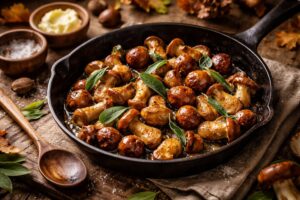
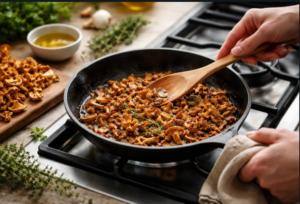
Dice 400g of fresh Porcini into 1cm cubes. Sauté in clarified butter until the edges are caramelized. Combine with 300g of roasted, peeled chestnuts, 400g of veal shoulder mince, and 200g of pork fatback. Season with salt, white pepper, and a touch of quatre-épices.
Stage 3: The Assembly & Larding
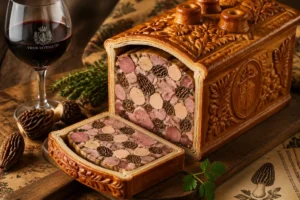
Line the mold with the pastry, leaving an overhang. Pack the filling tightly, layering whole Porcini slices in the center for a stunning cross-section. Close the pastry lid, create "chimneys" (vents), and brush with an egg wash infused with a pinch of saffron.
Stage 4: The Final Restoration
Bake at 200°C for 20 minutes, then reduce to 160°C until the core reaches 65°C. Once cooled, pour a warm Porcini-infused Madeira aspic through the chimneys to fill the gaps.
Chef’s Secret: The Cold-Sear Method
To prevent the Porcini from becoming "rubbery" inside the pastry, use the Cold-Sear Method. Start the mushrooms in a cold pan with cold butter. As the temperature rises slowly, the cellular walls of the Boletus edulis collapse more uniformly, concentrating the umami compounds before they even reach the oven.
The Umami Secret: Scientific Synergies
The Boletus edulis is a powerhouse of guanylate and glutamate. When these combine with the Maillard reaction products from the buttery crust and the roasted chestnuts, a synergistic effect occurs. The chestnuts provide the carbohydrate structure that "carries" the volatile mushroom aromas, while the fat from the veal acts as a solvent for the terpene-like compounds found in wild fungi.
The Art of Pairing
Sommelier's Selection: A vintage Barolo from the Dolomites region or a Meursault (Burgundy White) with significant oak aging. The buttery notes of the Chardonnay mirror the pastry, while the acidity cuts through the richness of the pâté.
Non-Alcoholic: A cold-brewed forest floor tea made from toasted barley and dried porcini skins.
Micro-FAQ
Q: Can I use dried Porcini? A: For the filling, fresh is mandatory for texture, but dried Porcini are excellent for intensifying the aspic jelly.
Q: Why did my pastry crack? A: Likely due to insufficient resting time or the filling being too moist. Ensure the mushrooms are well-sautéed to remove excess water.
To provide the best experiences, we use technologies like cookies to store and/or access device information. Consenting to these technologies will allow us to process data such as browsing behavior or unique IDs on this site. Not consenting or withdrawing consent, may adversely affect certain features and functions.
Functional
Always active
The technical storage or access is strictly necessary for the legitimate purpose of enabling the use of a specific service explicitly requested by the subscriber or user, or for the sole purpose of carrying out the transmission of a communication over an electronic communications network.
Preferences
The technical storage or access is necessary for the legitimate purpose of storing preferences that are not requested by the subscriber or user.
Statistics
The technical storage or access that is used exclusively for statistical purposes.The technical storage or access that is used exclusively for anonymous statistical purposes. Without a subpoena, voluntary compliance on the part of your Internet Service Provider, or additional records from a third party, information stored or retrieved for this purpose alone cannot usually be used to identify you.
Marketing
The technical storage or access is required to create user profiles to send advertising, or to track the user on a website or across several websites for similar marketing purposes.