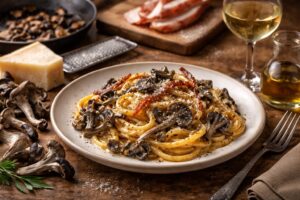
A sophisticated technical study in slow-braising and collagen-free sauce thickening, focusing on the preservation of the Lactarius deliciosus structural integrity through long-term acid exposure.
Provencal Saffron Milk Cap Daube with Red Wine and Juniper
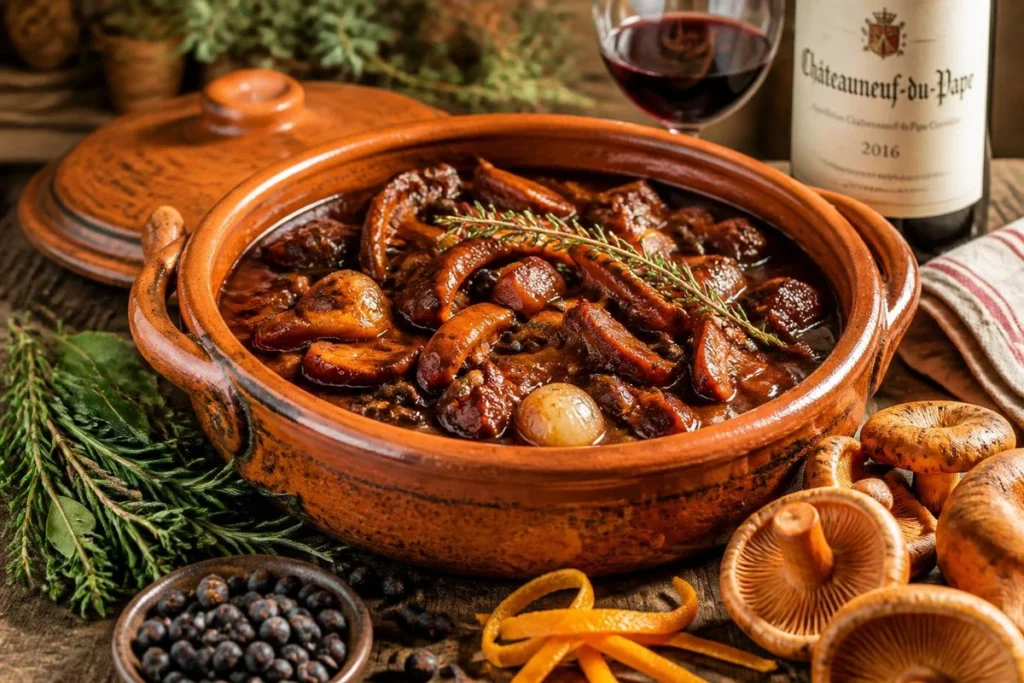
The Saffron Milk Cap (Lactarius deliciosus) is one of the few wild fungi capable of enduring the rigorous, slow-cooking process of a traditional Provençal Daube. While more delicate species like the Chanterelle (Chanterelle) would disintegrate under prolonged heat, the Lactarius maintains its firm, almost meat-like presence. This dish is an homage to the rustic yet refined flavors of Southern France, where the resinous notes of the pine forest meet the deep, tannic structure of a Mediterranean red wine.
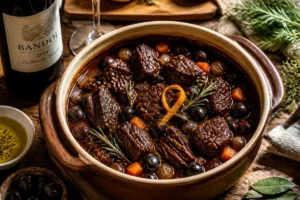
In the "Terroir Narrative" of Provence, the Daube is more than a stew; it is a ritual of patience. Traditionally prepared in a daubière (a specialized terracotta vessel), this version elevates the earthy Saffron Milk Cap by pairing it with wild juniper and a bouquet garni, reflecting the sun-drenched, scrubland landscape known as the garrigue.
Prep Time
30 Minutes
Cook Time
90 Minutes (Slow Braise)
Complexity
Grand Officier
Calories
310 kcal per serving
Region
Provence, France
The Culinary Physics of This Dish
The core of this recipe is the Red Wine Reduction and its effect on the mushroom's cellular walls. The acids in the wine (tartaric and malic) work to break down the complex polysaccharides in the Lactarius deliciosus, but the mushroom's density prevents total collapse. As the liquid reduces, a process of Osmosis occurs: the water-rich interior of the mushroom is replaced by the concentrated, flavor-dense wine and fat emulsion. The inclusion of juniper berries provides alpha-pinene, a terpene that chemically mirrors the natural resinous compounds found within the Saffron Milk Cap, creating a seamless flavor bridge.
Master Recipe (1:10 Rule)
600g Fresh Saffron Milk Caps (Lactarius deliciosus), halved or quartered
500ml Full-bodied Red Wine (Gigondas or Côtes du Rhône)
60g Salt-cured Pork Belly (Ventresca), diced
200g Pearl Onions, peeled
3 Large Carrots, turned (Tourné)
4 Garlic Cloves, crushed
6 Juniper Berries, lightly bruised
1 Zest of an Organic Orange (the Provencal secret)
Fresh Thyme and Rosemary (Bouquet Garni)
The Technique
1. The Sauté: Begin by rendering the fat from the pork belly in a heavy cocotte. Once crisp, add the pearl onions and carrots until a light golden Deglazing base is formed.
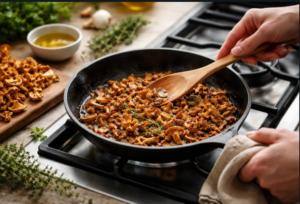
2. Fungal Sealing: Add the Lactarius deliciosus. It is crucial to sear them at high heat for 3 minutes to seal the surface before adding any liquid.
3. The Braise: Pour in the red wine, scraping the bottom of the pot to release the umami-rich fond. Add the garlic, juniper, orange zest, and bouquet garni.
4. Slow Reduction: Cover tightly and simmer on the lowest possible heat for 75-90 minutes. The sauce should reach a "Nappé" consistency – thick enough to coat the back of a spoon – without the use of flour.
Shop Integration
This slow-braising technique is ideal for mushrooms with a robust texture. While the Saffron Milk Cap is our primary focus here, this method can be masterfully applied to our Boletus edulis (Boletus edulis) for a richer, more unctuous result. For a different aromatic profile, the Marasmius oreades (Marasmius oreades) can be added in the final 10 minutes to provide a concentrated burst of forest scent. Our Craterellus cinereus also performs exceptionally well in wine-based reductions, offering a dark, mysterious aesthetic to the plate.
The Umami Profile
The umami in this Daube is "cumulative." It starts with the inosinates from the cured pork and is amplified by the guanylate content of the long-cooked mushrooms. The slow reduction of red wine concentrates the existing glutamates in the grapes, resulting in a dish that registers exceptionally high on the savoriness scale.
Sommelier’s Choice
A Châteauneuf-du-Pape or a robust Bandol (dominated by Mourvèdre) is the only logical choice. These wines possess the structure, spice, and leathery notes required to stand up to the juniper and the intense, wine-infused mushrooms.
The Etymological Chronicle
The word Daube comes from the Provencal adobar (to prepare or dress), which itself stems from the Old French adouber. In Italian, this method is closely related to the Stufato. In Spanish, it finds its cousin in the Adobo, though the flavor profiles differ. In German, such a preparation would be classified as a Schmorgericht, emphasizing the slow, covered cooking process that defines this culinary masterpiece.
Pure Umami | Mycological Research & Culinary Arts | 2026
To provide the best experiences, we use technologies like cookies to store and/or access device information. Consenting to these technologies will allow us to process data such as browsing behavior or unique IDs on this site. Not consenting or withdrawing consent, may adversely affect certain features and functions.
Functional
Always active
The technical storage or access is strictly necessary for the legitimate purpose of enabling the use of a specific service explicitly requested by the subscriber or user, or for the sole purpose of carrying out the transmission of a communication over an electronic communications network.
Preferences
The technical storage or access is necessary for the legitimate purpose of storing preferences that are not requested by the subscriber or user.
Statistics
The technical storage or access that is used exclusively for statistical purposes.The technical storage or access that is used exclusively for anonymous statistical purposes. Without a subpoena, voluntary compliance on the part of your Internet Service Provider, or additional records from a third party, information stored or retrieved for this purpose alone cannot usually be used to identify you.
Marketing
The technical storage or access is required to create user profiles to send advertising, or to track the user on a website or across several websites for similar marketing purposes.