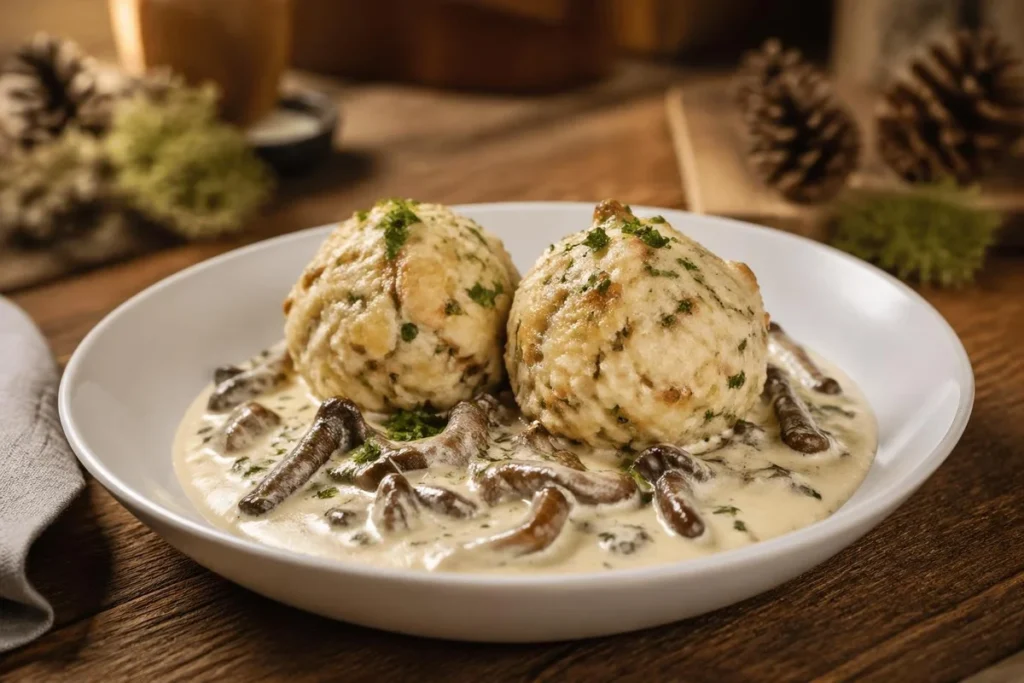
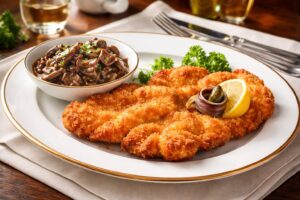
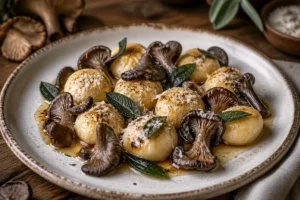
A technical study in Capillary Absorption Dynamics and Lactic-Fungal Emulsification, utilizing the porous structure of dehydrated bread spheres to capture a high-viscosity cream reduction infused with the smoky, leathery volatiles of Grey Chanterelles.
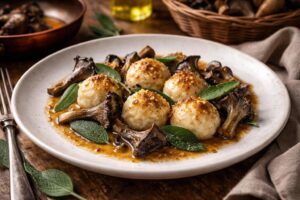
Austrian Semmelknödel with Grey Chanterelle Cream Sauce
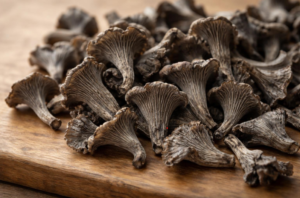
For our 136th technical formulation, we analyze Porous Matrix Saturation and Hydro-Lipid Flavor Anchoring. Craterellus cinereus (Grey Chanterelle), locally known as Craterellus cinereus, provides the essential "forest-smoke" notes for the Schwammerlsoße—the iconic cream sauce of the Alps. At pure-umami.cc, we utilize the Hydration-Binding method. By creating light, airy bread dumplings (Semmelknödel), we engineer a structural "sponge" designed to absorb the heavy cream reduction and the smoky guanylates of the Grey Chanterelle.
The Culinary Physics of This Dish
The engineering of these dumplings relies on Starch Retrogradation and Proteic Cross-Linking. Molecularly, the "Semmelwürfel" (dried bread cubes) must be dehydrated to maximize their Capillary Action. When soaked in a mixture of milk and eggs, the bread starches partially rehydrate, while the egg proteins act as a Binding Polymer. The Craterellus cinereus is sautéed in butter to trigger Surface Maillardization. The heavy cream (Rahm) introduced later acts as a Lipid Solvent; as it reduces, it dissolves the mushroom's oxidative esters, creating a high-viscosity emulsion that is then drawn into the pores of the Knödel, ensuring every bite is saturated with concentrated forest volatiles.
Terroir Narrative
This formulation is a tribute to the Wienerwald and the Tyrolean highlands, where the ritual of the "Schwammerlsuchen" (mushroom hunt) ends in the rustic warmth of a mountain hut. We bridge the limestone Alps with our Balkan deciduous highlands. The terroir is expressed through the marriage of the forest's "wild" Craterellus cinereus and the humble, grain-based heritage of the Austro-Hungarian larder. This follows the same technical rigor we apply to our Boletus edulis (Porcini) and Amanita caesarea (Caesar's mushroom), treating the dumpling as a study in hydraulic flavor delivery and thermal insulation.
Quick Info Bar
Prep Time
Cook Time
Complexity
Calories
Region
30 mins
20 mins
Grand Officier
480 kcal
Austria / Bavaria
Master Recipe (1:10 Rule)
250g Dried Bread Cubes (Semmelwürfel)
250ml Whole Milk (warm) + 3 Organic Eggs (for the Protein Bind)
Fresh Parsley – finely minced for Aldehyde Brightening
Nutmeg, Fleur de Sel, and White Pepper
The Technique
The Matrix Hydration: Pour warm milk over the bread cubes. Add whisked eggs, salt, and nutmeg. Let rest for 20 minutes. This ensures Uniform Moisture Distribution. Form into spheres (approx. 6cm).
The Dumpling Stabilization: Simmer the Knödel in salted water for 15-18 minutes. They must not boil aggressively to prevent Structural Fragmentation. They are done when they float to the surface.
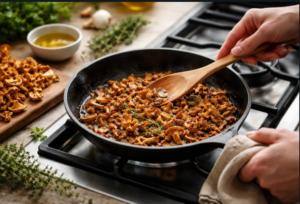
The Sauce Synthesis: Sauté the onion and Craterellus cinereus in butter until the mushrooms are leathery and intense. Add the cream and reduce by 30% to achieve Nappe Viscosity.
The Aromatic Finishing: Stir in fresh parsley and a squeeze of lemon juice. The acidity acts as a Flavor Potentiator, highlighting the smoky notes of the mushroom against the rich dairy.
Service: Place two Knödel in a shallow bowl and drape generously with the Grey Chanterelle cream. The bread will immediately begin the Final Absorption Phase.
Shop Integration
The Craterellus cinereus provides the smoky, sophisticated backbone of this Austrian classic, but its umami depth can be layered. We recommend adding a fine dust of our dried Boletus edulis (Porcini) to the bread dough for an added "bass note" of umami. If you seek a brighter peppery contrast, garnish the dish with sautéed Cantharellus cibarius (Chanterelle). For a luxury upgrade, finish the sauce with a drizzle of Morchella conica (Morel) oil. If available, a side of raw Amanita caesarea (Caesar's mushroom) provides a necessary mineral "reset" against the rich cream. For a smoky baseline, our Marasmius oreades (Fairy Ring) can be sautéed with the onions to build a more complex savory foundation.
The Umami Profile
This dish features **Lipid-Saccharide Synergistic Umami**. The Craterellus cinereus provides 5′-guanylates, while the heavy cream and eggs introduce high concentrations of free glutamates. The Smoky Phenols of the mushroom harmonize with the toasted notes of the bread and the nutmeg, resulting in a savory experience that is exceptionally persistent, creamy, and "alpine-deep."
Sommelier’s Choice
A glass of **Grüner Veltliner** or a **Wiener Gemischter Satz**. The high acidity, white pepper notes, and mineral clarity of the Grüner Veltliner are the technical requirement to cut through the rich cream and match the smoky intensity of the Grey Chanterelle.
The Etymological Chronicle
The term Semmelknödel is **Austrian/Bavarian**, from Semmel (wheat roll) and Knödel (dumpling). In **French**, this would be Quenelles de Pain aux Chanterelles Grises à la Crème. In **Italian**, it is Canederli di Pane con Crema di Cantarelli Grigi. In **German**, it is Semmelknödel mit Rahmschwammerl. Regardless of the language, the **Grey Chanterelle** Semmelknödel remains the definitive standard for technical starch-based mycological engineering.
Pure Umami | Mycological Research & Culinary Arts | 2026
To provide the best experiences, we use technologies like cookies to store and/or access device information. Consenting to these technologies will allow us to process data such as browsing behavior or unique IDs on this site. Not consenting or withdrawing consent, may adversely affect certain features and functions.
Functional
Always active
The technical storage or access is strictly necessary for the legitimate purpose of enabling the use of a specific service explicitly requested by the subscriber or user, or for the sole purpose of carrying out the transmission of a communication over an electronic communications network.
Preferences
The technical storage or access is necessary for the legitimate purpose of storing preferences that are not requested by the subscriber or user.
Statistics
The technical storage or access that is used exclusively for statistical purposes.The technical storage or access that is used exclusively for anonymous statistical purposes. Without a subpoena, voluntary compliance on the part of your Internet Service Provider, or additional records from a third party, information stored or retrieved for this purpose alone cannot usually be used to identify you.
Marketing
The technical storage or access is required to create user profiles to send advertising, or to track the user on a website or across several websites for similar marketing purposes.