Description: Master the ancestral art of the mushroom confit. A wild-harvested gourmet recipe using King Boletes preserved in aromatic fats—an umami-rich culinary masterpiece for the sophisticated pantry.
The term "confit" comes from the French verb confire—to preserve. Historically, this was a survival technique used by rural communities in the Perigord and Gascony regions to store the fleeting bounty of the autumn harvest for the lean winter months. When applied to Boletus edulis, this method transcends mere preservation and enters the realm of pure culinary alchemy. By slowly poaching the mushrooms in a bath of aromatic fats at sub-boiling temperatures, we replace the mushroom's internal moisture with rich, flavor-saturated lipids.
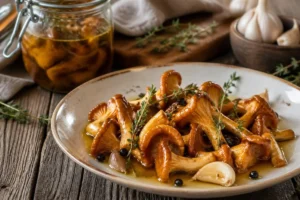
Unlike sautéing, which uses high heat to create a crust, the confit process tenderizes the wild-harvested mushroom from the inside out. The result is a texture that can only be described as "molten"—softer than butter, yet maintaining the unmistakable meaty fiber of the King Porcini. As the mushroom rests in its silken bath, it becomes a concentrated bomb of forest floor aromatics, ready to be resurrected as a topping for sourdough, a garnish for prime cuts, or eaten directly as a decadent delicacy.
The Boletus edulis is uniquely qualified for the confit technique due to its sponge-like hymenium (the pore layer under the cap). In wild specimens, this layer is dense and structurally sound, allowing it to act as a reservoir for infused oils. During the Mycorrhizal symbiosis, the mushroom develops a complex array of fat-soluble vitamins and aromatic terpenes. These molecules have a natural affinity for lipids, meaning the oil doesn't just coat the mushroom—it becomes a part of its molecular profile.
Aroma & Texture: A Boletus confit possesses a heady, intoxicating scent of roasted pine, vanilla, and concentrated umami. The texture is completely transformed: the "crunch" of the raw mushroom is replaced by a velvet-like consistency that melts upon contact with the palate.
Microbiology: Slow-roasting at 90°C (194°F) is high enough to break down the tough chitin in the cell walls, making the mushroom significantly more digestible, yet low enough to prevent the degradation of heat-sensitive antioxidants like ergothioneine. This creates a biologically stable, nutrient-dense preserve.
The Master Recipe: Slow-Roasted Porcini Confit
Ingredients
800g Wild-Harvested Boletus edulis (medium-sized, cleaned and halved/quartered)
500ml Extra Virgin Olive Oil or Rendered Duck Fat (for a richer, traditional profile)
6 cloves of Garlic, unpeeled and smashed
3 sprigs of Fresh Rosemary
2 Fresh Bay Leaves
1 tablespoon Whole Black Peppercorns
2 teaspoons Fine Sea Salt
Culinary Steps
The Preparation: Ensure your Boletus edulis are completely dry. Moisture is the enemy of a long-term confit. Cut them into large, uniform pieces to ensure even cooking.
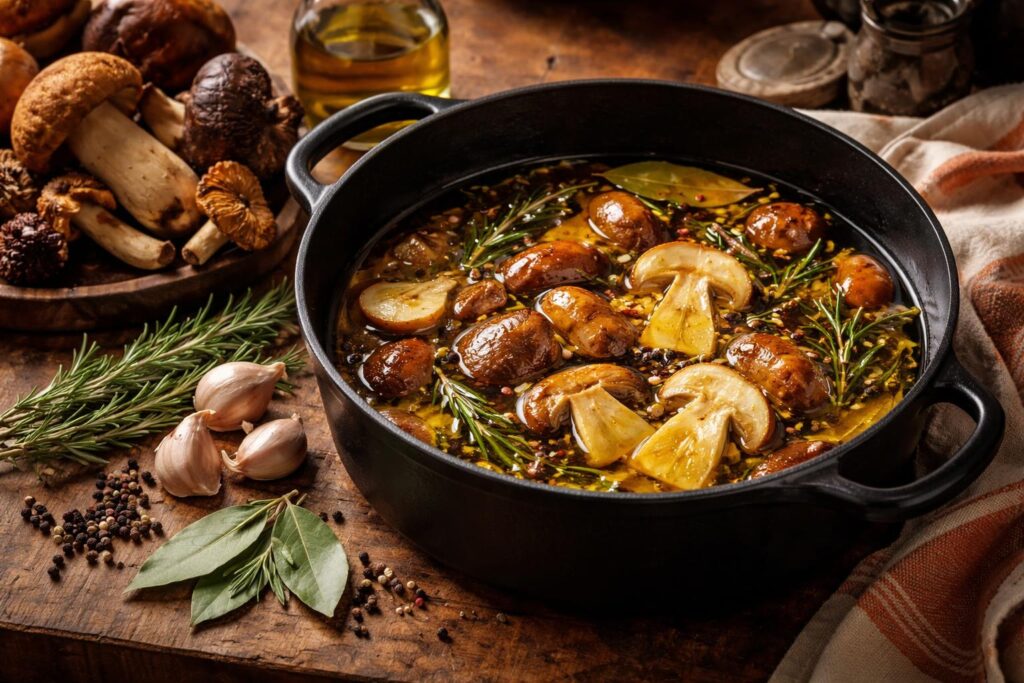
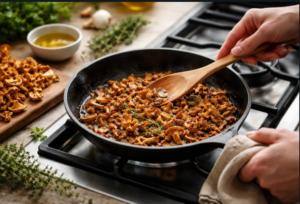
The Aromatics: In a heavy oven-proof pot (like a Dutch oven), combine the oil/fat, garlic, rosemary, bay leaves, and peppercorns.
The Integration: Submerge the mushroom pieces in the oil. They should be completely covered. Add the salt.
The Slow Roast: Place the pot in a preheated oven at 90°C (194°F). Do not use a fan/convection setting if possible. Let them roast undisturbed for 2 to 2.5 hours.
The Test: The mushrooms are ready when they are translucent throughout and feel completely tender when pierced with a needle.
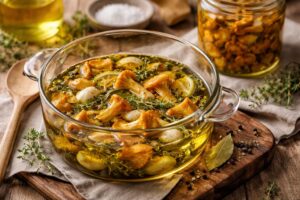
Storage: Allow to cool in the fat. For immediate use, serve warm. For preservation, transfer to sterilized jars, ensuring the mushrooms are completely submerged in the oil, and refrigerate for up to 3 weeks.
Pro Technique: The Temperature Guard
The secret to a successful confit is ensuring the oil never reaches a simmer. If you see bubbles rising rapidly, the temperature is too high, and you are frying the mushrooms rather than poaching them. Frying toughens the chitin; poaching softens it. Use an external oven thermometer to verify your oven's accuracy, as even a 10°C deviation can change the final texture from silken to rubbery.
The Umami Secret: Concentration by Dehydration
During the slow-roasting process, the mushroom's internal water slowly evaporates and is replaced by fat. This effectively concentrates the natural glutamates within the tissue. Because the mushroom is submerged in oil, the delicate volatile aromatics (the "smell of the forest") are trapped and re-absorbed into the fat, creating a closed-loop flavor system that results in an umami intensity far higher than that of a fresh mushroom.
The Art of the Pairing
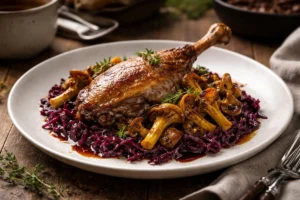
The intense richness of a confit requires a pairing with sharp contrast. A Vintage Champagne or a high-acid Riesling provides the necessary carbonation and acidity to "scrub" the palate of the fats. For a traditional route, a Sherry (Oloroso) offers a fortified, nutty depth that stands up to the concentrated Porcini flavor. For a non-alcoholic pairing, a chilled kombucha with ginger notes provides the acidity and fermentation funk to complement the dish.
Ancestral Nutrition
By using high-quality polyphenolic oils (like Extra Virgin Olive Oil), the confit process creates a stable delivery system for the mushroom's Vitamin D and Vitamin K. The slow-cooking method also maximizes the bioavailability of Beta-glucans, which are fiber-like compounds known to support heart health and maintain healthy cholesterol levels.
To provide the best experiences, we use technologies like cookies to store and/or access device information. Consenting to these technologies will allow us to process data such as browsing behavior or unique IDs on this site. Not consenting or withdrawing consent, may adversely affect certain features and functions.
Functional
Always active
The technical storage or access is strictly necessary for the legitimate purpose of enabling the use of a specific service explicitly requested by the subscriber or user, or for the sole purpose of carrying out the transmission of a communication over an electronic communications network.
Preferences
The technical storage or access is necessary for the legitimate purpose of storing preferences that are not requested by the subscriber or user.
Statistics
The technical storage or access that is used exclusively for statistical purposes.The technical storage or access that is used exclusively for anonymous statistical purposes. Without a subpoena, voluntary compliance on the part of your Internet Service Provider, or additional records from a third party, information stored or retrieved for this purpose alone cannot usually be used to identify you.
Marketing
The technical storage or access is required to create user profiles to send advertising, or to track the user on a website or across several websites for similar marketing purposes.