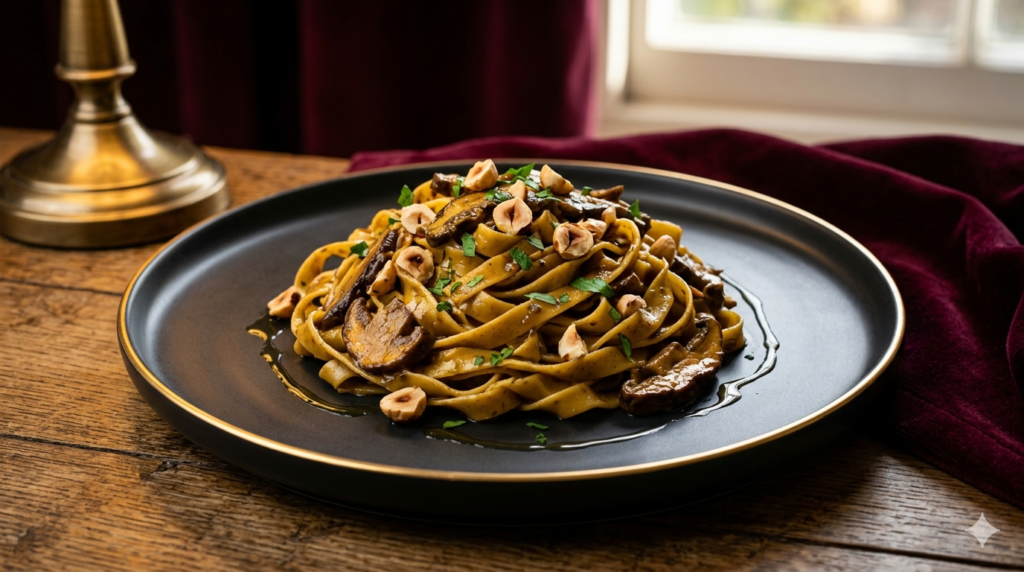
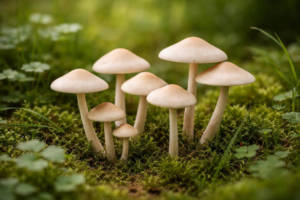
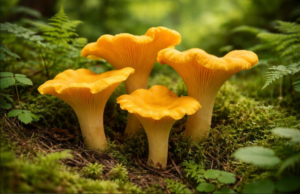
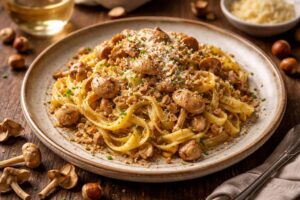
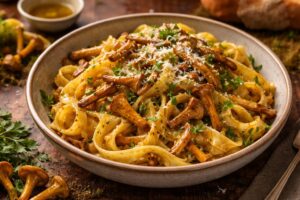
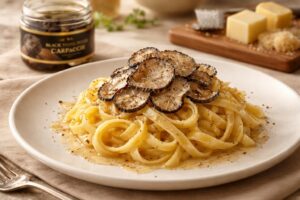
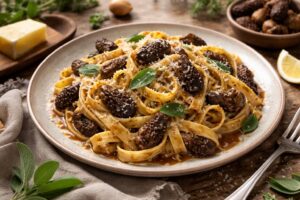
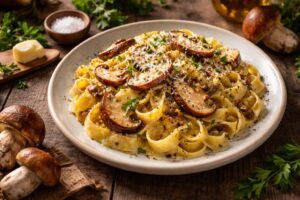
An ultra-sophisticated, textural masterpiece pairing the almond-scented Macrolepiota procera with the crunch of roasted Piedmont hazelnuts.
The Secret Forest Tagliatelle
Dried Parasol Mushrooms and Toasted Hazelnuts in a Sage-Butter Emulsion
The Historical Prelude
The "Secret Forest" pasta is a legendary recipe whispered among the foraging families of the Italian Dolomites and the Bulgarian Rhodopes. Historically, the Parasol mushroom (Macrolepiota procera) was often dried in the late summer to preserve its unique, nut-like volatiles for the winter months. While the fresh caps were eaten as "steaks," the dried slices were considered a "secret spice"—an ingredient that, when rehydrated, provided a depth of flavor more akin to aged cheese or roasted nuts than a typical fungus.
The addition of toasted hazelnuts (Nocciole) is a classic Piedmontese refinement. In the hazelnut groves of Northern Italy, foragers discovered that the tannins in the nuts acted as a molecular bridge to the smoky, almond-like profile of the Parasol. This dish was traditionally served at "The Forager's Midnight Table"—a private feast celebrating the successful preservation of the season's bounty. To eat Sophia's Secret is to participate in the ancient art of the "Dried Harvest," where time and air turn a simple mushroom into a culinary treasure.
This dish is an exploration of Cross-Categorical Nutty Umami. The objective is to align the "dry" umami of the rehydrated Parasol with the "roasted" umami of the hazelnut. We utilize the Mantecatura (emulsion) technique to bind the starch of the pasta water with the mushroom's soaking liquor, creating a sauce that is fundamentally mycological in its DNA.
Sensory & Foraging Profile
Nomenclature:Macrolepiota procera (Parasol) and Corylus avellana (Hazelnut).
Terroir: The finest Parasols for drying are those found in the high-altitude meadows of the Atlantic Fringes, where the salt-tinged air helps concentrate the mushroom's natural sugars. When dried, they develop a distinct cocoa and parsnip aroma that is the "secret" to this sauce.
Professional Protocol: We only use Dried Parasol Slices for this specific recipe. The drying process triggers an enzyme reaction that intensifies the Guanylate content tenfold. "Sophia's Rule" dictates that the mushrooms must be rehydrated in warm milk or light stock—never plain water—to maintain their silken texture.
Essential Equipment
Heavy Copper Sauté Pan: For the most precise control over the butter-emulsion.
Fine Mesh Sieve: For clarifying the rehydration nectar.
Microplane: For the final "snow" of aged Parmigiano Reggiano.
Master Recipe
Stage 1: The Aromatic Restoration
40g Dried Parasol Slices (The mandatory equivalent of 400g Fresh Mushrooms).
Rehydrate the 40g Dried Parasols in 200ml of warm vegetable stock for 25 minutes.
Remove the mushrooms and squeeze dry. Filter the liquid through a fine sieve and reserve—this is the "Secret Essence."
Stage 2: The Hazelnut & Sage Infusion
Sauté 50g of blanched hazelnuts in 40g of butter until they turn a light mahogany.
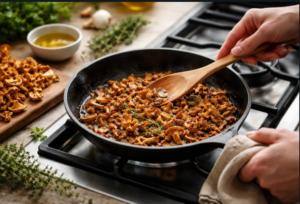
Add 6 fresh sage leaves and the rehydrated 40g of Parasols (400g fresh equivalent). Sauté until the mushrooms are slightly crispy at the edges.
Stage 3: The Mantecatura
Boil 320g of fresh egg Tagliatelle in salted water until al dente.
Transfer the pasta directly to the sauté pan. Add the reserved "Secret Essence" and a ladle of pasta water.
Toss vigorously over medium-high heat until a glossy, nutty emulsion forms. Finish with a squeeze of lemon and a shower of Parmigiano.
The Umami Secret: The 1:10 Molecular Bridge
The "Secret" lies in the 1:10 Concentration Ratio. 40g of dried Parasols carry the flavor volume of nearly half a kilo of fresh ones, but without the dilution of water. This allows you to "over-season" the pasta with the mushroom's own DNA. To reach "Pure Umami," pulverize 2g of the dried Parasol into a powder and whisk it into the butter at Stage 2—this ensures the fat itself becomes the carrier for the forest volatiles.
Pro Technique: The “Hazelnut Crush”
For a professional textural finish, crush half the hazelnuts and leave the other half whole. The crushed nuts will melt into the emulsion, thickening the sauce and adding a creaminess, while the whole nuts provide the "shatter-crunch" that contrasts with the silken pasta and mushrooms.
The Art of Pairing
Sommelier's Choice: A Barbera d'Asti or a Chardonnay from the Jura. The wine's acidity and oxidative, nutty undertones are a structural mirror to the hazelnuts and dried mushrooms.
Non-Alcoholic: A cold-brewed Oolong Tea, which provides the same floral and roasted complexity as the Parasol mushroom.
Ancestral Nutrition
Dried Parasols are an exceptional source of B-vitamins and Potassium, while hazelnuts provide Healthy Monounsaturated Fats and Vitamin E. Historically, this dish was served to "restore the mind" after a long winter, providing a high-density nutrient profile for the coming spring labor.
Micro-FAQ
Q: Why use dried instead of fresh? A: Drying creates specific flavor compounds (esters) in Parasols that aren't present in fresh ones. In this specific recipe, the "dried umami" is the only thing that can stand up to the intensity of roasted hazelnuts.
Q: Can I use different nuts? A: Walnuts are a decent substitute, but they carry a bitterness that hazelnuts don't have. If using walnuts, toast them very briefly.
The Parasol Lexicon: Global Names for Macrolepiota procera
The Parasol Mushroom is one of the most elegant and easily recognized wild fungi. Its names across various cultures often refer to its majestic height and umbrella-like cap:
Language
Regional & Folk Names
Expert Notes
Bulgarian
Сърнела, Чадъреста гъба, Конска гъба, Кукувиче
"Sarnela" comes from "Sarna" (Roe Deer), due to the spotted cap.
English
Parasol Mushroom, Drumstick (young stage)
Named for its resemblance to a lady's parasol.
Italian
Mazza di tamburo, Ombrellone, Bubbola maggiore
"Mazza di tamburo" means "Drumstick".
French
Coulemelle, Lépiote élevée, Nez de chat
"Coulemelle" is the traditional culinary name in France.
Spanish / Catalan
Galamperna, Macrolepiota, Paloma, Apagallums
"Apagallums" (Catalan) means "Light extinguisher".
German
Parasol, Riesenschirmling, Paukenschläger
"Riesenschirmling" means "Giant Umbrella".
Russian / Polish
Гриб-зонтик / Kania, Sowa
"Kania" is one of the most beloved wild mushrooms in Poland.
Romanian / Greek
Burete șerpesc / Ζαρκάδι (Zarkadi)
"Zarkadi" also refers to a deer, similar to the Bulgarian name.
Portuguese / Turkish
Frade, Cogumelo guarda-sol / Turna Bacağı
"Turna Bacağı" (Turkish) means "Crane's Leg".
Hungarian / Czech
Nagy őzlábgomba / Bedla vysoká
Common and highly appreciated in Central European cuisine.
Scientific identification: Macrolepiota procera | Pure Umami Research 2026
To provide the best experiences, we use technologies like cookies to store and/or access device information. Consenting to these technologies will allow us to process data such as browsing behavior or unique IDs on this site. Not consenting or withdrawing consent, may adversely affect certain features and functions.
Functional
Always active
The technical storage or access is strictly necessary for the legitimate purpose of enabling the use of a specific service explicitly requested by the subscriber or user, or for the sole purpose of carrying out the transmission of a communication over an electronic communications network.
Preferences
The technical storage or access is necessary for the legitimate purpose of storing preferences that are not requested by the subscriber or user.
Statistics
The technical storage or access that is used exclusively for statistical purposes.The technical storage or access that is used exclusively for anonymous statistical purposes. Without a subpoena, voluntary compliance on the part of your Internet Service Provider, or additional records from a third party, information stored or retrieved for this purpose alone cannot usually be used to identify you.
Marketing
The technical storage or access is required to create user profiles to send advertising, or to track the user on a website or across several websites for similar marketing purposes.