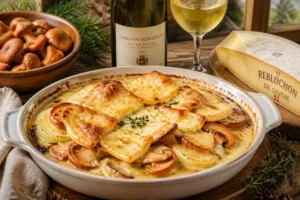
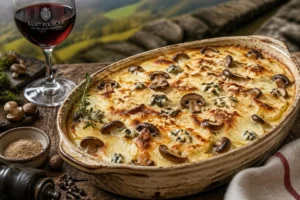
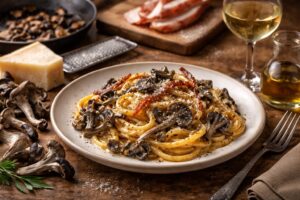
A technical study in long-duration thermal extraction and the synergistic interaction between fungal polysaccharides and animal-derived gelatin in a controlled-simmer environment.
Auvergne Saffron Milk Cap Potée
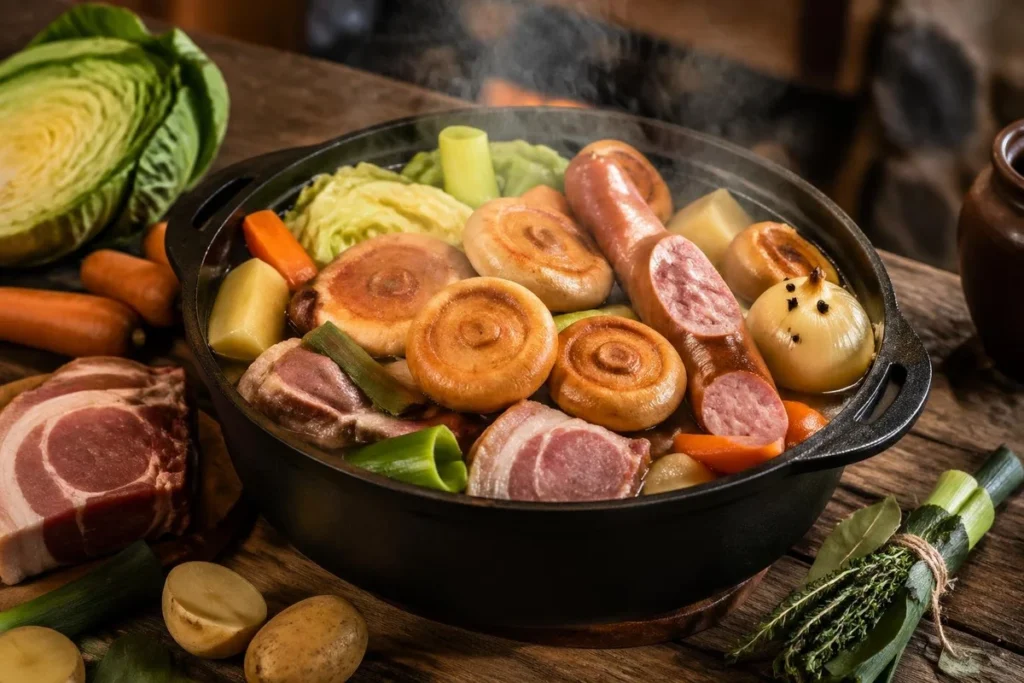
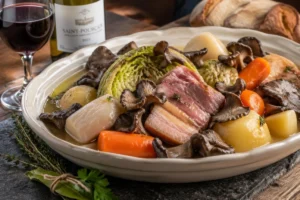
In the volcanic heart of France, the Saffron Milk Cap (Lactarius deliciosus) is a staple of the Potée Auvergnate, a dish designed for sustenance and deep flavor. While many preparations focus on the high-heat searing of fungi, this regional classic utilizes Long-Duration Thermal Extraction. The Lactarius is uniquely suited for this, as its dense chitinous structure prevents it from dissolving into the broth, instead becoming a tender, flavor-saturated component that absorbs the essence of the salted meats and winter vegetables.
The "Terroir Narrative" of this dish is one of survival and mountain heritage. Traditionally, the Potée was a communal meal, cooked in a heavy iron pot over an open fire. By integrating the Saffron Milk Cap, we introduce a resinous, forest-floor top note that elevates the humble cabbage and pork base, creating a sophisticated bridge between the wild forage of the Puy-de-Dôme and the farmhouse larder.
Prep Time
40 Minutes
Cook Time
120 Minutes
Complexity
Grand Officier
Calories
410 kcal per serving
Region
Auvergne, France
The Culinary Physics of This Dish
This dish relies on the Synergistic Interaction between fungal polysaccharides and animal gelatin. As the salted pork and sausages simmer, they release collagen that transforms into gelatin, increasing the viscosity of the broth. The Lactarius deliciosus, added in the second half of the process, undergoes a slow rehydration. The mushroom acts as a biological sponge; through Osmosis, the gelatin-rich, savory broth replaces the mushroom's internal fluids. The orange latex provides a natural emulsifier that helps unify the disparate fats from the meat and the vegetable fibers into a cohesive, unctuous liquid.
Master Recipe (1:10 Rule)
600g Fresh Saffron Milk Caps (Lactarius deliciosus), left whole if small
500g Salted Pork Shoulder or Petit Salé
2 Smoked Montbéliard or Morteau Sausages
1 Large Green Cabbage, quartered
300g Floury Potatoes (Bintje), halved
2 Large Leeks and 3 Carrots, roughly chopped
1 Onion studded with 2 Cloves
Bouquet Garni (Thyme, Bay Leaf, Leek Green)
The Technique
1. Desalting: Soak the salted pork in cold water for 2 hours prior to cooking. This is essential for controlling the final salinity of the Potée.
2. The Primary Simmer: Place the pork in a large pot, cover with cold water, and bring to a slow simmer. Skim any impurities (the écume) that rise to the surface to ensure a clear broth.
3. Vegetable Integration: After 60 minutes, add the cabbage, carrots, leeks, and the onion. The cabbage provides the sulfurous backbone that supports the mushroom's earthy profile.
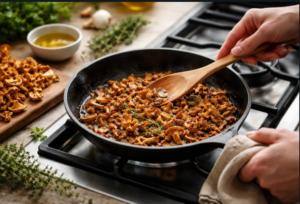
4. Fungal Introduction: Add the Lactarius deliciosus and the sausages during the final 45 minutes. Cooking the mushrooms for this duration allows for the Long-Duration Extraction without compromising their firm texture.
5. The Finish: Add the potatoes for the last 25 minutes. Serve the meats on a platter surrounded by the vegetables and mushrooms, with the broth served separately in bowls.
Shop Integration
The slow-cooking method of the Potée is a masterclass in flavor development. While the Saffron Milk Cap is our star here, our Boletus edulis (Boletus edulis) can be added for a deeper, more velvety broth. For a distinct textural contrast, incorporating the Marasmius oreades (Marasmius oreades) provides a concentrated burst of forest aroma in the liquid. If you seek a visual and savory masterpiece, our Craterellus cinereus offers a dark, intense umami that pairs beautifully with smoked sausages.
The Umami Profile
The umami in this dish is "Deep and Layered." It utilizes the inosinates of the cured pork and the guanylates of the Saffron Milk Caps. Because the ingredients are simmered together for a long period, these compounds have ample time to form a complex savory matrix. The cabbage adds S-methylmethionine, which acts as a flavor catalyst, heightening the perception of the mushroom's resinous notes.
Sommelier’s Choice
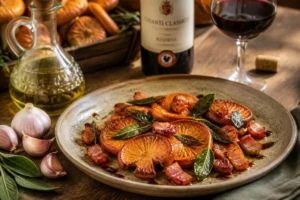
A red wine with high acidity and low tannins is required to balance the fat and salt. A Côtes d'Auvergne (Gamay or Pinot Noir) is the traditional choice. Its bright red fruit and volcanic minerality provide a refreshing counterpoint to the heavy, slow-cooked meats and the earthy mushrooms.
The Etymological Chronicle
The name Potée simply refers to that which is cooked in a pot (pot). In French, Lactaire délicieux is the culinary standard. In Italian, this slow-cooked style is akin to the Bollito Misto. In German, it is a Eintopf, a "one-pot" meal that defines northern European comfort. In Spanish, the Cocido is the linguistic cousin, though the Níscalo (Saffron Milk Cap) is a more frequent addition in the mountainous regions of central France than in the Iberian plains.
Pure Umami | Mycological Research & Culinary Arts | 2026
To provide the best experiences, we use technologies like cookies to store and/or access device information. Consenting to these technologies will allow us to process data such as browsing behavior or unique IDs on this site. Not consenting or withdrawing consent, may adversely affect certain features and functions.
Functional
Always active
The technical storage or access is strictly necessary for the legitimate purpose of enabling the use of a specific service explicitly requested by the subscriber or user, or for the sole purpose of carrying out the transmission of a communication over an electronic communications network.
Preferences
The technical storage or access is necessary for the legitimate purpose of storing preferences that are not requested by the subscriber or user.
Statistics
The technical storage or access that is used exclusively for statistical purposes.The technical storage or access that is used exclusively for anonymous statistical purposes. Without a subpoena, voluntary compliance on the part of your Internet Service Provider, or additional records from a third party, information stored or retrieved for this purpose alone cannot usually be used to identify you.
Marketing
The technical storage or access is required to create user profiles to send advertising, or to track the user on a website or across several websites for similar marketing purposes.