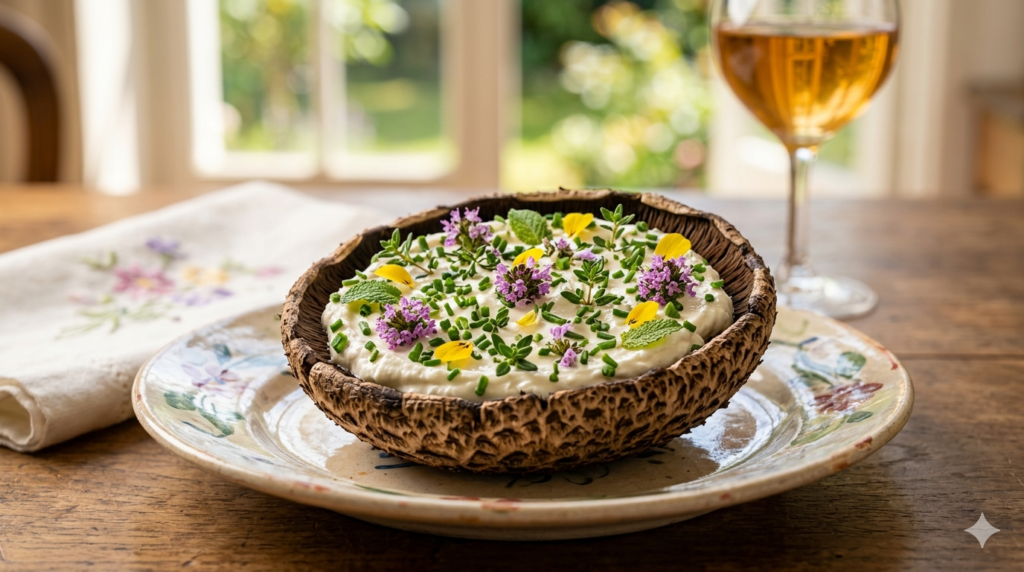
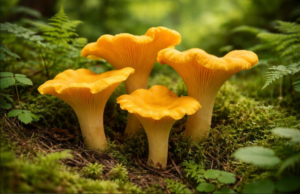
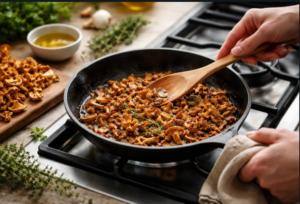
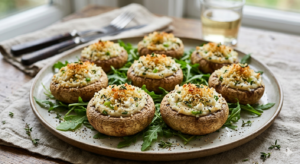
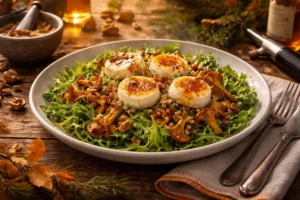
A visual and culinary masterpiece inspired by the Impressionist gardens of Giverny, featuring the towering Macrolepiota procera and a vibrant, herb-flecked Fromage de Chèvre.
The Painter’s Meadow Palette
Gratinated Parasol Caps with Whipped Goat Cheese and an Emerald Herb Infusion
The Historical Prelude
The Macrolepiota procera, or Parasol Mushroom, is the architect of the summer meadow. With its elegant, stippled cap and slender stature, it was a frequent muse for the Impressionists. **Claude Monet**, an avid gourmet and gardener at Giverny, was known to delight in the "wild harvests" of the surrounding Normandy countryside. In his journals and kitchen records, mushrooms were often paired with the tangy, fresh cheeses of the local farms.
This dish reimagines the Parasol as a natural canvas. Historically, in the **French Loire Valley**, large mushroom caps were treated as "edible plates" for the transport of herb-heavy goat cheeses. By baking the mushroom, we bridge the gap between the wild, nutty volatiles of the forest edge and the bright, lactic acidity of the creamery—a flavor profile as layered and textured as a Monet oil painting.
The Parasol is a "Dry-Cell" fungus. Unlike the spongy Porcini, it does not release excessive water when heated, making it the perfect vessel for high-moisture fillings like goat cheese. Our philosophy is "Aromatic Encapsulation": we use the cap's gills to trap the melting cheese, creating a structural bond that prevents the filling from escaping while concentrating the mushroom's almond-like essence.
Sensory & Foraging Profile
Nomenclature:Macrolepiota procera (Parasol) and Chèvre Frais (Fresh Goat Cheese).
Terroir: The finest Parasols for baking are found in the sun-drenched meadows of the Atlantic Fringes and the French Savoie. These habitats produce caps with a distinct toasted-almond aroma and a structural "shag" on the skin that caramelizes beautifully under dry heat.
Professional Protocol: We harvest only when the cap has fully expanded into its "parasol" shape. We practice the "Movable Ring" test—if the ring on the stem slides freely, the mushroom is mature and ready. In accordance with "Leave No Trace" ethics, we leave the woody stems in the field to allow their nutrients to return to the host soil.
Essential Equipment
Stone Baking Sheet: To provide a constant, radiating heat that crisps the mushroom base.
Pastry Bag (Plain Tip): For a precise, artistic application of the herbed mousse.
Silicon Pastry Brush: To apply a delicate glaze of herb-infused oil to the cap's exterior.
Master Recipe
Stage 1: The Cap Preparation
4 Large Fresh Parasol Caps (approx. 400g).
Wipe the caps with a dry cloth to remove any meadow debris. Brush the outer "shaggy" skin with a mixture of melted butter and a hint of honey to promote browning.
Stage 2: The Monet Mousse
200g Fresh Goat Cheese (Chèvre), softened.
1 tablespoon of heavy cream and 1 egg yolk (for a stable, aerated lift).
A "Palette" of finely minced Chives, Parsley, and Tarragon (The Emerald Trio).
Whisk until smooth and transfer to the pastry bag.
Stage 3: The Gratin
Pipe the herbed cheese into the gill-side of the 400g Fresh Parasol Caps.
Dust the surface with a whisper of fine sourdough breadcrumbs and lemon zest.
Bake at 190°C for 15-18 minutes. The mushroom should be tender and the cheese topping should be golden and slightly puffed.
The Umami Secret: The 1:10 Floral Fortification
To achieve a "Pure Umami" experience that echoes the intensity of the forest, utilize the 1:10 Fortification. Take 5g of dried Parasol caps (the equivalent of 50g fresh), pulverize them into a fine dust, and fold it directly into the goat cheese. This dust acts as an "umami amplifier," bridging the tangy cheese with the nutty mushroom and ensuring the flavor of the meadow is present in every molecule of the mousse.
Pro Technique: The “Emerald Oil” Drizzle
For a true Monet aesthetic, blanch a handful of parsley and chives, shock them in ice water, and blend with neutral oil. Strain through a coffee filter. Drizzle this vibrant green oil around the baked mushroom before serving. It adds a "painterly" splash of color and a fresh, herbal finish to the rich, baked earthiness.
The Art of Pairing
Sommelier's Choice: A Sancerre or a crisp Sauvignon Blanc from the Loire. The wine's herbal notes and high acidity are the traditional partners for goat cheese and wild mushrooms.
Non-Alcoholic: A chilled Verjus tonic with a sprig of fresh mint.
Ancestral Nutrition
Parasol mushrooms are a rich source of B-complex vitamins, while goat cheese provides easily digestible proteins and probiotics. Historically, in the **French countryside**, this was a "Summer Solstice" dish, believed to provide the metabolic energy needed for the upcoming grain harvest.
Micro-FAQ
Q: Can I use the stems in the filling? A: No. The stems of Macrolepiota procera are too fibrous. However, you can dry them and grind them to make the "Umami Dust" mentioned in our secret section.
Q: Why bake at 190°C? A: This high temperature is necessary to brown the breadcrumbs and "shaggy" skin before the delicate goat cheese loses its airy structure.
The Parasol Lexicon: Global Names for Macrolepiota procera
The Parasol Mushroom is one of the most elegant and easily recognized wild fungi. Its names across various cultures often refer to its majestic height and umbrella-like cap:
Language
Regional & Folk Names
Expert Notes
Bulgarian
Сърнела, Чадъреста гъба, Конска гъба, Кукувиче
"Sarnela" comes from "Sarna" (Roe Deer), due to the spotted cap.
English
Parasol Mushroom, Drumstick (young stage)
Named for its resemblance to a lady's parasol.
Italian
Mazza di tamburo, Ombrellone, Bubbola maggiore
"Mazza di tamburo" means "Drumstick".
French
Coulemelle, Lépiote élevée, Nez de chat
"Coulemelle" is the traditional culinary name in France.
Spanish / Catalan
Galamperna, Macrolepiota, Paloma, Apagallums
"Apagallums" (Catalan) means "Light extinguisher".
German
Parasol, Riesenschirmling, Paukenschläger
"Riesenschirmling" means "Giant Umbrella".
Russian / Polish
Гриб-зонтик / Kania, Sowa
"Kania" is one of the most beloved wild mushrooms in Poland.
Romanian / Greek
Burete șerpesc / Ζαρκάδι (Zarkadi)
"Zarkadi" also refers to a deer, similar to the Bulgarian name.
Portuguese / Turkish
Frade, Cogumelo guarda-sol / Turna Bacağı
"Turna Bacağı" (Turkish) means "Crane's Leg".
Hungarian / Czech
Nagy őzlábgomba / Bedla vysoká
Common and highly appreciated in Central European cuisine.
Scientific identification: Macrolepiota procera | Pure Umami Research 2026
To provide the best experiences, we use technologies like cookies to store and/or access device information. Consenting to these technologies will allow us to process data such as browsing behavior or unique IDs on this site. Not consenting or withdrawing consent, may adversely affect certain features and functions.
Functional
Always active
The technical storage or access is strictly necessary for the legitimate purpose of enabling the use of a specific service explicitly requested by the subscriber or user, or for the sole purpose of carrying out the transmission of a communication over an electronic communications network.
Preferences
The technical storage or access is necessary for the legitimate purpose of storing preferences that are not requested by the subscriber or user.
Statistics
The technical storage or access that is used exclusively for statistical purposes.The technical storage or access that is used exclusively for anonymous statistical purposes. Without a subpoena, voluntary compliance on the part of your Internet Service Provider, or additional records from a third party, information stored or retrieved for this purpose alone cannot usually be used to identify you.
Marketing
The technical storage or access is required to create user profiles to send advertising, or to track the user on a website or across several websites for similar marketing purposes.