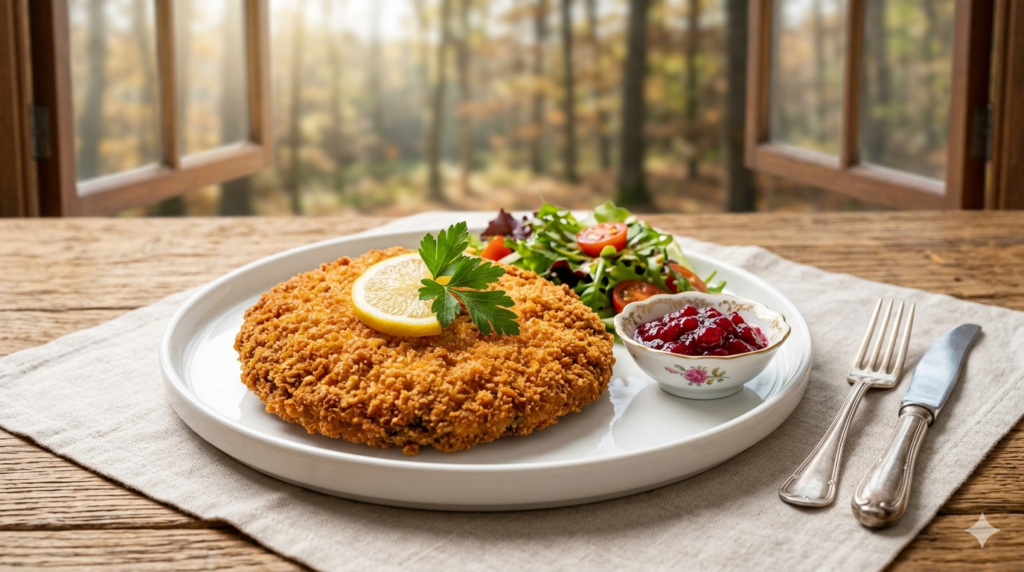
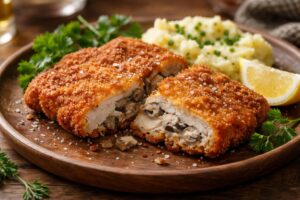
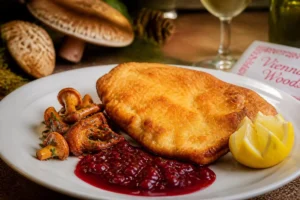
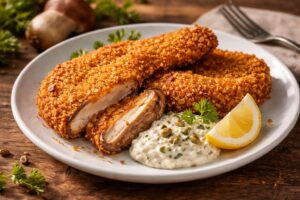
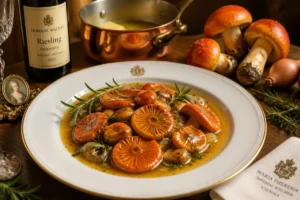
A majestic, plant-based tribute to the classic Viennese Schnitzel, featuring the massive, nutty caps of the Macrolepiota procera.
The Meadow King’s Cutlet
Golden-Crusted Parasol Caps with a Hint of Lemon and Wild Herbs
The Historical Prelude
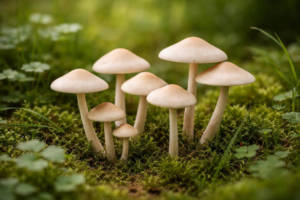
The Macrolepiota procera, elegantly known as the Parasol Mushroom, has been revered as "The Forest Steak" across the pastoral landscapes of Central Europe and the Balkans for centuries. Standing up to 40cm tall, its massive, plate-like caps were historically a prize for mountain shepherds in the Dolomites and the Rhodopes.
While the aristocrats of Vienna were perfecting the veal Wiener Schnitzel, the rural foragers discovered that the Parasol's dry, spongy flesh possessed a unique ability to mimic the texture of a tender cutlet when breaded and fried. By the early 20th century, this "Vegetarian Schnitzel" became a seasonal staple in the bohemian cafes of Prague and Budapest, celebrated for its toasted-almond aroma and a meat-like bite that requires no aging—only a fresh morning harvest from a sun-drenched clearing.
The Parasol is the only mushroom that is "pre-structured" for breading. Its gills are exceptionally deep and dry, acting as natural anchors for the flour and egg wash. Our philosophy focuses on Moisture Management: because the Parasol is naturally low in water, we can achieve a "shatter-crisp" crust without the interior turning into a mushy puree, preserving the distinct "flaky" texture of the mushroom gills.
Terroir: The finest specimens for schnitzel are found in the Atlantic Fringes and the limestone-rich grasslands of Western Europe. These habitats produce caps with a high concentration of free amino acids, resulting in a deeper savory profile.
Professional Protocol: We harvest only the caps, as the stems are woody and fibrous. In accordance with "Leave No Trace" ethics, we only select "opened" parasols (the umbrella stage), ensuring the movable ring on the stem has already dropped its spores to populate the meadow for the following season.
Essential Equipment
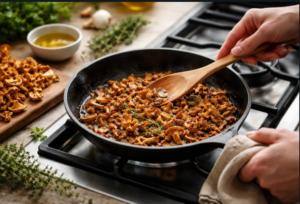
Wide Cast Iron Skillet: To accommodate the large diameter of the caps and maintain a constant frying temperature.
Fine Mesh Sieve: For a uniform dusting of the "Umami Flour."
Wire Cooling Rack: Essential to prevent the bottom of the schnitzel from steaming and losing its crunch.
Master Recipe
Stage 1: The Cap Preparation
4 Large Fresh Parasol Caps (approx. 400g).
Gently remove the stems (reserve for drying into powder). Wipe the caps with a dry cloth; never use water, or the breading will slide off.
Lightly press the caps flat with the palm of your hand to ensure even contact with the pan.
Stage 2: The Triple-Dredge System
Station 1: 100g Flour mixed with 5g Parasol Dust (see Umami Secret).
Station 2: 2 Organic Eggs, whisked with a splash of milk and sea salt.
Station 3: 150g coarse sourdough breadcrumbs or Panko.
Stage 3: The Golden Sauté
Heat 100ml of clarified butter or neutral oil in the skillet until it reaches 180°C.
Dredge the caps in flour, then egg, then breadcrumbs.
Fry for 3-4 minutes per side until a deep mahogany gold. The edges should be exceptionally crispy. Serve immediately with a wedge of lemon.
The Umami Secret: The 1:10 Crusting Synergy
To elevate a simple fry into a "Pure Umami" masterpiece, utilize the 1:10 Fortification. Take 5g of dried Parasol stems or caps (the equivalent of 50g fresh), grind them into a molecularly fine dust, and mix it into the flour. This dust adheres to the gills, and as it hits the hot oil, it undergoes an accelerated Maillard reaction, intensifying the "toasted nut" flavor of the fresh mushroom tenfold.
Pro Technique: The “Spoon Basting”
During the final minute of frying, tilt the pan and use a large spoon to pour the hot butter over the top of the schnitzel. This ensures that any "pits" in the shaggy cap are fully cooked and crispy, adding a professional gloss and depth to the crust.
The Art of Pairing
Sommelier's Choice: A Grüner Veltliner from Austria or a Dry Riesling. The wine's white pepper notes and high acidity are the perfect structural foil for the richness of the fried breading.
Non-Alcoholic: A cold-pressed apple cider with a dash of sparkling water and a sprig of thyme.
Ancestral Nutrition
Parasol mushrooms are a significant source of B-vitamins and Antioxidants. Historically, in the **Balkan** villages, this schnitzel was served to workers during the hay harvest, as it provided the "heaviness" of meat with the light digestibility required for laboring under the summer sun.
Micro-FAQ
Q: Why is the 1:10 ratio critical for this recipe? A: Because 5g of dried Parasol powder provides the flavor concentration of 50g of fresh mushroom. Adding this to the breading ensures the "Forest Steak" flavor isn't diluted by the flour and egg.
Q: Can I use the stems? A: No. The stems of the Parasol are too tough to eat, even when fried. Always remove them and save them for drying to make your Umami Dust.
The Parasol Lexicon: Global Names for Macrolepiota procera
The Parasol Mushroom is one of the most elegant and easily recognized wild fungi. Its names across various cultures often refer to its majestic height and umbrella-like cap:
Language
Regional & Folk Names
Expert Notes
Bulgarian
Сърнела, Чадъреста гъба, Конска гъба, Кукувиче
"Sarnela" comes from "Sarna" (Roe Deer), due to the spotted cap.
English
Parasol Mushroom, Drumstick (young stage)
Named for its resemblance to a lady's parasol.
Italian
Mazza di tamburo, Ombrellone, Bubbola maggiore
"Mazza di tamburo" means "Drumstick".
French
Coulemelle, Lépiote élevée, Nez de chat
"Coulemelle" is the traditional culinary name in France.
Spanish / Catalan
Galamperna, Macrolepiota, Paloma, Apagallums
"Apagallums" (Catalan) means "Light extinguisher".
German
Parasol, Riesenschirmling, Paukenschläger
"Riesenschirmling" means "Giant Umbrella".
Russian / Polish
Гриб-зонтик / Kania, Sowa
"Kania" is one of the most beloved wild mushrooms in Poland.
Romanian / Greek
Burete șerpesc / Ζαρκάδι (Zarkadi)
"Zarkadi" also refers to a deer, similar to the Bulgarian name.
Portuguese / Turkish
Frade, Cogumelo guarda-sol / Turna Bacağı
"Turna Bacağı" (Turkish) means "Crane's Leg".
Hungarian / Czech
Nagy őzlábgomba / Bedla vysoká
Common and highly appreciated in Central European cuisine.
Scientific identification: Macrolepiota procera | Pure Umami Research 2026
To provide the best experiences, we use technologies like cookies to store and/or access device information. Consenting to these technologies will allow us to process data such as browsing behavior or unique IDs on this site. Not consenting or withdrawing consent, may adversely affect certain features and functions.
Functional
Always active
The technical storage or access is strictly necessary for the legitimate purpose of enabling the use of a specific service explicitly requested by the subscriber or user, or for the sole purpose of carrying out the transmission of a communication over an electronic communications network.
Preferences
The technical storage or access is necessary for the legitimate purpose of storing preferences that are not requested by the subscriber or user.
Statistics
The technical storage or access that is used exclusively for statistical purposes.The technical storage or access that is used exclusively for anonymous statistical purposes. Without a subpoena, voluntary compliance on the part of your Internet Service Provider, or additional records from a third party, information stored or retrieved for this purpose alone cannot usually be used to identify you.
Marketing
The technical storage or access is required to create user profiles to send advertising, or to track the user on a website or across several websites for similar marketing purposes.