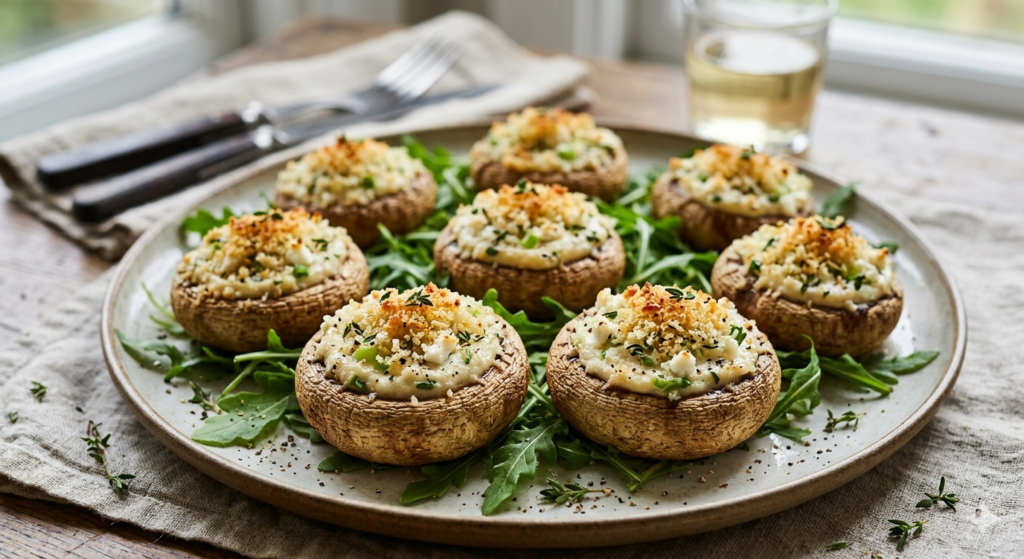
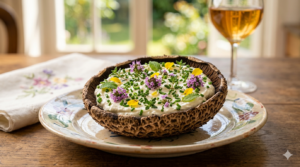
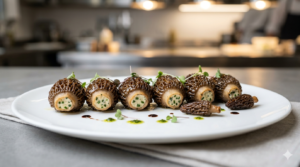
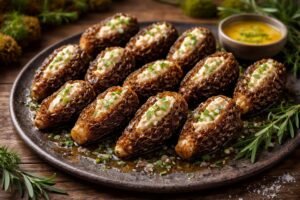
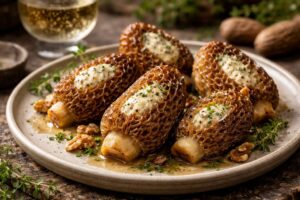
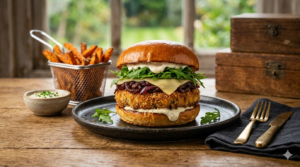
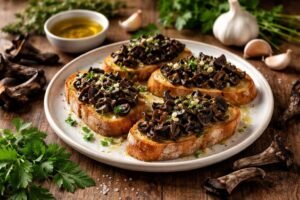
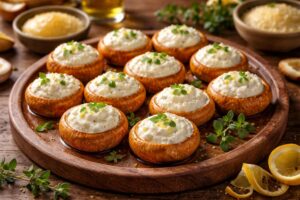
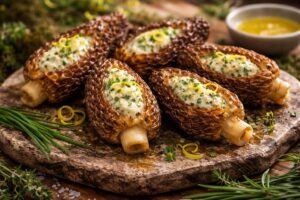
A regal vegetarian delicacy featuring the majestic, nutty Macrolepiota procera filled with a whipped, herb-infused artisanal cream.
The Meadow Empress
Gratinated Parasol Caps with a Velvety Herbed Fromage Mousse
The Historical Prelude
The Macrolepiota procera, elegantly known as the Parasol Mushroom, is a towering figure in the mycological landscape of Western Europe. Standing like a sentinel in the sun-drenched clearings of the Black Forest and the rolling meadows of the French Pyrenees, it has earned the moniker "The King of the Fields." Historically, the Parasol was a favorite of the 18th-century French country gentry, who prized its enormous, plate-like caps as natural vessels for complex fillings.
While the Italian Cucina Povera tradition often saw these caps breaded and fried like a veal cutlet, it was the refined kitchens of the Dolomites that began stuffing them with soft, alpine cheeses and high-altitude herbs. Legend suggests that the dish was a celebratory hallmark of the summer solstice, served to the Dukes of Savoy during their mountain retreats. The juxtaposition of the mushroom's "wild" nuttiness with the "domesticated" creaminess of the mousse represents the perfect culinary balance between the untamed forest and the artisanal dairy traditions of Europe.
The Parasol is unique for its dry, spongy texture that acts as a flavor wick. Our philosophy treats the cap as a flavor reservoir. By stuffing the cap while raw and then slow-gratinating, we allow the mushroom's natural moisture to steam the "mousse" from below, while the surface develops a golden, Maillard-rich crust.
Sensory & Foraging Profile
Nomenclature:Macrolepiota procera (Large Parasol) and Persillade (Fine Herb blend).
Terroir: The finest Parasols are harvested from the Atlantic Fringes, where the salty breeze and calcium-rich grasslands produce caps with a distinct toasted-almond aroma. They require open, sunny spaces to develop their signature "shaggy" scales.
Professional Protocol: Only the caps are used for this preparation, as the stems are fibrous and woody. In accordance with "Leave No Trace" principles, we harvest only when the "ring" on the stem is movable, indicating the mushroom is fully mature and has already begun its spore release.
Essential Equipment
Wide Stainless Steel Baking Sheet: To ensure even air circulation around the large caps.
Pastry Bag with Star Tip: For piping the mousse into the gills with professional precision.
Silicone Brush: For applying a uniform layer of infused oil to the peridium (outer skin).
Master Recipe
Stage 1: The Cap Preparation
4 Large Fresh Parasol Caps (approx. 400g) (or 40g Dried Parasol slices, rehydrated and pressed into "mats").
Gently remove the stems (reserve for stock). Wipe the caps with a dry cloth. Do not wash, as the gills will absorb excess water and become soggy.
Brush the outer scales with a blend of melted butter and crushed garlic.
Stage 2: The Herbed Cheese Mousse
250g Artisanal Goat Cheese or Chèvre (softened).
100ml Heavy Cream (whipped to soft peaks).
Finely chopped Chives, Chervil, and a touch of Tarragon.
Fold the whipped cream into the cheese to create a light, aerated mousse. Season with white pepper and a hint of lemon zest.
Stage 3: The Infusion & Gratin
Pipe the mousse into the gill-side of the 400g Fresh Parasol Caps (or 40g rehydrated equivalent).
Dust the surface with a fine layer of sourdough breadcrumbs and 36-month aged Parmigiano Reggiano.
Bake at 190°C for 12–15 minutes until the caps have softened and the cheese mousse is bubbling and golden.
The Umami Secret: The 1:10 Grist Synergy
To achieve a "Pure Umami" depth, we use a 1:10 ratio technique in the mousse. Take 5g of dried Parasol, pulverize it into a fine dust, and fold it into the cheese. This 5g of dust carries the flavor intensity of 50g of fresh mushroom, creating a "mushroom-in-mushroom" flavor profile that is deeply savory and lingers on the palate.
Pro Technique: The “Gasket Seal”
When stuffing the caps, leave a 1cm margin around the edge. As the mushroom cooks, it will shrink slightly; the margin prevents the mousse from overflowing and creates a "gasket" of concentrated mushroom juices that caramelize against the edge of the cheese.
The Art of Pairing
Sommelier's Choice: A Dry Riesling from the Alsace region. The wine's petrol notes and high acidity cut through the richness of the goat cheese while echoing the Parasol's nuttiness.
Non-Alcoholic: A chilled Verjus tonic with a sprig of fresh rosemary.
Ancestral Nutrition
Parasol mushrooms are exceptionally high in B-complex vitamins and Antioxidants. In the traditional folk medicine of the Pyrenees, they were used to support digestion and "lighten the spirit" during the late summer heat.
Micro-FAQ
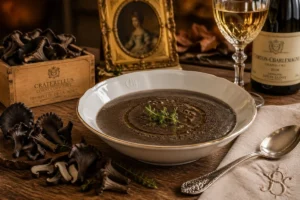
Q: Why do I only use the caps? A: The stems of Macrolepiota procera are extremely tough and contain a high amount of chitin. They are best dried and ground into powder for soups.
Q: Can I use the 1:10 ratio with other cheeses? A: Yes, but ensure the cheese is not too salty (like Roquefort), as it may compete with the delicate umami of the Parasol.
The Parasol Lexicon: Global Names for Macrolepiota procera
The Parasol Mushroom is one of the most elegant and easily recognized wild fungi. Its names across various cultures often refer to its majestic height and umbrella-like cap:
Language
Regional & Folk Names
Expert Notes
Bulgarian
Сърнела, Чадъреста гъба, Конска гъба, Кукувиче
"Sarnela" comes from "Sarna" (Roe Deer), due to the spotted cap.
English
Parasol Mushroom, Drumstick (young stage)
Named for its resemblance to a lady's parasol.
Italian
Mazza di tamburo, Ombrellone, Bubbola maggiore
"Mazza di tamburo" means "Drumstick".
French
Coulemelle, Lépiote élevée, Nez de chat
"Coulemelle" is the traditional culinary name in France.
Spanish / Catalan
Galamperna, Macrolepiota, Paloma, Apagallums
"Apagallums" (Catalan) means "Light extinguisher".
German
Parasol, Riesenschirmling, Paukenschläger
"Riesenschirmling" means "Giant Umbrella".
Russian / Polish
Гриб-зонтик / Kania, Sowa
"Kania" is one of the most beloved wild mushrooms in Poland.
Romanian / Greek
Burete șerpesc / Ζαρκάδι (Zarkadi)
"Zarkadi" also refers to a deer, similar to the Bulgarian name.
Portuguese / Turkish
Frade, Cogumelo guarda-sol / Turna Bacağı
"Turna Bacağı" (Turkish) means "Crane's Leg".
Hungarian / Czech
Nagy őzlábgomba / Bedla vysoká
Common and highly appreciated in Central European cuisine.
Scientific identification: Macrolepiota procera | Pure Umami Research 2026
To provide the best experiences, we use technologies like cookies to store and/or access device information. Consenting to these technologies will allow us to process data such as browsing behavior or unique IDs on this site. Not consenting or withdrawing consent, may adversely affect certain features and functions.
Functional
Always active
The technical storage or access is strictly necessary for the legitimate purpose of enabling the use of a specific service explicitly requested by the subscriber or user, or for the sole purpose of carrying out the transmission of a communication over an electronic communications network.
Preferences
The technical storage or access is necessary for the legitimate purpose of storing preferences that are not requested by the subscriber or user.
Statistics
The technical storage or access that is used exclusively for statistical purposes.The technical storage or access that is used exclusively for anonymous statistical purposes. Without a subpoena, voluntary compliance on the part of your Internet Service Provider, or additional records from a third party, information stored or retrieved for this purpose alone cannot usually be used to identify you.
Marketing
The technical storage or access is required to create user profiles to send advertising, or to track the user on a website or across several websites for similar marketing purposes.