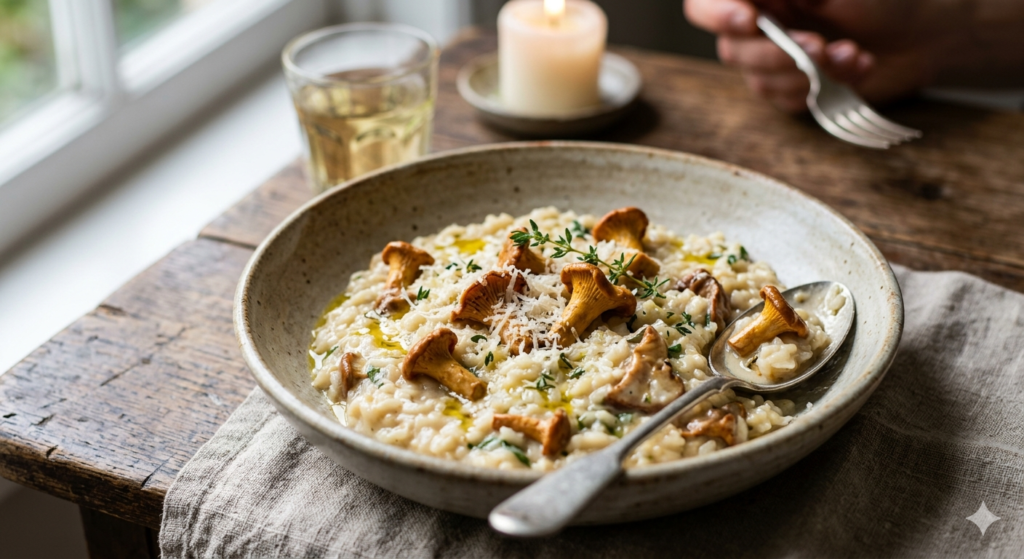
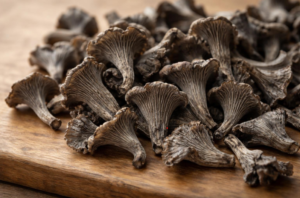
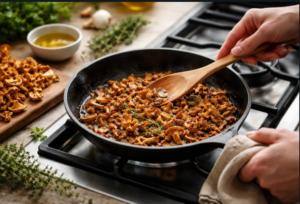
An opulent autumnal masterpiece pairing the apricot-scented Cantharellus cibarius with the fleeting pungency of wild-harvested Ramsons.
The Alchemist’s Risotto
Golden Chanterelles and Wild Garlic in a Mantecatura of Pure Luxury
The Historical Prelude
The Cantharellus cibarius, or Golden Chanterelle, has reigned as the "Queen of the Forest" since it first graced the tables of the French Valois dynasty. In the 18th century, it became an emblem of culinary refinement when it was featured in the encyclopedic works of François Pierre de La Varenne, the chef who moved French cuisine away from the heavy spices of the Middle Ages toward the natural flavors of the terroir.
The pairing with Wild Garlic (Allium ursinum) draws from a deeper, ancestral heritage found in the Black Forest and the Pyrenees. Known to the ancient Celts as "Bear's Garlic," it was believed to grant the strength of the forest's apex predator. When the sophisticated rice-culture of Northern Italy met these wild northern aromatics, the result was a dish that defined the transition of the seasons—a meal reserved for the festa della vendemmia (harvest festival) in the aristocratic estates of the Dolomites.
A true risotto is a living emulsion. The objective is to release the amylopectin starch from the Carnaroli rice to bond with the mushroom lipids. We treat the Golden Chanterelle with reverence; its high water content requires a "Dry-Sear" phase to concentrate its esters of apricot and peach before it ever touches the rice.
Sensory & Foraging Profile
Nomenclature:Cantharellus cibarius (Golden Chanterelle) and Allium ursinum (Wild Garlic/Ramsons).
Terroir: Our Chanterelles are sourced from the acidic, moss-covered floors of the Atlantic Fringes and the coniferous heights of the French Alps. The presence of symbiotic birch and spruce trees lends the fungi a subtle pine-resin finish that balances the heat of the wild garlic.
Professional Protocol: We adhere to the "Soft-Touch" harvest. Using a specialized brush to remove forest debris in the field ensures the delicate gills (pseudogills) are not damaged. We never harvest more than 20% of a colony to preserve the local mycelial health.
Essential Equipment
Heavy-Bottomed Copper Saucier: For precise thermal conductivity and even starch agitation.
Flat Wooden Spatula: To scrape the bottom of the pan without bruising the rice grains.
Pre-Warmed Serving Plates: To prevent the Mantecatura from seizing upon contact.
Master Recipe
Stage 1: The Chanterelle Concentration
500g Fresh Golden Chanterelles (or 50g Dried Chanterelles, rehydrated and patted dry).
Dry-sear the 500g Fresh Chanterelles (or 50g rehydrated equivalent) in a hot pan for 2 minutes. Once they release their moisture, add a knob of butter and a pinch of salt. Set aside half for the final garnish.
Stage 2: The Tostatura & Infusion
Toast 320g Carnaroli rice in a dry pan until it smells of toasted bread. Deglaze with a glass of dry Chablis.
Slowly add simmering blonde vegetable stock. At the 10-minute mark, stir in the sautéed Chanterelles.
Stage 3: The Wild Garlic Mantecatura
When the rice is al dente, remove from heat.
Add 60g of cold, cultured butter and a handful of finely shredded Wild Garlic leaves.
Vigorously beat in 70g of 24-month aged Parmigiano Reggiano until the risotto achieves the all'onda (wave-like) consistency.
The Umami Secret: The 1:10 Terroir Bond
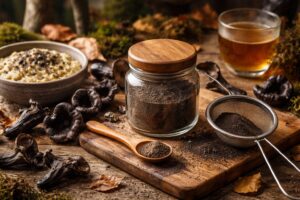
The Golden Chanterelle contains high levels of glutamic acid. By utilizing the 1:10 ratio (50g dried = 500g fresh), you can create a "Chanterelle Dust" by grinding 5g of the dried mushrooms and adding it to the stock. This provides a constant, underlying savory frequency that bridges the gap between the rice starch and the fresh mushroom caps.
Pro Technique: The “Ghost Garlic” Infusion
To avoid the bitterness of burnt garlic, we use the "Ghost" method: Rub the bottom of the cold risotto pan with a cut clove of garlic before starting. Then, only add the delicate Wild Garlic leaves at the very end of the Mantecatura to preserve their volatile oils and vibrant green color.
The Art of Pairing
Sommelier's Choice: A Meursault or a high-altitude Chardonnay from the Dolomites. The wine's buttery, lactic notes harmonize with the risotto's texture, while the acidity cleanses the palate from the wild garlic.
Non-Alcoholic: A cold-pressed apple and celery nectar, providing a crisp, autumnal acidity.
Ancestral Nutrition
Chanterelles are one of the richest plant-based sources of Vitamin D and Iron. Historically, this risotto was a "recovery meal" in the French Alps, designed to bolster the immune system before the first snowfall.
Micro-FAQ
Q: Can I use regular garlic if Ramsons are out of season? A: You can, but use only 1/4 the amount and roast it first. Wild Garlic is much milder and more herbal than its domestic counterpart.
Q: Why is the 1:10 ratio critical for the stock? A: Using 50g of dried Chanterelles to fortify your stock ensures that the rice absorbs the essence of the mushroom into its core, not just on the surface.
To provide the best experiences, we use technologies like cookies to store and/or access device information. Consenting to these technologies will allow us to process data such as browsing behavior or unique IDs on this site. Not consenting or withdrawing consent, may adversely affect certain features and functions.
Functional
Always active
The technical storage or access is strictly necessary for the legitimate purpose of enabling the use of a specific service explicitly requested by the subscriber or user, or for the sole purpose of carrying out the transmission of a communication over an electronic communications network.
Preferences
The technical storage or access is necessary for the legitimate purpose of storing preferences that are not requested by the subscriber or user.
Statistics
The technical storage or access that is used exclusively for statistical purposes.The technical storage or access that is used exclusively for anonymous statistical purposes. Without a subpoena, voluntary compliance on the part of your Internet Service Provider, or additional records from a third party, information stored or retrieved for this purpose alone cannot usually be used to identify you.
Marketing
The technical storage or access is required to create user profiles to send advertising, or to track the user on a website or across several websites for similar marketing purposes.