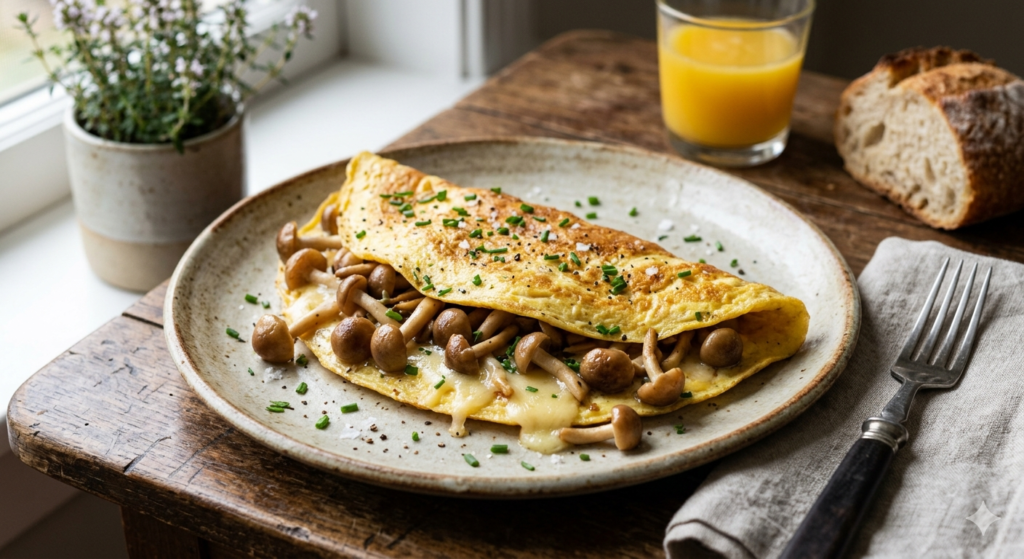
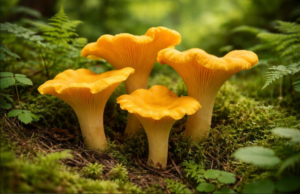
A refined, silken French Omelette featuring the nutty, almond-scented Marasmius oreades and aged Swiss Gruyère.
The Meadow-Circle Omelette
Silken Organic Eggs with Wild Marasmius and Caves-Aged Gruyère
The Historical Prelude
The Marasmius oreades, known as the Fairy Ring Mushroom or Mousseron de prés, is steeped in European folklore. Found in perfect emerald circles across the grasslands of the French Alps and the Pyrenees, these rings were once believed to be the dancing grounds of elves. However, in the culinary world, they are famed for a scientific miracle: they can completely dehydrate in the sun and "resurrect" with the first rainfall, losing none of their flavor.
The French Omelette, specifically the Omelette aux Mousserons, became a symbol of culinary precision in the 19th century. It was a favorite of the composer Gioachino Rossini, a notorious gourmand who insisted that the delicate, almond-like aroma of the Fairy Ring was the only suitable partner for the richness of butter-heavy eggs. This dish represents the epitome of "Cucina Povera" luxury—transforming simple meadow fungi and eggs into a meal fit for the Bourbon monarchs through sheer technical mastery.
A French Omelette is not "cooked"; it is managed. The goal is a baveuse (creamy) interior with a smooth, pale-yellow exterior, devoid of any browning (Maillard). The Fairy Ring Mushroom is chosen specifically for its low moisture and high protein-bound aromatics, which infuse the egg curd without diluting the texture.
Sensory & Foraging Profile
Nomenclature:Marasmius oreades (Fairy Ring) and Le Gruyère AOP.
Terroir: These mushrooms thrive in the permanent pastures of Western Europe. The soil must be unfertilized and rich in organic grass thatch. This terroir gives the mushroom its unique "cyanic" sweetness, reminiscent of bitter almonds and freshly mown hay.
Professional Protocol: We harvest only the caps, as the stems are notoriously tough. Foragers must look for the "scalloped" edges and the characteristic "hump" (umbo) in the center of the cap. We practice "Circle Integrity," never harvesting more than half of a ring to allow the mycelium to continue its outward expansion.
Essential Equipment
Carbon Steel Omelette Pan: For a perfectly non-stick surface that allows the egg to slide.
Heat-Resistant Silicone Spatula: To create the "fine curd" during the initial coagulation phase.
Fine Mesh Sieve: For straining the eggs to ensure a molecularly smooth texture.
Master Recipe
Stage 1: The Mushroom Resurrection
200g Fresh Fairy Ring Caps (or 20g Dried Fairy Ring Mushrooms, rehydrated).
Sauté the 200g Fresh Caps (or 20g rehydrated equivalent) in a small pan with 10g of butter and a whisper of shallot for 4 minutes. The caps should become slightly nutty and golden.
Stage 2: The Egg Preparation
3 Large Organic Eggs (Room Temperature).
Whisk the eggs vigorously with a fork, then pass through a fine sieve to remove the chalazae. Add a pinch of fine sea salt.
Stage 3: The Rolling Technique
Heat the carbon steel pan over medium-high heat with 15g of cold butter. Once the butter foams but hasn't browned, pour in the eggs.
Stir rapidly in a circular motion while shaking the pan. When the eggs look like soft scrambled "curds" but are still wet, flatten them into an even layer.
Place the 200g of sautéed Fairy Rings (or 20g rehydrated) and 30g of grated Gruyère in the center.
Fold the omelette into a cigar shape (tri-fold) and roll it onto a warm plate. Brush the top with a bit of butter for a mirror-like sheen.
The Umami Secret: The Resurrection Extraction
Fairy Ring mushrooms are unique in their concentration of trehalose (a natural sugar) and specific amino acids. By utilizing the 1:10 dry-to-fresh ratio, you can achieve a "flavor bomb" effect. If using the 20g of dried caps, rehydrate them in only 40ml of warm milk. Use this "mushroom-milk" as the base for your egg mixture to infuse the entire omelette with the essence of the meadow.
Pro Technique: The “Pointed Fold”
To achieve the 3-star Michelin look, use the edge of the pan to help the omelette tuck under itself. The final shape should be "almond-like" (pointed at both ends), echoing the aromatic profile of the Marasmius within.
The Art of Pairing
Sommelier's Choice: A Champagne Blanc de Blancs. The effervescence and brioche notes of the Chardonnay-based wine provide a stunning contrast to the silken eggs and the nuttiness of the Gruyère.
Non-Alcoholic: A cold-brewed Darjeeling Tea, which shares the floral and nutty undertones of the Fairy Ring mushroom.
Ancestral Nutrition
Fairy Ring mushrooms are a potent source of Riboflavin (B2) and Niacin. Historically, they were known as "The Forager's Bread" in the Black Forest, consumed by shepherds to maintain cognitive focus and energy during long days in the high pastures.
Micro-FAQ
Q: Can I use the stems of the Fairy Ring? A: No. The stems are incredibly fibrous and do not soften with cooking. Always remove them at the base of the cap before sautéing.
Q: Why use the 1:10 ratio for the eggs? A: Because 20g of dried Fairy Rings provides a much more stable aromatic profile for an omelette than 200g of fresh ones, which might release too much moisture and break the delicate egg curd.
To provide the best experiences, we use technologies like cookies to store and/or access device information. Consenting to these technologies will allow us to process data such as browsing behavior or unique IDs on this site. Not consenting or withdrawing consent, may adversely affect certain features and functions.
Functional
Always active
The technical storage or access is strictly necessary for the legitimate purpose of enabling the use of a specific service explicitly requested by the subscriber or user, or for the sole purpose of carrying out the transmission of a communication over an electronic communications network.
Preferences
The technical storage or access is necessary for the legitimate purpose of storing preferences that are not requested by the subscriber or user.
Statistics
The technical storage or access that is used exclusively for statistical purposes.The technical storage or access that is used exclusively for anonymous statistical purposes. Without a subpoena, voluntary compliance on the part of your Internet Service Provider, or additional records from a third party, information stored or retrieved for this purpose alone cannot usually be used to identify you.
Marketing
The technical storage or access is required to create user profiles to send advertising, or to track the user on a website or across several websites for similar marketing purposes.