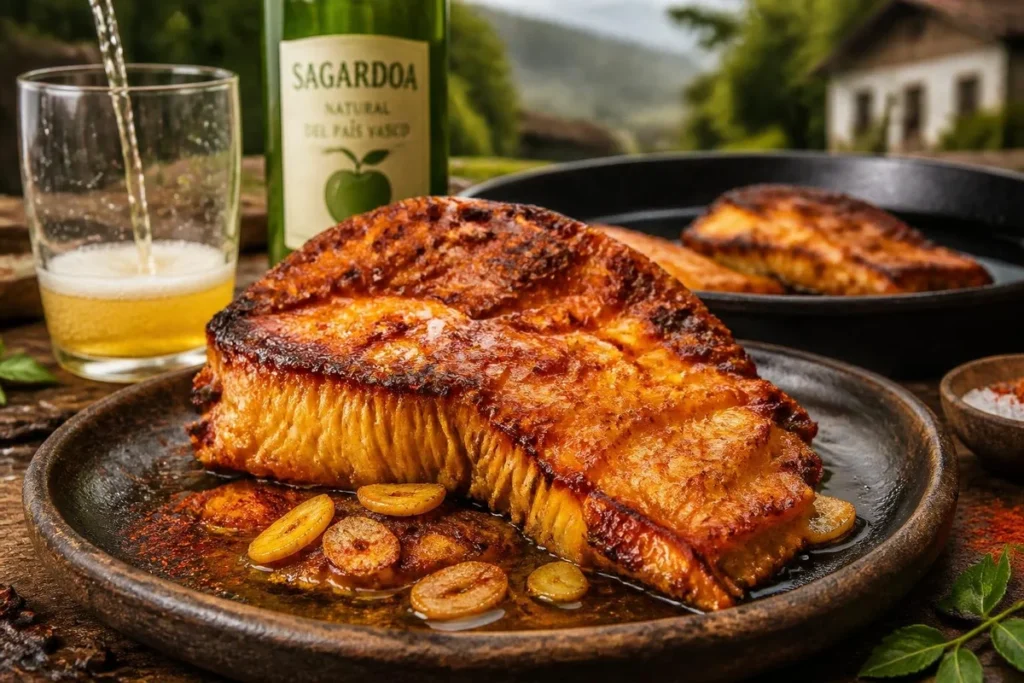
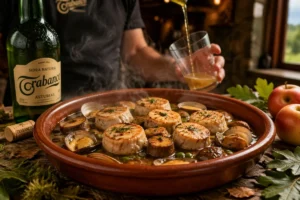
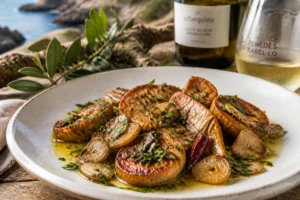
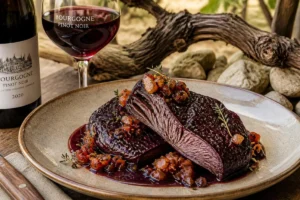
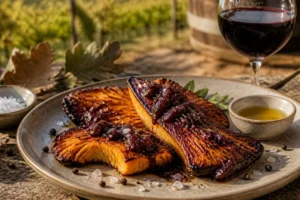
Experience the rustic intensity of the Pyrenees with this (Laetiporus sulphureus) preparation, featuring a professional Txuleta-style sear and a reduction of traditional Basque natural cider to harmonize the mushroom's density with high-altitude acidity.
Basque Cider-Glazed Chicken Woods
In the rugged hills of Euskadi, where the Atlantic mist clings to ancient oak forests, the culinary heart beats in the Sagardotegia (cider houses). This preparation treats Laetiporus sulphureus—the "Chicken of the Woods"—with the same fire-driven respect as a massive Basque ribeye. By utilizing the sharp, funky acidity of natural Basque cider (Sagardoa), we transform the mushroom into a succulent, wood-fired masterpiece that embodies the untamed spirit of the Basque Country.
The Culinary Physics of This Dish
This recipe focuses on Acetic-Polysaccharide Cleavage and Flash-Caramelization. Unlike sweet ciders, Basque cider is fermented with wild yeasts, resulting in high levels of volatile acidity. When used as a deglazing agent on a high-heat seared Laetiporus, the acetic acid works to micro-tenderize the chitinous surface. This allows the cider's residual tannins to bond with the mushroom's proteins, creating a savory, protective glaze that mimics the "crust" of traditionally grilled meats.
Terroir Narrative: The Atlantic Oakwood
The Basque Country is a land of vertical greenery and maritime influence. Foragers in the Gipuzkoa region often find Laetiporus on the "Pollard Oaks"—trees historically pruned for charcoal and ship-building. The mushroom's natural sulfurous undertones find a perfect partner in the "funk" of natural cider. This dish is a tribute to the *Baserri* (farmhouse) lifestyle—relying on the forge, the orchard, and the deep forest to create flavors that are as resilient as the culture itself.
Quick Info Bar
Attribute
Specification
Prep Time
30 Minutes
Cook Time
15 Minutes
Complexity
Grand Officier
Calories
295 kcal
Region
Basque Country (Spain/France)
Master Recipe (1:10 Rule)
The 1:10 ratio of cider reduction to mushroom weight ensures a sharp, acidic brightness that cuts through the savory density of the "Chicken."
500gLaetiporus sulphureus (cut into large, steak-like "Txuleta" slabs)
150ml Basque Natural Cider (Sagardoa – must be still and tart)
40ml Extra Virgin Olive Oil (Arbequina or Picual)
3 Cloves of Garlic, thinly sliced (for al ajillo finish)
5g Coarse Sea Salt (Sal de Añana)
1 tsp Piment d'Espelette (for subtle Basque heat)
10g Beef Tallow or high-quality lard (optional, for authentic grill depth)
The Technique
The preparation begins with the Dry-Heat Sear. Place the mushroom slabs on a smoking-hot cast iron surface (mimicking a plancha). Sear for 4 minutes per side until charred and compressed. Next is the Sagardoa Glaze. Pour the cider directly onto the hot mushrooms; the liquid will rapidly evaporate and "hiss," creating a steam-jacket that tenderizes the interior.
As the cider reduces to a syrupy consistency, move the mushrooms to the edge of the pan. Add the olive oil and garlic to the center, frying the garlic until golden. Toss everything together with a dusting of Piment d'Espelette. This creates a multi-layered finish: the sharp acidity of the cider reduction balanced by the mellow richness of toasted garlic oil.
Shop Integration
While the bold Basque style defines the Laetiporus, our shop offers the essential mycological palette for all high-gastronomy pursuits. You can explore the deep, nutty profile of our Porcini (Boletus edulis) or the delicate texture of the Fairy Ring Mushroom (Marasmius oreades). We also offer the prestigious Caesar's Mushroom (Amanita caesarea), Grey Chanterelle (Craterellus cinereus), and the classic Chanterelle (Cantharellus cibarius). For a truly unique and prized foraged experience, don't miss our seasonal Morels (Morchella conica).
The Umami Profile
The umami intensity in this dish is amplified through Fermentative Synergy. The inherent glutamates in Laetiporus sulphureus are stimulated by the natural yeasts and malic acids of the Basque cider. This creates a "vibrant" umami—one that feels lighter and more energetic than cream-based preparations, making it the perfect companion for grilled meats or as a standalone forest steak.
Sommelier’s Choice
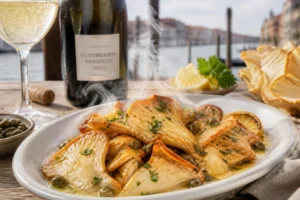
The only authentic choice is Basque Natural Cider, poured from a height (*escanciar*) to aerate the tannins and wake up the volatiles. If wine is preferred, a Txakoli de Getaria—a bone-dry, slightly effervescent white with saline notes—provides a sophisticated counterpoint to the smoky, cider-glazed mushroom.
THE ETYMOLOGICAL CHRONICLE
Basque: In Euskara, it is known as Ardagai hori, acknowledging its brilliant yellow color and traditional use as tinder or foraged food.
French: French mycologists refer to it as Létipore soufré, noting its sulfur-yellow pores and distinctive shelf-like growth.
Spanish: Known in the Pyrenees as Políporo azufrado, it is highly valued in mountain communities for its substantial, meat-like texture.
Italian: Identified as Poliporo solfureo, frequently used in rustic preparations across the northern Alpine regions.
Pure Umami | Mycological Research & Culinary Arts | 2026
To provide the best experiences, we use technologies like cookies to store and/or access device information. Consenting to these technologies will allow us to process data such as browsing behavior or unique IDs on this site. Not consenting or withdrawing consent, may adversely affect certain features and functions.
Functional
Always active
The technical storage or access is strictly necessary for the legitimate purpose of enabling the use of a specific service explicitly requested by the subscriber or user, or for the sole purpose of carrying out the transmission of a communication over an electronic communications network.
Preferences
The technical storage or access is necessary for the legitimate purpose of storing preferences that are not requested by the subscriber or user.
Statistics
The technical storage or access that is used exclusively for statistical purposes.The technical storage or access that is used exclusively for anonymous statistical purposes. Without a subpoena, voluntary compliance on the part of your Internet Service Provider, or additional records from a third party, information stored or retrieved for this purpose alone cannot usually be used to identify you.
Marketing
The technical storage or access is required to create user profiles to send advertising, or to track the user on a website or across several websites for similar marketing purposes.