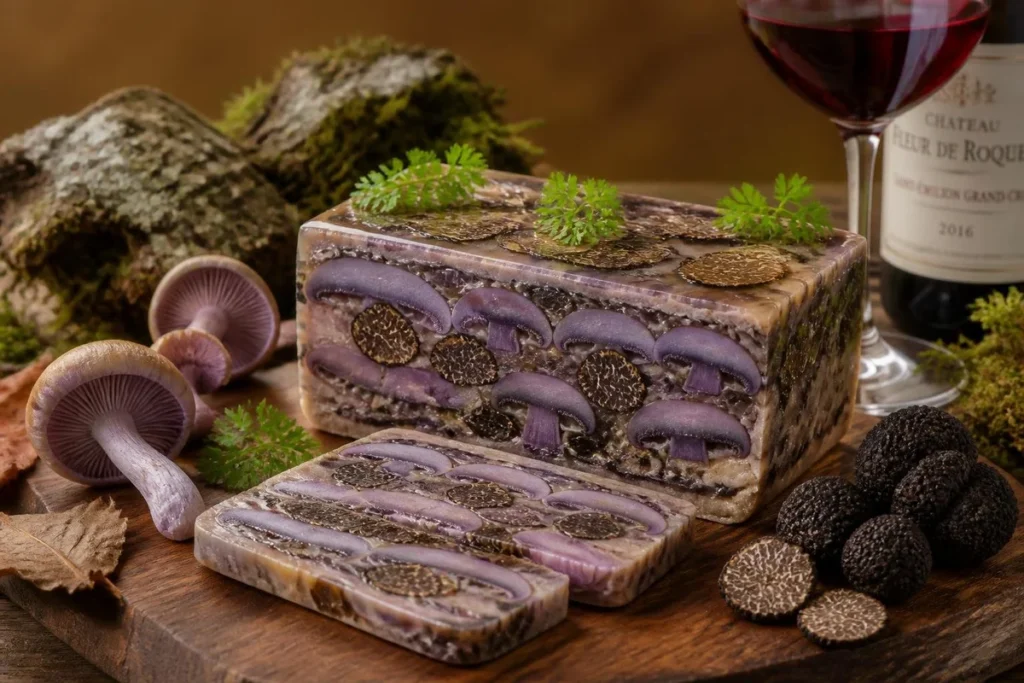
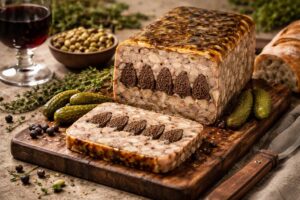
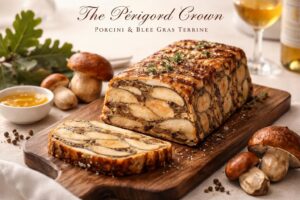
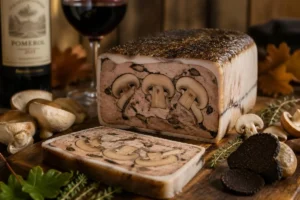
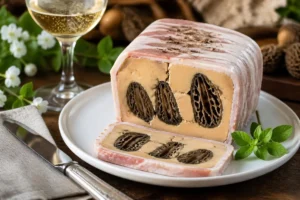
This architectural preparation utilizes the classic French terrine technique to create a molecularly dense mosaic, layering the intense, soil-driven aromatics of the Perigord black truffle with the delicate, lilac-hued floral profile of the Wood Blewit.
Perigord Black Truffle and Wood Blewit Terrine
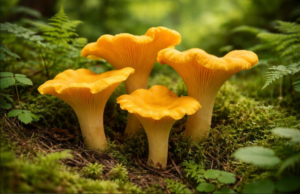
In the limestone-rich woodlands of the Perigord, the Clitocybe nuda serves as the perfect textural canvas for the region's "Black Diamond"—the truffle. This terrine is a study in mycological architecture. Historically, French nobility enjoyed chilled terrines as a way to showcase the rare finds of the autumn hunt. By layering the vibrant violet Wood Blewit with the dark, marble-patterned truffle, we create a dish that is visually arresting and scientifically complex, capturing the very soul of the Perigordian forest floor.
Prep Time
Cook Time
Complexity
Calories
Region
90 min
45 min
Grand Officier
260 kcal
Perigord, France
Master Recipe (1:10 Ratio)
The 1:10 ratio is applied to the truffle weight relative to the Wood Blewit to ensure a powerful but balanced aromatic infusion.
600g Fresh Clitocybe nuda (whole small caps)
60g Fresh Perigord Black Truffle (Tuber melanosporum)
400ml High-clarity poultry aspic (rich in natural gelatin)
100ml Dry white wine (Bergerac preferred for deglazing)
2 Shallots (micro-minced)
Fine sea salt and white pepper
Fresh chervil for garnish
The Technique
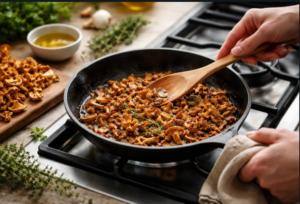
Gently poach the Clitocybe nuda caps in a small amount of white wine and butter until just tender. Use the Bergerac for Deglazing the pan to capture all fungal essences. Slice the truffle into paper-thin rounds using a mandoline. In a chilled terrine mold, begin the Structural Layering: a thin layer of aspic, followed by a mosaic of Wood Blewit caps and truffle slices. Repeat until the mold is filled. The mold is then placed in a Bain-marie (water bath) at 80°C for 45 minutes to encourage Thermal Infusion. Chill for at least 12 hours. This allow for the Crystallization of the collagen, locking the complex aromatics into a stable solid state.
Shop Integration
The luxurious, soil-driven profile of a Perigord terrine is the ultimate scientific partner for our premium Boletus edulis or the deep, smoky complexity of our Morchella conica. To create a regal mycological tasting menu, consider pairing the Wood Blewit with the delicate floral notes of our Cantharellus cibarius or the sophisticated almond-like sweetness of Marasmius oreades. Our Amanita caesarea and Craterellus cinereus provide the necessary structural variety to contrast the intense, earthy depth of the truffle-infused Wood Blewit.
The Umami Profile
This dish demonstrates "underground umami." The truffle provides a massive hit of 5′-ribonucleotides, which act as a catalyst for the glutamates already present in the Wood Blewit. When these compounds meet the gelatin-rich aspic, they create a "time-release" flavor profile. The initial taste is the floral lightness of the Wood Blewit, followed by a heavy, lingering wave of truffle umami that occupies the entire sensory field of the palate.
Sommelier’s Choice
A wine with "forest floor" notes and significant age is required. We recommend a Saint-Émilion Grand Cru (Merlot-dominant). Its velvety tannins and notes of truffle, plum, and damp earth echo the ingredients of the terrine perfectly, while its balanced acidity provides a clean finish to each rich, savory bite.
The Etymological Chronicle
In the Perigordian dialect (Occitan), the Wood Blewit is often called Camparòl blau. While the French name Pied-bleu is globally recognized, the English Blewit (blue-cap) remains a hallmark of historical foraging. In Germany, it is the Violetter Rötelritterling, and in Italy, the Agarico violetto. Each name pays tribute to the mushroom's noble lilac coloration, which stands in beautiful, stark contrast to the dark, mysterious depths of the black truffle.
Pure Umami | Mycological Research & Culinary Arts | 2026
To provide the best experiences, we use technologies like cookies to store and/or access device information. Consenting to these technologies will allow us to process data such as browsing behavior or unique IDs on this site. Not consenting or withdrawing consent, may adversely affect certain features and functions.
Functional
Always active
The technical storage or access is strictly necessary for the legitimate purpose of enabling the use of a specific service explicitly requested by the subscriber or user, or for the sole purpose of carrying out the transmission of a communication over an electronic communications network.
Preferences
The technical storage or access is necessary for the legitimate purpose of storing preferences that are not requested by the subscriber or user.
Statistics
The technical storage or access that is used exclusively for statistical purposes.The technical storage or access that is used exclusively for anonymous statistical purposes. Without a subpoena, voluntary compliance on the part of your Internet Service Provider, or additional records from a third party, information stored or retrieved for this purpose alone cannot usually be used to identify you.
Marketing
The technical storage or access is required to create user profiles to send advertising, or to track the user on a website or across several websites for similar marketing purposes.