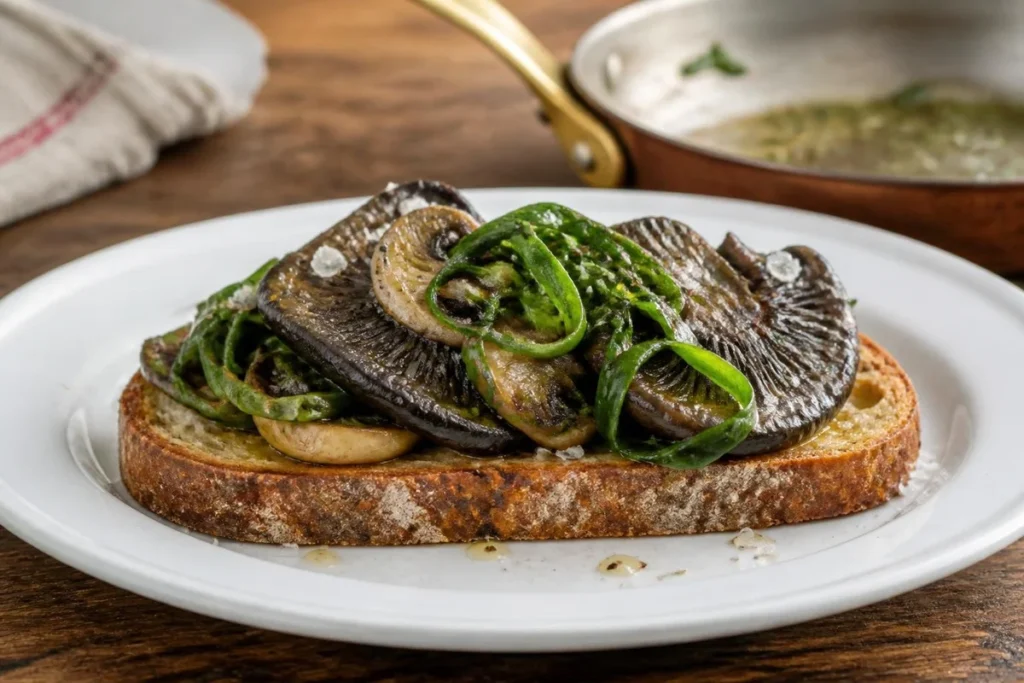
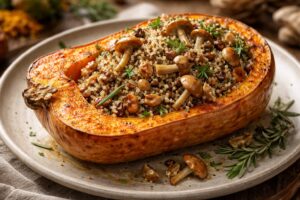
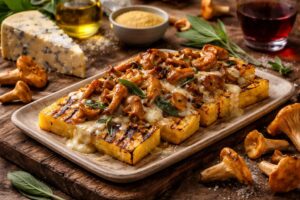
This preparation focuses on the contrast between the rustic crunch of sourdough and the silken, flexible gills of Russula cyanoxantha. By utilizing a gentle sauté with wild leeks (allium ursinum), the mushroom's mild hazelnut notes are brought to the foreground, creating a sophisticated open-faced composition that bridges the gap between traditional forest foraging and modern bistro elegance.
Charcoal Burner and Wild Leek Tartine
This preparation focuses on the contrast between the rustic crunch of sourdough and the silken, flexible gills of Russula cyanoxantha. By utilizing a gentle sauté with wild leeks (allium ursinum), the mushroom's mild hazelnut notes are brought to the foreground, creating a sophisticated open-faced composition that bridges the gap between traditional forest foraging and modern bistro elegance.
The Culinary Physics of This Dish
The Russula cyanoxantha provides a unique structural element to the Tartine; where other Russulas would crumble into small fragments upon contact with a knife, the Charcoal Burner's flexible lamellae allow for clean, vertical slices that remain perched atop the bread. This "mycological elasticity" ensures that the mushroom retains its internal moisture during the sauté, preventing the sourdough from becoming soggy while providing a "snap" that contrasts with the aerated, fermented crumb of the bread.
Terroir Narrative
This dish is an homage to the Vosges mountains in Eastern France, where the arrival of the Charcoal Burner in early summer coincides with the final harvest of wild forest leeks. In this border region between France and Germany, the "Charbonnier" is celebrated for its versatility. The Tartine represents a simplified, high-integrity version of a "casse-croûte"—the traditional snack of French foresters—reimagined through the lens of modern Parisian boulangerie culture.
Prep Time
Cook Time
Complexity
Calories
Region
15 Mins
8 Mins
Grand Officier
310 kcal
Vosges, France
Master Recipe (1:10 Rule)
400 g Russula cyanoxantha (Sliced into 1cm thick sections)
2 Large Slices Sourdough bread (Pain de Campagne)
50 g Wild leeks or Ramps (finely sliced)
30 g Beurre de Baratte (High-quality cultured butter)
10 ml Extra virgin walnut oil
5 g Flaky Fleur de Sel
1 g Freshly ground white pepper
The Technique
1. The Bread Base: Toast the sourdough slices until golden but still slightly soft in the center. Brush lightly with walnut oil to create a moisture barrier.
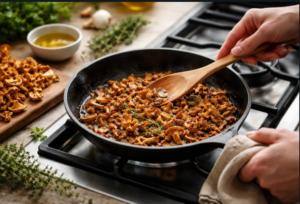
2. High-Tension Sauté: Heat the butter in a copper pan until it foams. Add the Russula cyanoxantha. Allow the caps to sear undisturbed for 3 minutes to achieve a caramelized exterior without breaking the gill structure.
3. Allium Infusion: Add the wild leeks during the final 90 seconds of cooking. They should wilt and become vibrant green, releasing their sulfurous aroma into the butter without browning.
4. Assembly: Mound the mushroom and leek mixture onto the toasted sourdough. Ensure the "Charbonnier" caps are facing upwards to showcase their iridescent violet-gray skin.
5. Seasoning: Finish with a generous pinch of Fleur de Sel and white pepper. The salt crystals provide a necessary crunch that mirrors the toasted bread.
6. Deglazing (Optional): If the pan has caramelized juices, add a teaspoon of water or white wine, swirl, and pour over the tartine for an extra boost of concentrated umami.
Shop Integration
The earthy simplicity of a mushroom tartine can be elevated by the treasures in our collection. For a more robust flavor, add a layer of sautéed Boletus edulis (Boletus edulis), or use the delicate Marasmius oreades (Marasmius oreades) to fill the gaps between the larger Charcoal Burner slices. For a royal touch, garnish with the vibrant Amanita caesarea (Amanita caesarea) or Cantharellus cibarius (Cantharellus cibarius). Our Craterellus cornucopioides (Craterellus cinereus) and Morchella (Morchella conica) are also excellent choices for those seeking a more complex, seasonal variation of this classic dish.
The Umami Profile
This dish relies on synergistic umami. The mushrooms provide free glutamic acid, while the sourdough fermentation process produces its own natural glutamates. The wild leeks contribute organosulfur compounds that act as aromatic amplifiers, making the mushroom's savory notes feel more intense and elongated on the palate.
Sommelier’s Choice
Alsace Pinot Gris: A wine with enough body and "smoke" to stand up to the earthy mushrooms, yet with a crisp acidity that refreshes the palate after each bite of buttery sourdough.
THE ETYMOLOGICAL CHRONICLE
French:Russule charbonnière – Named for the coal-like hues of its cap, a favorite among forest charcoal makers.
Italian:Colombina maggiore – Meaning "The Great Dove," referring to the gentle, soft-colored skin of the cap.
German:Frauentäubling – A poetic name meaning "Lady's Little Dove," signifying the mushroom's non-brittle, flexible nature.
Spanish:Carbonera – Associated with the soot and ash of the forest floor where its dark cap often blends in.
To provide the best experiences, we use technologies like cookies to store and/or access device information. Consenting to these technologies will allow us to process data such as browsing behavior or unique IDs on this site. Not consenting or withdrawing consent, may adversely affect certain features and functions.
Functional
Always active
The technical storage or access is strictly necessary for the legitimate purpose of enabling the use of a specific service explicitly requested by the subscriber or user, or for the sole purpose of carrying out the transmission of a communication over an electronic communications network.
Preferences
The technical storage or access is necessary for the legitimate purpose of storing preferences that are not requested by the subscriber or user.
Statistics
The technical storage or access that is used exclusively for statistical purposes.The technical storage or access that is used exclusively for anonymous statistical purposes. Without a subpoena, voluntary compliance on the part of your Internet Service Provider, or additional records from a third party, information stored or retrieved for this purpose alone cannot usually be used to identify you.
Marketing
The technical storage or access is required to create user profiles to send advertising, or to track the user on a website or across several websites for similar marketing purposes.