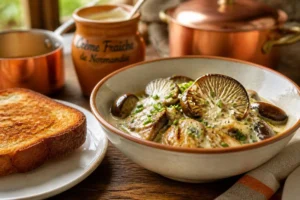
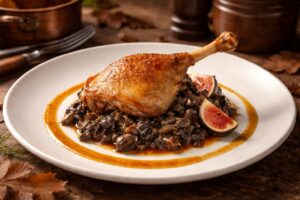
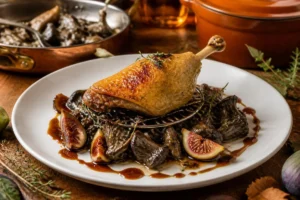
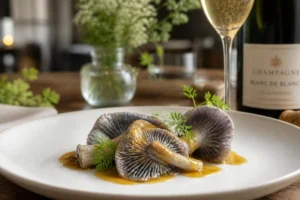
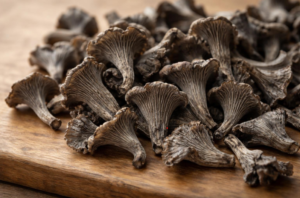
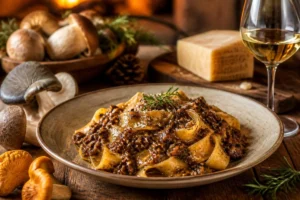
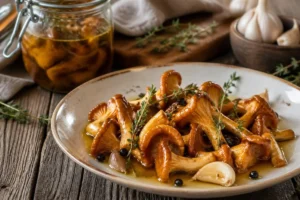
This technique employs low-temperature lipid poaching to saturate the flexible lamellae of Russula cyanoxantha with the rich, gamey essence of duck fat. By avoiding cellular agitation, the mushroom retains its structural elegance while undergoing a profound flavor transformation, resulting in a melt-in-the-mouth texture that is both decadent and technically precise.
Charcoal Burner Confit in Duck Fat
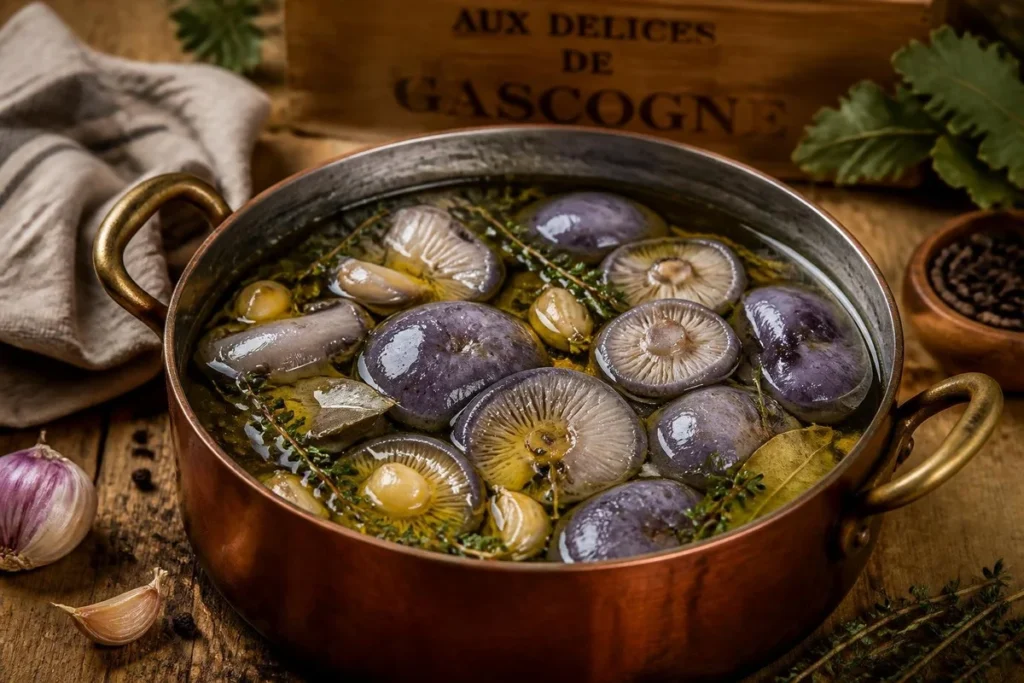
This technique employs low-temperature lipid poaching to saturate the flexible lamellae of Russula cyanoxantha with the rich, gamey essence of duck fat. By avoiding cellular agitation, the mushroom retains its structural elegance while undergoing a profound flavor transformation, resulting in a melt-in-the-mouth texture that is both decadent and technically precise.
The Culinary Physics of This Dish
The Russula cyanoxantha possesses a unique gill structure that does not shatter under pressure, making it the ideal candidate for Confit. At a sustained temperature of 85°C, the mushroom's moisture is slowly replaced by duck fat through a process of osmosis. This lipid-for-water exchange enhances the mouthfeel significantly. The duck fat acts as a flavor carrier, locking in the mushroom's volatile terpenes while adding its own complex fatty acids, creating a dense, silky texture that is impossible to achieve through standard sautéing.
Terroir Narrative
Drawing inspiration from the Gascony region of France, this dish celebrates the marriage of forest and farm. In the Southwest, duck fat (graisse de canard) is the primary culinary medium, used to preserve the harvest of the shifting seasons. The Charcoal Burner, found in the damp oak forests of the Pyrenees foothills, is a natural partner for the rich, pastoral notes of the duck. This is "slow food" in its purest form, reflecting a landscape where nothing is wasted and every ingredient is elevated through patience.
Prep Time
Cook Time
Complexity
Calories
Region
20 Mins
90 Mins
Grand Officier
340 kcal
Gascony, France
Master Recipe (1:10 Rule)
500 g Russula cyanoxantha (Whole small caps)
600 ml Pure rendered duck fat
3 Garlic cloves (smashed)
2 Sprigs of fresh thyme
1 Bay leaf
10 g Coarse sea salt
5 Black peppercorns
The Technique
1. Preparation: Clean the Russula cyanoxantha meticulously. Large caps should be halved, but small, "button" caps are best left whole to maximize the confit effect.
2. Temperature Control: In a heavy copper or ceramic pot, melt the duck fat until it reaches exactly 85°C. Use a digital thermometer to ensure it does not boil, as this would fry the mushrooms rather than poaching them.
3. Infusion: Add the garlic, thyme, bay leaf, and peppercorns to the fat. Let them infuse for 10 minutes before adding the mushrooms.
4. Submersion: Carefully add the mushrooms. They must be completely submerged. Place a piece of parchment paper (cartouche) over the surface to keep the mushrooms pressed into the fat.
5. The Poach: Place in an oven preheated to 90°C and cook for 90 minutes. The mushrooms should be tender but still hold their shape perfectly.
6. Finishing: Lift the mushrooms out with a slotted spoon. For a modern twist, flash-sear them in a hot pan for 30 seconds just before serving to add a crisp edge to the silken interior.
Shop Integration
While the Charcoal Burner thrives in a confit, our store provides an array of species that can complement this fatty, rich preparation. Pair with the robust Boletus edulis (Boletus edulis) for a classic forest medley, or contrast the richness with the sharp, peppery notes of Cantharellus cibarius (Cantharellus cibarius). For an aromatic boost, include our Marasmius oreades (Marasmius oreades). Our Amanita caesarea (Amanita caesarea) and Morchella (Morchella conica) are also available for those looking to recreate the most exclusive menus of the French Southwest. Don't miss the chance to try our Craterellus cornucopioides (Craterellus cinereus) for its unique smoky undertones.
The Umami Profile
This dish creates an Umami Synergism. The mushroom provides L-glutamate, while the slow-rendered duck fat contains inosinate. When combined, these compounds bind to the tongue's receptors more effectively than either could alone, resulting in a flavor intensity that is mathematically greater than the sum of its parts. The slow cooking also allows for the development of adipose-derived umami, where the fats themselves become seasoned by the mycological essence.
Sommelier’s Choice
Madiran (Sud-Ouest): A powerful red wine with high tannin levels. The tannins are essential to cut through the richness of the duck fat, while the dark fruit notes complement the earthy depth of the poached Russula.
THE ETYMOLOGICAL CHRONICLE
French:Russule charbonnière – Derived from the visual spectrum of "charbon" (coal), referencing the cap's unique coloration.
Italian:Colombina maggiore – Meaning "The Great Dove," referring to the gentle gray and violet hues of the species.
German:Frauentäubling – A name that honors the flexible, non-brittle nature of the mushroom, a rarity among the Russula genus.
Spanish:Carbonera – Literally "The Coal-Seller," a poetic nod to its smoky appearance in the wild.
To provide the best experiences, we use technologies like cookies to store and/or access device information. Consenting to these technologies will allow us to process data such as browsing behavior or unique IDs on this site. Not consenting or withdrawing consent, may adversely affect certain features and functions.
Functional
Always active
The technical storage or access is strictly necessary for the legitimate purpose of enabling the use of a specific service explicitly requested by the subscriber or user, or for the sole purpose of carrying out the transmission of a communication over an electronic communications network.
Preferences
The technical storage or access is necessary for the legitimate purpose of storing preferences that are not requested by the subscriber or user.
Statistics
The technical storage or access that is used exclusively for statistical purposes.The technical storage or access that is used exclusively for anonymous statistical purposes. Without a subpoena, voluntary compliance on the part of your Internet Service Provider, or additional records from a third party, information stored or retrieved for this purpose alone cannot usually be used to identify you.
Marketing
The technical storage or access is required to create user profiles to send advertising, or to track the user on a website or across several websites for similar marketing purposes.