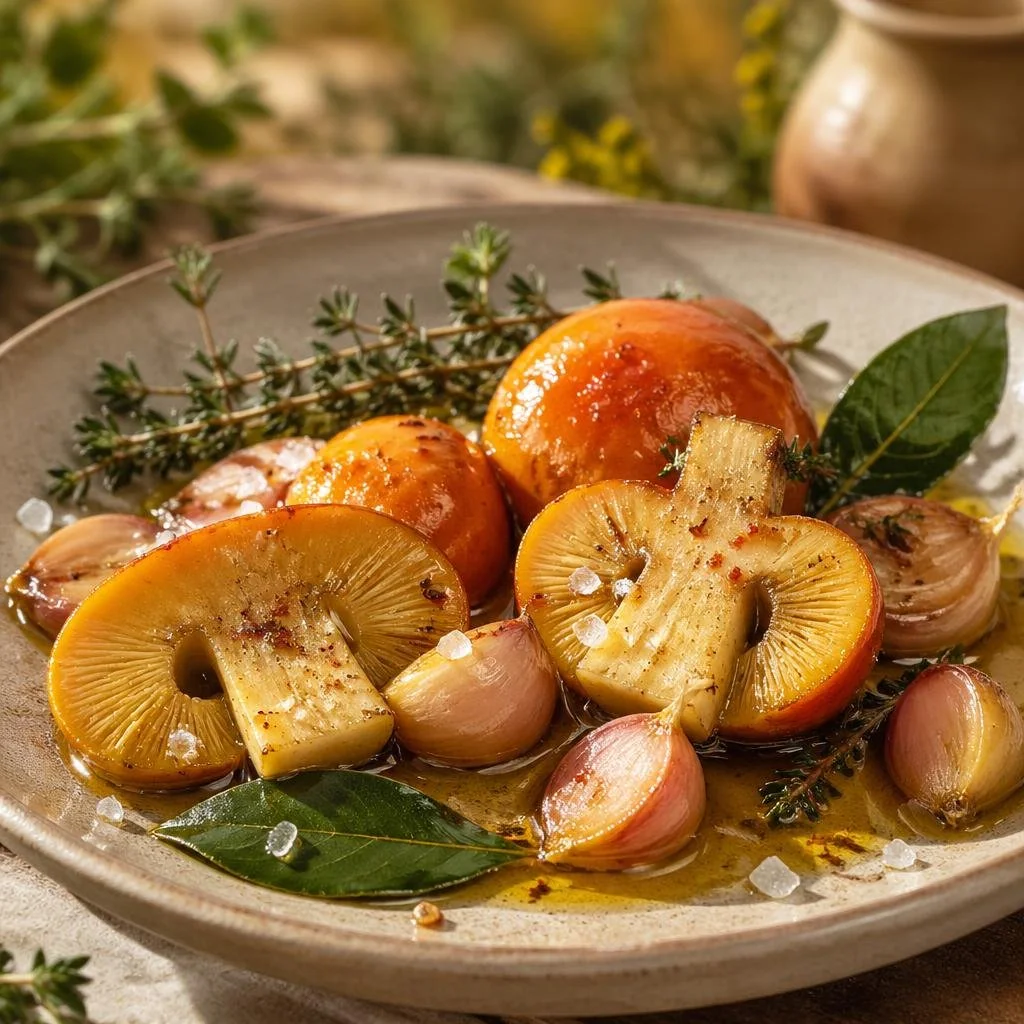
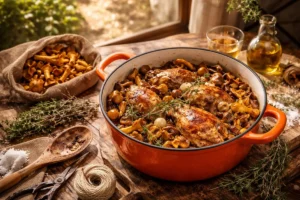
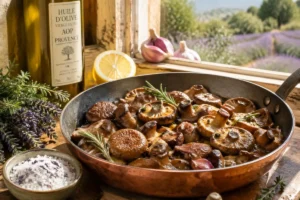
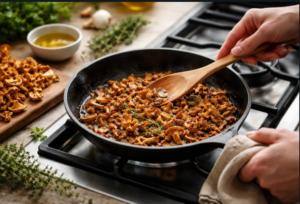
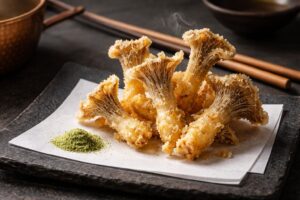
Immerse yourself in the rustic luxury of Southern France with this Amanita caesarea recipe, featuring slow-cooked garlic confit in golden olive oil. A masterclass in gentle aromatic extraction.
Languedoc Garlic Confit with Caesar Mushroom
Terroir Narrative
In the sun-baked garrigue of Languedoc, where the scent of wild thyme and rosemary hangs heavy in the Mediterranean breeze, the Amanita caesarea is the crown jewel of the late summer harvest. This recipe draws upon the region's ancient affinity for L'Ail Rose de Lautrec (pink garlic). By slow-cooking the garlic in local olive oil until it reaches a buttery consistency, we create a mellow, sweet foundation that supports rather than masks the delicate imperial mushroom. This dish is a dialogue between the sharpness of the earth and the silkiness of the forest.
The Culinary Physics of This Dish
The focus of this preparation is Allicin Transformation via low-temperature lipid submersion. Garlic contains sulfurous compounds that are sharp and pungent when raw. By poaching the cloves at a constant 80°C for 40 minutes, these molecules break down into allyl sulfides, providing a creamy, umami-rich sweetness. When the Amanita caesarea is added to this infused oil, the mushroom's hydrophilic proteins absorb the mellow garlic essence without the bitterness associated with high-heat sautéing, preserving the fungal "egg" aroma.
Quick Info Bar
Prep Time
10 Minutes
Cook Time
45 Minutes (Slow Confit)
Complexity
Grand Officier
Calories
225 kcal
Region
Languedoc, France
Master Recipe (1:10 Rule)
500g Amanita caesarea (Whole small caps or vertical halves)
100ml Languedoc Extra Virgin Olive Oil
10-12 Cloves of Pink Garlic (Lautrec AOP, peeled)
2 Fresh Bay Leaves
4g Fleur de Sel de Narbonne
1g Espelette Pepper (for a subtle finish)
The Technique (Technical Steps)
The Confit: Place the garlic cloves and olive oil in a small saucepan. Heat to 80°C and maintain for 35-40 minutes until the garlic is soft enough to spread like butter. Remove the cloves and set aside.
Infusion Phase: Add the bay leaves to the hot oil for 2 minutes to release their resinous oils.
Fungal Extraction: Increase the oil temperature slightly to 110°C. Add the Caesar mushrooms. Poach gently for 5-6 minutes, spooning the oil over the caps.
Integration: Return the garlic cloves to the pan. Use a fork to slightly crush two of the cloves into the oil to emulsify the sauce.
Finishing: Lift the mushrooms and garlic onto a warm plate. Season with Fleur de Sel and a dusting of Espelette pepper.
"In the Languedoc, we say garlic is the peasant's truffle, but with the Oronge, it becomes a king's ransom." — Southern French Culinary Oral History
Shop Integration
Low and slow cooking requires superior thermal conductivity. Discover our professional-grade French tin-lined copper saucepans and infusion kits at the [Pure Umami Store].
The Umami Secret
Slow-cooked garlic creates vinyldithiins, which act as flavor bridges to the mushroom's nucleotide chain. This synergy creates a deep, resonant umami that lingers far longer than a traditional sauté, effectively "tricking" the palate into perceiving a much richer, meatier dish.
Sommelier’s Choice
The garlic confit pairs exceptionally well with a white wine from Limoux (Chardonnay or Mauzac blend). Its slight oak influence and creamy texture mirror the buttery garlic and the mushroom's nutty profile.
The Etymological Chronicle: The Spanish “Amanita de los Césares”
In the formal mycological and academic circles of Spain, the mushroom is known with deep reverence as the Amanita de los Césares. While rural foragers might use Oronja or Ou de Reig, this full title is a linguistic monument to Spain's Roman heritage. In provinces like Extremadura and Andalusia—once the heart of Roman Hispania—the mushroom remains a symbol of imperial luxury. The name serves as a constant reminder that for over two millennia, this specific fungus has occupied the highest echelon of the culinary world, being the only Amanita species explicitly named to honor the absolute power of the Roman Emperors.
To provide the best experiences, we use technologies like cookies to store and/or access device information. Consenting to these technologies will allow us to process data such as browsing behavior or unique IDs on this site. Not consenting or withdrawing consent, may adversely affect certain features and functions.
Functional
Always active
The technical storage or access is strictly necessary for the legitimate purpose of enabling the use of a specific service explicitly requested by the subscriber or user, or for the sole purpose of carrying out the transmission of a communication over an electronic communications network.
Preferences
The technical storage or access is necessary for the legitimate purpose of storing preferences that are not requested by the subscriber or user.
Statistics
The technical storage or access that is used exclusively for statistical purposes.The technical storage or access that is used exclusively for anonymous statistical purposes. Without a subpoena, voluntary compliance on the part of your Internet Service Provider, or additional records from a third party, information stored or retrieved for this purpose alone cannot usually be used to identify you.
Marketing
The technical storage or access is required to create user profiles to send advertising, or to track the user on a website or across several websites for similar marketing purposes.