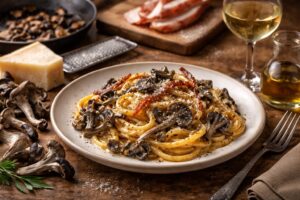
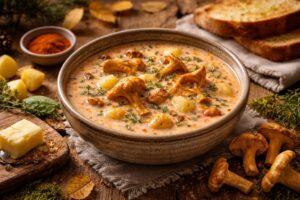
A technical study in Legume-Protein Synergy and Thermal Lipid Binding, utilizing the Parasol mushroom's fibrous context to simulate the structural integrity of Toulouse sausage, slow-braised within a high-starch bean matrix.
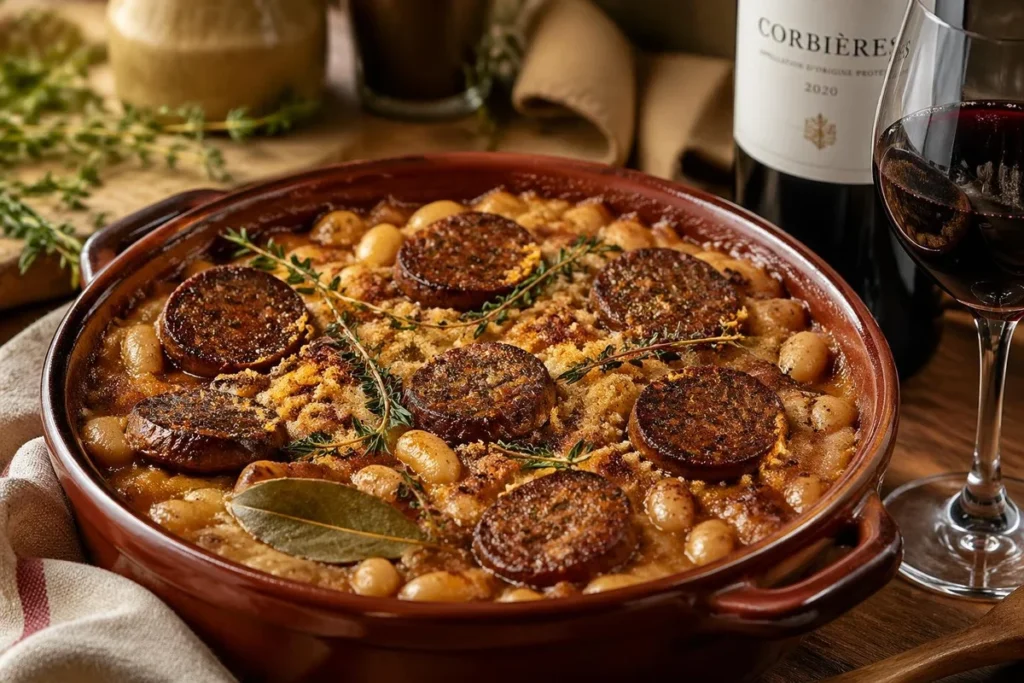
Languedoc Cassoulet with Parasol “Sausage” Medallions
For our eighty-seventh technical formulation, we analyze Fibrous Textural Emulation. Macrolepiota procera (Parasol Mushroom), locally known as Macrolepiota procera, is uniquely suited for meat-mimicry due to its resilient cap and stem fibers. At pure-umami.cc, we utilize the mushroom to engineer a plant-based alternative to the Saucisse de Toulouse. By compressing minced Parasol tissue with smoked paprika and garlic, and slow-braising the resulting "medallions" within a traditional white bean stew, we achieve a harmonic fusion where the mushroom absorbs the bean's earthy starches while contributing its own deep fungal umami to the broth.
The Culinary Physics of This Dish
The engineering of this Cassoulet relies on Starch Gelatinization and Mycelial Compression. Molecularly, the Haricot beans (lingot or tarbais) release amylose and amylopectin during the 3-hour simmer, creating a naturally thick, creamy suspension. The "Sausage" medallions utilize the Macrolepiota procera as a structural foundation. We use a Thermal Binding Technique: the minced mushroom is mixed with a small amount of vital wheat gluten or egg white and seared at high temperature to "lock" the protein matrix. During the subsequent braise, these medallions act as Flavor Sponges, drawing in the garlic, thyme, and bean-liquor through osmotic pressure, while maintaining a firm, "sausage-like" bite.
Terroir Narrative
This formulation is a tribute to the Languedoc region of Southern France, specifically the cities of Castelnaudary, Carcassonne, and Toulouse. We bridge this historic Occitan heritage with the Balkan highland meadows. The terroir is expressed through the marriage of the forest's "wild" Macrolepiota procera and the creamy, mineral-rich beans of the French southwest. This follows the same technical rigor we apply to our Boletus edulis (Porcini) and Cantharellus cibarius (Chanterelle), treating the slow-cooked stew as a vessel for complex, maturated savory profiles.
Fresh Thyme, Bay Leaf, and Duck Fat (or Olive Oil)
Fleur de Sel and Black Pepper
The Technique
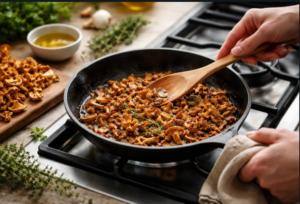
The "Sausage" Engineering: Mix the minced **Macrolepiota procera** with garlic, smoked paprika, fennel, and a binder. Form into thick medallions and sear in a hot pan until a dark, caramelized crust forms. This provides the Maillard Baseline for the stew.
The Bean Foundations: Simmer the soaked beans with the mirepoix, herbs, and stock. The temperature should remain at a gentle 90°C to ensure the beans soften without bursting—this is the technical requirement for Laminar Starch Release.
The Integration: Once the beans are tender (approx. 2 hours), place the Parasol medallions into the pot, nestling them into the bean matrix.
The Crust Formation: Sprinkle the top with breadcrumbs and a drizzle of fat. Bake uncovered at 150°C for another hour. Periodically break the crust and stir it back into the beans—this is the Traditional Seven-Fold Technique that builds the dish's legendary depth.
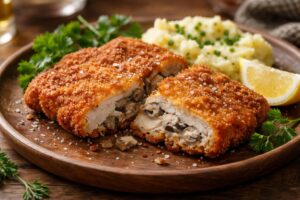
Service: Serve in the original earthenware pot (cassole). The crust should be dark and shatteringly crisp, contrasted by the creamy beans and the succulent, spicy Parasol "sausages."
Shop Integration
The Macrolepiota procera provides the essential fibrous volume, but its depth can be layered. We recommend adding a few whole dried Boletus edulis (Porcini) to the beans during the initial simmer for a "meatier" broth. If you seek a brighter peppery contrast, garnish with sautéed Cantharellus cibarius (Chanterelle). For a luxury upgrade, finish the cassoulet with Morchella conica (Morel) infused butter under the breadcrumb crust. If available, a side of raw Amanita caesarea (Caesar's mushroom) with lemon provides a necessary acidic break from the rich, starchy stew. For a smoky baseline, our Craterellus cinereus (Grey Chanterelle) can be minced and added to the initial mirepoix sauté.
The Umami Profile
This dish features **Slow-Phase Synergistic Umami**. The Macrolepiota procera provides guanylates, which are amplified by the long braising process. The Haricot beans provide a high concentration of glutamic acid, and the smoked paprika introduces a "synthetic" smoke-umami that mimics cured meats. The result is a savory experience that is exceptionally heavy and persistent, triggering the deep-tissue satiety receptors.
Sommelier’s Choice
A glass of **Corbières** or a bold **Minervois (Carignan/Syrah)**. The high tannins and dark fruit notes of these Languedoc reds are the technical requirement to cut through the starch and fat of the cassoulet and match the smoky, earthy Parasol medallions.
The Etymological Chronicle
The term Cassoulet is **French**, named after the cassole earthenware pot. In **Italian**, this would be a Cassoeula di Fagioli e Mazza di Tamburo. In **German**, it is Parasolpilz-Bohneneintopf. In **Spanish**, it is Cassoulet de Galamperna. Regardless of the language, the **Parasol mushroom** Cassoulet remains the definitive standard for technical slow-cooked legume-mycological fusion.
Pure Umami | Mycological Research & Culinary Arts | 2026
To provide the best experiences, we use technologies like cookies to store and/or access device information. Consenting to these technologies will allow us to process data such as browsing behavior or unique IDs on this site. Not consenting or withdrawing consent, may adversely affect certain features and functions.
Functional
Always active
The technical storage or access is strictly necessary for the legitimate purpose of enabling the use of a specific service explicitly requested by the subscriber or user, or for the sole purpose of carrying out the transmission of a communication over an electronic communications network.
Preferences
The technical storage or access is necessary for the legitimate purpose of storing preferences that are not requested by the subscriber or user.
Statistics
The technical storage or access that is used exclusively for statistical purposes.The technical storage or access that is used exclusively for anonymous statistical purposes. Without a subpoena, voluntary compliance on the part of your Internet Service Provider, or additional records from a third party, information stored or retrieved for this purpose alone cannot usually be used to identify you.
Marketing
The technical storage or access is required to create user profiles to send advertising, or to track the user on a website or across several websites for similar marketing purposes.