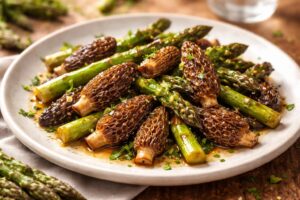
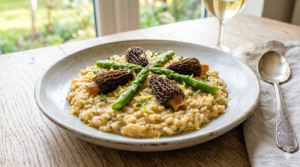
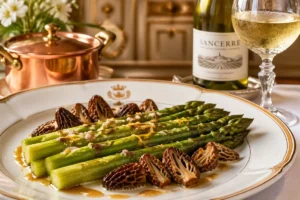
Description: Master this wild-harvested gourmet recipe. Tender spring asparagus topped with a warm King Morel vinaigrette—an umami-rich culinary masterpiece of forest and field.
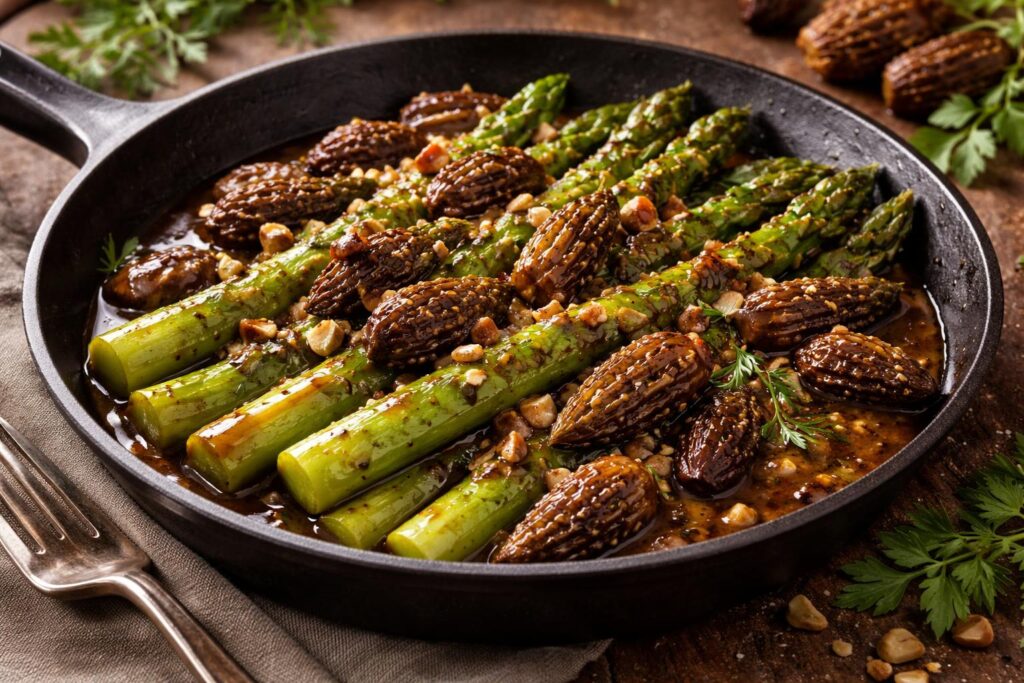
Pan-Roasted Asparagus with Morel Mushroom Vinaigrette
In the botanical calendar of the European wilderness, the appearance of Asparagus officinalis and Morchella (Morel) signals a brief, two-week window of peak gastronomic perfection. This dish is not a salad, but a warm, integrated vegetable course where the heat from the roasting pan is used to build a spontaneous emulsion. Historically, this pairing was celebrated in the riverside cottages of the Loire Valley, where the wild-harvested stalks and fungi were simply prepared to preserve their fleeting, delicate aromatics.
This wild-harvested recipe focuses on the interplay of two distinct forms of earthiness: the sulfurous, mineral snap of the asparagus and the smoky, leathery depth of the King Morel. By creating a warm vinaigrette directly in the pan, the morels release their rich, mahogany-colored juices, which are then bound by hazelnut oil and sherry vinegar. This technique ensures that the Morchella's intricate honeycomb structure is fully saturated with the dressing, turning every mushroom into a reservoir of concentrated forest essence.
Sensory & Foraging Profiles: The Hazelnut Bridge
The Morchella is often found in Mycorrhizal symbiosis with old ash trees, just as the asparagus begins to break through the loose, sandy soils of the riverbanks. The mushroom's profile is dominated by octenol, while the asparagus is rich in asparagustic acid. These two compounds share a chemical affinity that is unlocked by the addition of roasted nut oils, which act as a bridge between the mushroom's nuttiness and the vegetable's green bitterness.
Aroma & Texture: The aroma is a heady mix of toasted grain, wet stone, and woodsmoke. Texture-wise, the dish offers a satisfying "al dente" crunch from the roasted asparagus, contrasted by the soft, porous, and almost meat-like resilience of the sautéed morels.
Microbiology: From a microbiological perspective, wild morels contain a high concentration of ergothioneine, a powerful antioxidant that remains stable under high heat. When pan-roasted with asparagus—a natural source of glutathione—they create a nutrient-dense pairing that supports liver function and cellular health. The lipids in the vinaigrette ensure that the fat-soluble Vitamin D and Vitamin K in the ingredients are fully bioavailable.
The Master Recipe: Asparagus & Morel Vinaigrette
Ingredients
200g Wild-Harvested Morchella (cleaned and halved)
500g Fresh Asparagus (medium thickness)
3 tablespoons Roasted Hazelnut Oil (or Extra Virgin Olive Oil)
1 tablespoon Sherry Vinegar
1 small Shallot, finely minced
1 tablespoon fresh Chervil or Tarragon, chopped
Sea Salt and Pink Peppercorns
Toasted Hazelnuts, crushed (for garnish)
Culinary Steps
The Roast: Toss the asparagus with one tablespoon of oil and a pinch of salt. Roast in a hot cast-iron skillet over medium-high heat for 6-8 minutes, turning occasionally until slightly charred but still crisp. Remove to a warm plate.
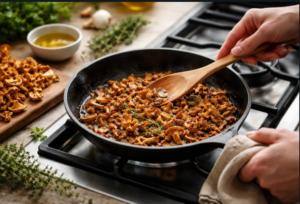
The Mushroom Sauté: In the same skillet, add the remaining oil and the Morchella. Sauté for 5 minutes until the morels develop a golden, nutty exterior. Add the shallots and cook for another minute.
The Emulsion: Turn off the heat. Immediately whisk in the sherry vinegar. The vinegar will deglaze the pan and mix with the mushroom juices and oil to form a warm, thickened vinaigrette.
The Infusion: Add the fresh herbs and pink peppercorns to the pan, swirling to combine.
Assembly: Pour the warm morels and vinaigrette over the roasted asparagus. Garnish with crushed hazelnuts for extra texture.
Pro Technique: The “Residual Heat” Emulsion
The secret to this gourmet vinaigrette is the "pan-mounting" technique. By adding the vinegar only after the heat is turned off, you prevent it from evaporating too quickly. Instead, it captures the chitin-rich extracts and fats from the Morchella, creating a stable, silky glaze that is much more flavorful than a cold dressing. This method preserves the delicate, volatile aromas of the wild mushrooms.
The Umami Secret: Acidity and Glutamate Magnification
The L-Glutamate levels in Morchella are naturally high, but our perception of them is heightened in an acidic environment. The acetic acid in the sherry vinegar acts as a taste receptor stimulant, making the morel's umami profile appear twice as intense. When combined with the mineral salts in the asparagus, the resulting flavor is a "high-resolution" experience of the forest's savory potential.
The Art of the Pairing
Asparagus is notoriously difficult to pair with wine, but the earthy morels provide a bridge. A Grüner Veltliner from Austria is the classic choice; its white pepper notes and racy acidity match both the mushroom and the vegetable. For a non-alcoholic pairing, chilled cucumber water with a sprig of mint offers a refreshing, vegetal contrast that cleanses the palate between bites of the rich vinaigrette.
Ancestral Nutrition
This dish is a powerhouse of Vitamin K, Folate, and Vitamin D2. Historically, these spring ephemerals were the primary source of nutrition to "reawaken" the body's digestive system. The prebiotic fibers in the asparagus support the gut microbiome, while the trace minerals in the Morchella replenish the stores depleted during the winter months.
The Morel Lexicon: Regional Names for Morchella
The Morel is the undisputed queen of the spring forest. Its honeycomb structure and deep earthy aroma have earned it legendary status in cuisines from the Himalayas to the Appalachian Mountains:
Language
Regional & Folk Names
Cultural Context
English
Morel, Yellow Morel, Sponge Mushroom, Dryland Fish
"Dryland fish" is a popular folk name in the American South.
French
Morille, Morille blonde, Morille ronde
A staple of classic French haute cuisine.
German
Speisemorchel, Rund-Morchel
Highly valued in Alpine culinary traditions.
Bulgarian
Смърчкула, Пумпалка, Корминка, Мрежовка
"Pumpalka" refers to its spinning-top shape.
Romanian
Zbârciog, Ciuciulete, Попеască
"Zbârciog" is the most common term in Romanian folklore.
Russian / Polish
Сморчок (Smorchok) / Smardz jadalny
Considered a sign of the real spring's arrival.
Italian / Spanish
Spugnola / Colmenilla, Morilla
"Spugnola" (Italy) and "Colmenilla" (Spain) refer to the sponge/honeycomb look.
Turkish
Kuzu Göbeği Mantarı
Literally "Lamb's Belly" mushroom, a gourmet export of Turkey.
Japanese / Chinese
Amigasa-take (アミガサタケ) / Yangdujun
In China, it is highly valued for its medicinal properties.
Nordic (SE/NO/DK)
Toppmurkla / Rund morkel
A highly anticipated spring find in Scandinavia.
Scientific identification: Genus: Morchella | Pure Umami Research 2026
To provide the best experiences, we use technologies like cookies to store and/or access device information. Consenting to these technologies will allow us to process data such as browsing behavior or unique IDs on this site. Not consenting or withdrawing consent, may adversely affect certain features and functions.
Functional
Always active
The technical storage or access is strictly necessary for the legitimate purpose of enabling the use of a specific service explicitly requested by the subscriber or user, or for the sole purpose of carrying out the transmission of a communication over an electronic communications network.
Preferences
The technical storage or access is necessary for the legitimate purpose of storing preferences that are not requested by the subscriber or user.
Statistics
The technical storage or access that is used exclusively for statistical purposes.The technical storage or access that is used exclusively for anonymous statistical purposes. Without a subpoena, voluntary compliance on the part of your Internet Service Provider, or additional records from a third party, information stored or retrieved for this purpose alone cannot usually be used to identify you.
Marketing
The technical storage or access is required to create user profiles to send advertising, or to track the user on a website or across several websites for similar marketing purposes.