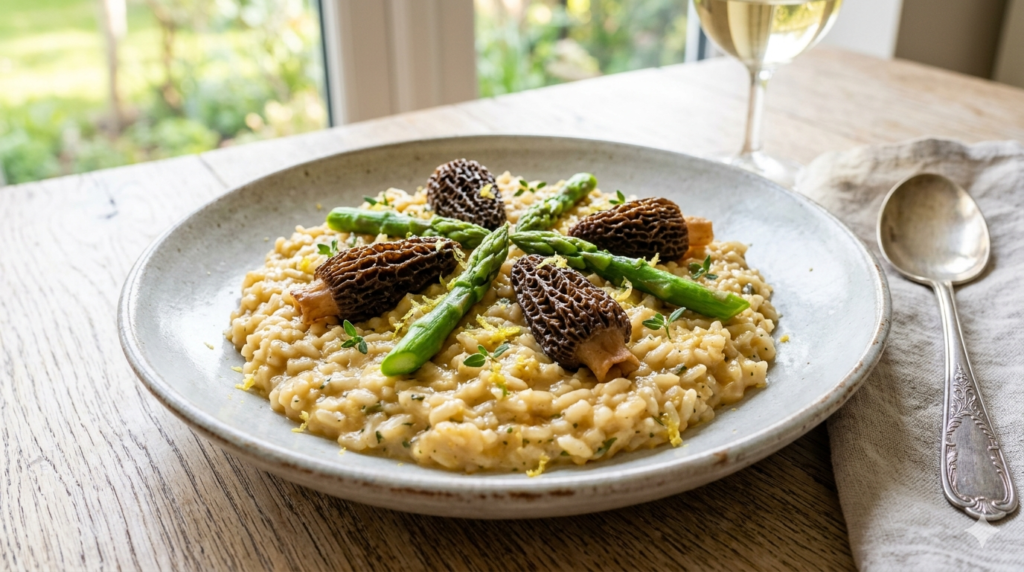
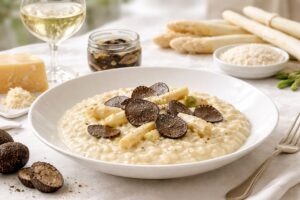
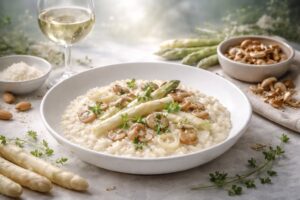
A sophisticated plant-based masterpiece pairing the honeycombed Morchella with the crisp vibrancy of spring asparagus, bound in a creamy, starch-rich emulsion.
The Vernal Earth Feast
Wild Morels and Young Asparagus in a Silken Pine-Nut and Miso Mantecatura
The Historical Prelude
The Morchella (Morel) and Asparagus officinalis are the twin heralds of the Western European spring, historically appearing in the damp clearings of the Black Forest and the Atlantic Fringes simultaneously. In the 18th-century royal gardens of the French Alps, asparagus was known as "the ivory spear," a vegetable so prized for its delicacy that it was often reserved for the tables of the aristocracy.
The evolution of a vegan gourmet risotto represents a modern refinement of the Cucina Povera luxury found in the Dolomites. Historically, when dairy was scarce in high-altitude monastic retreats, chefs utilized the natural starch of Carnaroli rice and the richness of pressed nut oils to create an emulsion that rivaled the creaminess of butter. By pairing the smoky, nut-like depth of the morel with the mineral-rich "snap" of the asparagus, this dish bridges the gap between the dark forest floor and the sun-drenched garden.
The challenge of a vegan risotto is achieving the Mantecatura (the creamy finish) without animal fats. Our philosophy focuses on Starch Manipulation and Lipid Substitution. We utilize the amylopectin released during the slow agitation of the rice, bound with a molecular emulsion of white miso and cold-pressed olive oil, to mimic the mouthfeel of traditional dairy-based risottos.
Sensory & Foraging Profile
Nomenclature:Morchella esculenta (Yellow Morel) and Asparagus officinalis (Green Asparagus).
Terroir: The finest morels for this preparation are found in the Pyrenees or the French Savoie, where the limestone-rich soil adds a distinct flinty mineral note to the mushroom's profile. The asparagus should be sourced from the same terroir to ensure a unified "flavor memory."
Professional Protocol: We adhere to the "Hollow-Core Inspection." Every morel is halved to verify its pristine internal cavity. In accordance with "Leave No Trace" ethics, we only harvest morels that have already reached maturity, ensuring the sporal load has been released back into the soil.
Essential Equipment
Heavy Copper Risottiera: For perfect heat conductivity and even starch release.
Fine Mesh Sieve: For clarifying the mushroom rehydration nectar.
Wooden "Girorisotto" Spoon: To aerate the rice without damaging the delicate grains.
Master Recipe
Stage 1: The Aromatic Restoration
40g Dried Wild Morels (The mandatory equivalent of 400g Fresh Morels).
Rehydrate the 40g Dried Morels (400g fresh equivalent) in 400ml of warm spring water for 30 minutes.
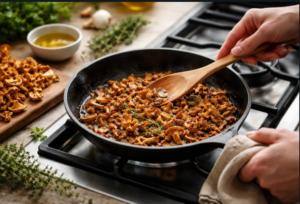
Remove the mushrooms, squeeze gently, and filter the liquid through a coffee filter. This liquid is your "Morel Nectar."
Stage 2: The Tostatura & Infusion
Toast 320g of Carnaroli rice in a dry pan until hot.
Deglaze with 100ml of dry white wine (preferably a Chablis). Once evaporated, begin adding a mixture of simmering vegetable stock and your "Morel Nectar" one ladle at a time.
At the 10-minute mark, add 200g of asparagus tips (sliced on a bias).
Stage 3: The Vegan Mantecatura
Once the rice is al dente, remove from heat.
Vigorously beat in 40ml of cold-pressed extra virgin olive oil and 1 teaspoon of white miso paste dissolved in a little warm stock.
Fold in the sautéed morels and a handful of nutritional yeast for an additional umami layer.
The Umami Secret: The 1:10 Molecular Extraction
The "Pure Umami" experience is achieved through the 1:10 Molecular Extraction. Dried morels contain ten times the density of guanylates compared to fresh. By using the filtered rehydration nectar to cook the rice, you are infusing the very core of the grain with the mushroom's DNA. When this guanylate meets the glutamates in the miso, the savory perception is increased exponentially, providing a deep, meat-like finish that is entirely plant-based.
Pro Technique: The “Asparagus Peel” Stock
To deepen the spring flavor, don't discard the woody ends of the asparagus. Simmer them in your vegetable stock for 15 minutes before starting the risotto. This "Ghost Infusion" ensures that the essence of the asparagus permeates the entire dish, not just the bites containing the tips.
The Art of Pairing
Sommelier's Choice: A dry Sancerre or a Sauvignon Blanc from the Loire Valley. The wine's herbal, grassy notes are a mirror image of the asparagus, while its mineral acidity cuts through the richness of the risotto.
Non-Alcoholic: A chilled infusion of green apple and cucumber, providing a crisp, vegetal counterpoint.
Ancestral Nutrition
Morels are an exceptional source of Iron and Vitamin D, while asparagus provides Folic Acid and Fiber. Historically, in the **French Savoie**, this combination was considered the "Spring Tonic," served to restore mineral levels and "purify the blood" after the dormant winter months.
Micro-FAQ
Q: Why is the 1:10 ratio so important for vegan risotto? A: Without the fat of butter or cheese, you rely entirely on the intensity of the mushroom. 40g of dried morels provide the aromatic weight of 400g of fresh ones, ensuring the dish feels "heavy" and satisfying without animal products.
Q: Can I use regular garlic? A: Yes, but use it sparingly and ensure it is roasted or sautéed until very soft. Raw garlic can easily overpower the delicate hazelnut notes of the Morchella.
The Morel Lexicon: Regional Names for Morchella
The Morel is the undisputed queen of the spring forest. Its honeycomb structure and deep earthy aroma have earned it legendary status in cuisines from the Himalayas to the Appalachian Mountains:
Language
Regional & Folk Names
Cultural Context
English
Morel, Yellow Morel, Sponge Mushroom, Dryland Fish
"Dryland fish" is a popular folk name in the American South.
French
Morille, Morille blonde, Morille ronde
A staple of classic French haute cuisine.
German
Speisemorchel, Rund-Morchel
Highly valued in Alpine culinary traditions.
Bulgarian
Смърчкула, Пумпалка, Корминка, Мрежовка
"Pumpalka" refers to its spinning-top shape.
Romanian
Zbârciog, Ciuciulete, Попеască
"Zbârciog" is the most common term in Romanian folklore.
Russian / Polish
Сморчок (Smorchok) / Smardz jadalny
Considered a sign of the real spring's arrival.
Italian / Spanish
Spugnola / Colmenilla, Morilla
"Spugnola" (Italy) and "Colmenilla" (Spain) refer to the sponge/honeycomb look.
Turkish
Kuzu Göbeği Mantarı
Literally "Lamb's Belly" mushroom, a gourmet export of Turkey.
Japanese / Chinese
Amigasa-take (アミガサタケ) / Yangdujun
In China, it is highly valued for its medicinal properties.
Nordic (SE/NO/DK)
Toppmurkla / Rund morkel
A highly anticipated spring find in Scandinavia.
Scientific identification: Genus: Morchella | Pure Umami Research 2026
To provide the best experiences, we use technologies like cookies to store and/or access device information. Consenting to these technologies will allow us to process data such as browsing behavior or unique IDs on this site. Not consenting or withdrawing consent, may adversely affect certain features and functions.
Functional
Always active
The technical storage or access is strictly necessary for the legitimate purpose of enabling the use of a specific service explicitly requested by the subscriber or user, or for the sole purpose of carrying out the transmission of a communication over an electronic communications network.
Preferences
The technical storage or access is necessary for the legitimate purpose of storing preferences that are not requested by the subscriber or user.
Statistics
The technical storage or access that is used exclusively for statistical purposes.The technical storage or access that is used exclusively for anonymous statistical purposes. Without a subpoena, voluntary compliance on the part of your Internet Service Provider, or additional records from a third party, information stored or retrieved for this purpose alone cannot usually be used to identify you.
Marketing
The technical storage or access is required to create user profiles to send advertising, or to track the user on a website or across several websites for similar marketing purposes.