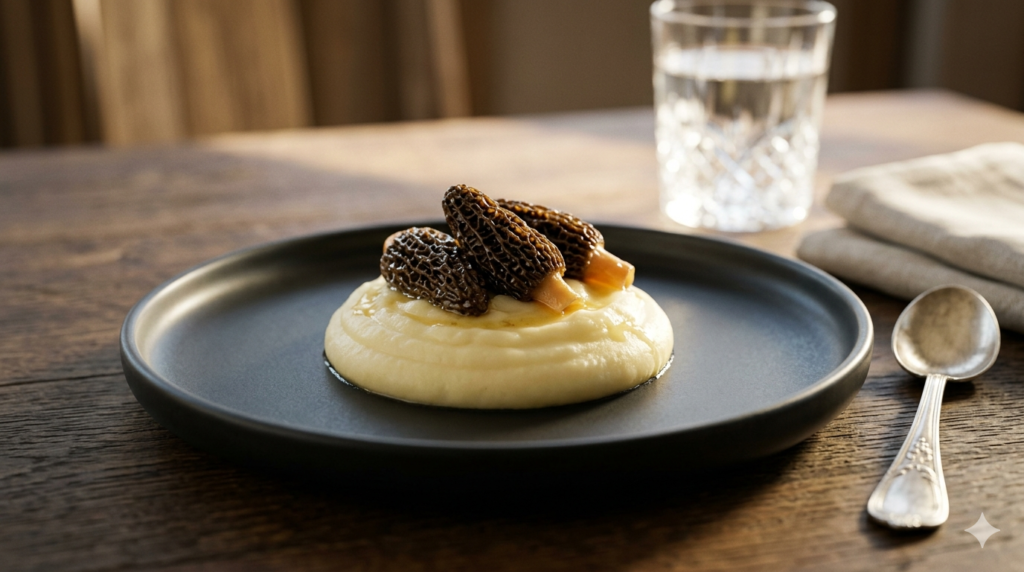
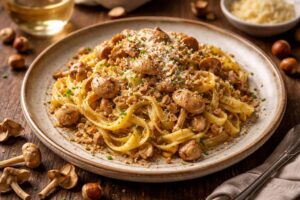
An ethereal, velvet-textured homage to Joël Robuchon's legendary Pommes Purée, infused with the prestigious, smoky depth of the Morchella.
The Velvet Morchella Cloud
Robuchon-Inspired Potato Purée with Wild Spring Morels and Beurre Noisette
The Historical Prelude
The Robuchon-Style Purée is arguably the most famous potato dish in culinary history. Perfected by the "Chef of the Century," Joël Robuchon, at his restaurant Jamin in Paris, it transformed the humble potato from a rustic side dish into a three-star Michelin masterpiece. Robuchon's secret was a 2:1 ratio of potatoes to butter and an obsessive commitment to the Passe-Vite (food mill) and fine-mesh sieve.
The integration of Morchella (Morel) into this silken canvas is a tribute to the terroir of the French Savoie. In the high-altitude dining rooms of the French Alps, the earthy, nut-like volatiles of the morel are used to provide a "dark" counterpoint to the lactic sweetness of the butter-heavy purée. Historically, this dish was served as a standalone course—a "Silky Umami Cloud" that represented the pinnacle of French technical precision and the untamed luxury of the spring forest.
The objective is Molecular Emulsification. We do not "mash" the potato; we suspend its starch cells in a sea of high-fat cultured butter. The morels are treated using the Lipid Infusion method—sautéed until they reach the Beurre Noisette (brown butter) stage, ensuring their smoky essence is physically bonded to the fats that will later emulsify the purée.
Sensory & Foraging Profile
Nomenclature:Morchella esculenta (Yellow Morel) and Solanum tuberosum (Ratte or Yukon Gold Potatoes).
Terroir: The finest morels for this purée are sourced from the Black Forest or the Atlantic Fringes, where the soil produces mushrooms with a high mineral density. The potatoes must be waxy and starch-rich, traditionally the Ratte de Touraine, known for its chestnut-like flavor.
Professional Protocol: We adhere to the "Hollow-Core Inspection." Every morel is halved to verify its pristine internal cavity. In accordance with "Leave No Trace" ethics, we only harvest morels into mesh-vented baskets to allow spores to fall back into the soil as we move through the clearings.
Essential Equipment
Moulin à Légumes (Food Mill): With the finest disk to aerate the potato without making it "gluey."
Tamins (Fine Mesh Sieve): For the final pass to achieve a 3-star Michelin texture.
Heavy Copper Pan: For drying the potato mash and preparing the morel-butter emulsion.
Master Recipe
Stage 1: The Potato Foundation
1kg Ratte or Yukon Gold potatoes, boiled in their skins in highly salted water.
Peel while hot and pass through the food mill into a heavy copper pan.
The "Drying" Stage: Stir the mash over medium heat for 5 minutes to remove all residual moisture. This is critical for maximizing butter absorption.
If using 30g Dried (300g Fresh equivalent), rehydrate in warm whole milk and reserve.
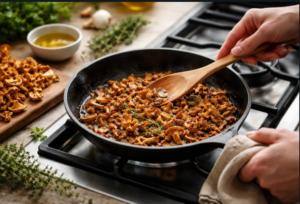
Sauté the morels in 250g of high-quality cultured butter until the butter browns (Beurre Noisette) and smells of toasted hazelnuts. Strain the butter and reserve the morels for garnish.
Stage 3: The Final Marriage
Slowly whisk the Morel-infused brown butter into the dried potato mash in small batches.
Add 200ml of hot whole milk (or the morel-rehydration milk) until the purée is light and airy.
Pass the entire purée through a fine-mesh Tamins sieve.
Fold in the sautéed morels and serve immediately in a pre-warmed bowl.
The Umami Secret: The 1:10 Lipid Synergy
The "Pure Umami" of this dish is achieved through the 1:10 Lipid Infusion. Dried morels contain ten times the density of flavor compounds compared to fresh ones. By rehydrating 30g of dried morels in the milk used for the purée and sautéing them in the butter, you are saturating the fats with guanylates. When these bond with the glutamates naturally found in the potato and butter, the savory profile is magnified, creating a "long" finish that coats the entire palate.
Pro Technique: The “Sieve Pressure”
To achieve the Robuchon texture, do not just let the purée fall through the sieve. Use a plastic scraper to push it through with force. This breaks down the starch molecules at a microscopic level, ensuring a texture that is closer to a custard or a cloud than a traditional mash.
The Art of Pairing
Sommelier's Choice: A vintage Champagne or a Chardonnay from Burgundy (Meursault). The wine's lactic and toasted-brioche notes are a structural mirror to the butter and morels.
Non-Alcoholic: A warm infusion of toasted barley and a whisper of smoked salt.
Ancestral Nutrition
Morels are an exceptional source of Iron and Vitamin D, while potatoes provide high levels of Potassium. Historically, in the French Savoie, this "Rich Mash" was served to restore energy and vitality after the long, calorie-deficient winter months in the high mountains.
Micro-FAQ
Q: Why is the 1:10 ratio critical for this purée? A: Because 30g of dried morels provides the exact aromatic intensity of 300g of fresh ones, but without the excess moisture that would break the delicate starch-butter emulsion of the purée.
Q: Can I use a food processor? A: Absolutely not. The high-speed blades of a processor will turn the potato starch into a sticky, elastic "glue." Only a manual food mill or sieve can achieve the Robuchon cloud texture.
The Morel Lexicon: Regional Names for Morchella
The Morel is the undisputed queen of the spring forest. Its honeycomb structure and deep earthy aroma have earned it legendary status in cuisines from the Himalayas to the Appalachian Mountains:
Language
Regional & Folk Names
Cultural Context
English
Morel, Yellow Morel, Sponge Mushroom, Dryland Fish
"Dryland fish" is a popular folk name in the American South.
French
Morille, Morille blonde, Morille ronde
A staple of classic French haute cuisine.
German
Speisemorchel, Rund-Morchel
Highly valued in Alpine culinary traditions.
Bulgarian
Смърчкула, Пумпалка, Корминка, Мрежовка
"Pumpalka" refers to its spinning-top shape.
Romanian
Zbârciog, Ciuciulete, Попеască
"Zbârciog" is the most common term in Romanian folklore.
Russian / Polish
Сморчок (Smorchok) / Smardz jadalny
Considered a sign of the real spring's arrival.
Italian / Spanish
Spugnola / Colmenilla, Morilla
"Spugnola" (Italy) and "Colmenilla" (Spain) refer to the sponge/honeycomb look.
Turkish
Kuzu Göbeği Mantarı
Literally "Lamb's Belly" mushroom, a gourmet export of Turkey.
Japanese / Chinese
Amigasa-take (アミガサタケ) / Yangdujun
In China, it is highly valued for its medicinal properties.
Nordic (SE/NO/DK)
Toppmurkla / Rund morkel
A highly anticipated spring find in Scandinavia.
Scientific identification: Genus: Morchella | Pure Umami Research 2026
To provide the best experiences, we use technologies like cookies to store and/or access device information. Consenting to these technologies will allow us to process data such as browsing behavior or unique IDs on this site. Not consenting or withdrawing consent, may adversely affect certain features and functions.
Functional
Always active
The technical storage or access is strictly necessary for the legitimate purpose of enabling the use of a specific service explicitly requested by the subscriber or user, or for the sole purpose of carrying out the transmission of a communication over an electronic communications network.
Preferences
The technical storage or access is necessary for the legitimate purpose of storing preferences that are not requested by the subscriber or user.
Statistics
The technical storage or access that is used exclusively for statistical purposes.The technical storage or access that is used exclusively for anonymous statistical purposes. Without a subpoena, voluntary compliance on the part of your Internet Service Provider, or additional records from a third party, information stored or retrieved for this purpose alone cannot usually be used to identify you.
Marketing
The technical storage or access is required to create user profiles to send advertising, or to track the user on a website or across several websites for similar marketing purposes.