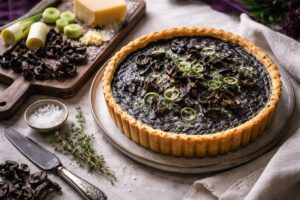
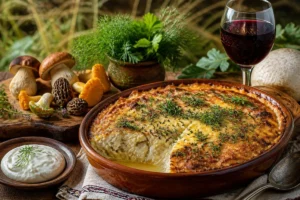
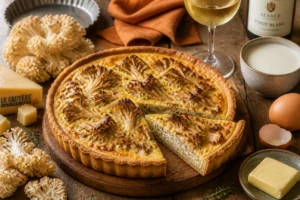
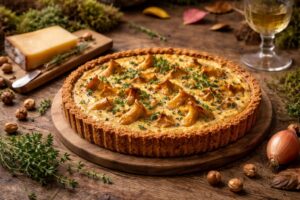
Description: Master this wild-harvested gourmet recipe. A delicate, savory King Morel custard topped with a crisp Parmesan tuile—an umami-rich culinary masterpiece of modern mycophagy.
In the evolution of European mycological cuisine, there comes a point where the rustic nature of the forage meets the precision of the laboratory. The Morel Mushroom Flan represents this zenith. Historically, savory custards were a staple of medieval banquet tables, but the integration of the Morchella (Morel) transforms a humble egg dish into an ethereal experience. Unlike a sauté or a stew, the flan format allows the mushroom's volatile aromatics to be captured and suspended within a delicate protein matrix, ensuring that none of the elusive forest "perfume" escapes.
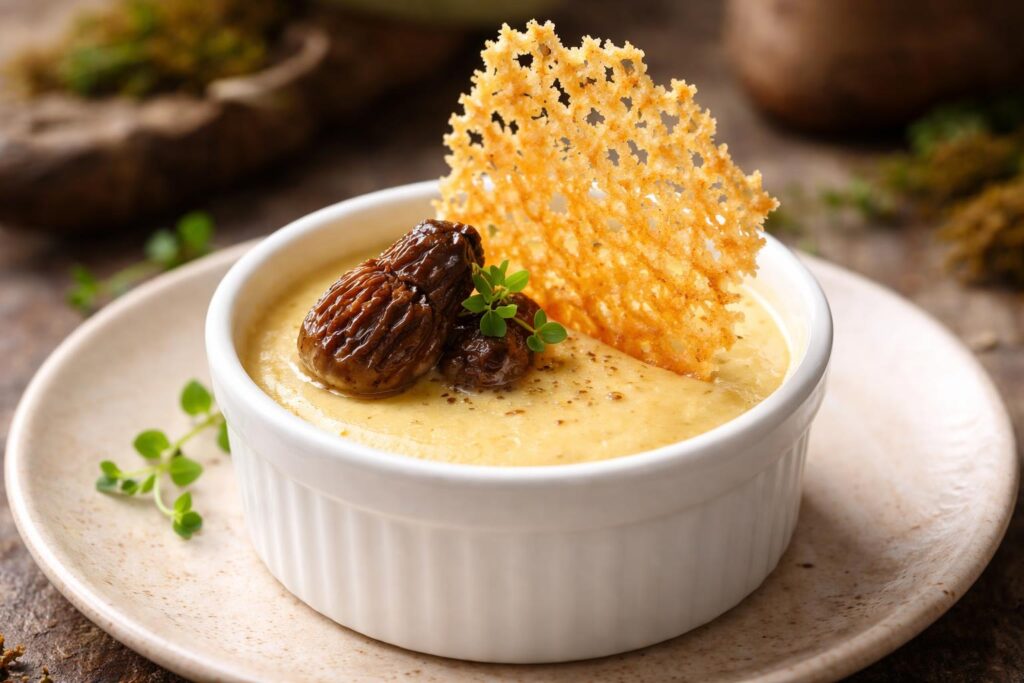
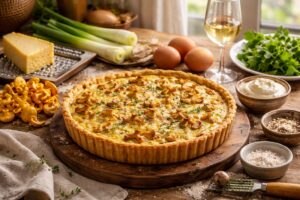
This wild-harvested masterpiece is a study in structural contrast. The flan itself is nearly liquid—a silken, creamy cloud infused with the smoky essence of the King Morel. Crowning this is the Parmesan Tuile, a razor-thin, crystalline lattice of aged cheese that provides the necessary salt and "snap" to break the custard's tension. This is a dish for the connoisseur, designed to showcase the Morchella's unique ability to dominate a dish not through bulk, but through molecular intensity.
Sensory & Foraging Profiles: The Spore and the Scale
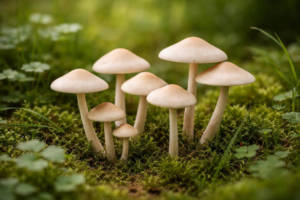
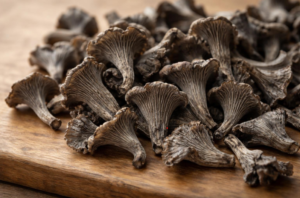
The Morchella is a biologically enigmatic fungus, often found in Mycorrhizal symbiosis with distressed trees or in the calcium-rich soils of the Balkan highlands. This environmental stress concentrates its flavor compounds, particularly benzaldehyde and furfural, which provide the mushroom's signature almond-like nuttiness and toasted wood aroma.
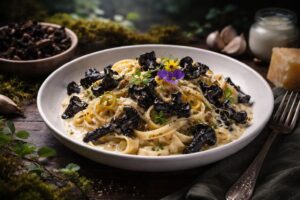
Aroma & Texture: The aroma is a sophisticated layering of warm milk, roasted chestnuts, and damp moss. The texture is the primary focus: a "melt-in-the-mouth" custard that carries the particulate, slightly grainy texture of finely minced morels, finished with the sharp, brittle crunch of the tuile.
Microbiology: From a microbiological perspective, morels are rich in chitin and nucleotides. In this flan, we use a slow-infusion method where the morels are steeped in warm cream. This process allows the L-glutamates to migrate from the mushroom's cell walls into the liquid lipids of the cream. The resulting infusion is a chemical "blueprint" of the forest, which is then thermally locked into place during the gentle baking process.
The Infusion: Sauté the minced Morchella and shallot in butter until dry and aromatic. Add the cream and nutmeg, bring to a simmer, then remove from heat. Cover and steep for 20 minutes.
The Custard: Whisk the egg yolks and whole egg together. Slowly temper the warm mushroom cream into the eggs, whisking constantly. Strain through a fine-mesh sieve, pressing the morels to extract every drop of essence.
The Bake: Pour the mixture into small, buttered ramekins. Place in a bain-marie (water bath) and bake at 140°C for 30-35 minutes until the edges are set but the center still wobbles like jelly.
The Tuile: Sprinkle thin circles of Parmesan onto a parchment-lined tray. Bake at 180°C for 5 minutes until golden and lacy. Let cool until crisp.
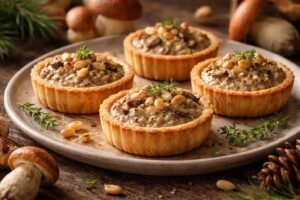
Assembly: Unmold the flans (or serve in ramekins) and top with a vertical Parmesan tuile and a single sautéed morel cap for visual impact.
Pro Technique: The “Press and Purée”
To achieve a professional-grade intensity, do not discard the morels after straining the custard. Take half of the steeped morel mince and purée it into a fine paste, then whisk it back into the strained liquid. This "double-morel" technique ensures that you have both the clean, smooth mouthfeel of a classic flan and the intense, granular flavor concentration that only wild-harvested Morchella can provide.
The Umami Secret: Casein and Guanylate Binding
Parmesan cheese is a powerhouse of free amino acids (Casein-derived), while Morchella provides the guanylate that acts as a flavor multiplier. When the crunchy tuile dissolves into the creamy flan, these two components meet on the tongue, creating a synergistic umami effect that lingers on the receptors for much longer than a standard savory dish. It is a biological "infinite loop" of savory satisfaction.
The Art of the Pairing
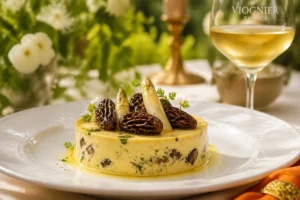
The delicate, creamy nature of the flan requires a wine with "clean" acidity but a weighted body, such as a Viognier or a Chenin Blanc (Savennières). The wine's stone fruit notes offer a brilliant contrast to the forest musk. For a non-alcoholic pairing, a warm clarified mushroom broth served in a small glass provides a deep, savory bridge to the custard's creaminess.
Ancestral Nutrition
This dish is a dense source of B-complex vitamins and Zinc. Morchella is one of the few natural sources of Vitamin D2, while the eggs provide Choline for brain health. Historically, such concentrated preparations were used as "brain tonics" in early European medicine, providing the necessary fats and minerals to support cognitive function during the demanding spring harvest season.
To provide the best experiences, we use technologies like cookies to store and/or access device information. Consenting to these technologies will allow us to process data such as browsing behavior or unique IDs on this site. Not consenting or withdrawing consent, may adversely affect certain features and functions.
Functional
Always active
The technical storage or access is strictly necessary for the legitimate purpose of enabling the use of a specific service explicitly requested by the subscriber or user, or for the sole purpose of carrying out the transmission of a communication over an electronic communications network.
Preferences
The technical storage or access is necessary for the legitimate purpose of storing preferences that are not requested by the subscriber or user.
Statistics
The technical storage or access that is used exclusively for statistical purposes.The technical storage or access that is used exclusively for anonymous statistical purposes. Without a subpoena, voluntary compliance on the part of your Internet Service Provider, or additional records from a third party, information stored or retrieved for this purpose alone cannot usually be used to identify you.
Marketing
The technical storage or access is required to create user profiles to send advertising, or to track the user on a website or across several websites for similar marketing purposes.