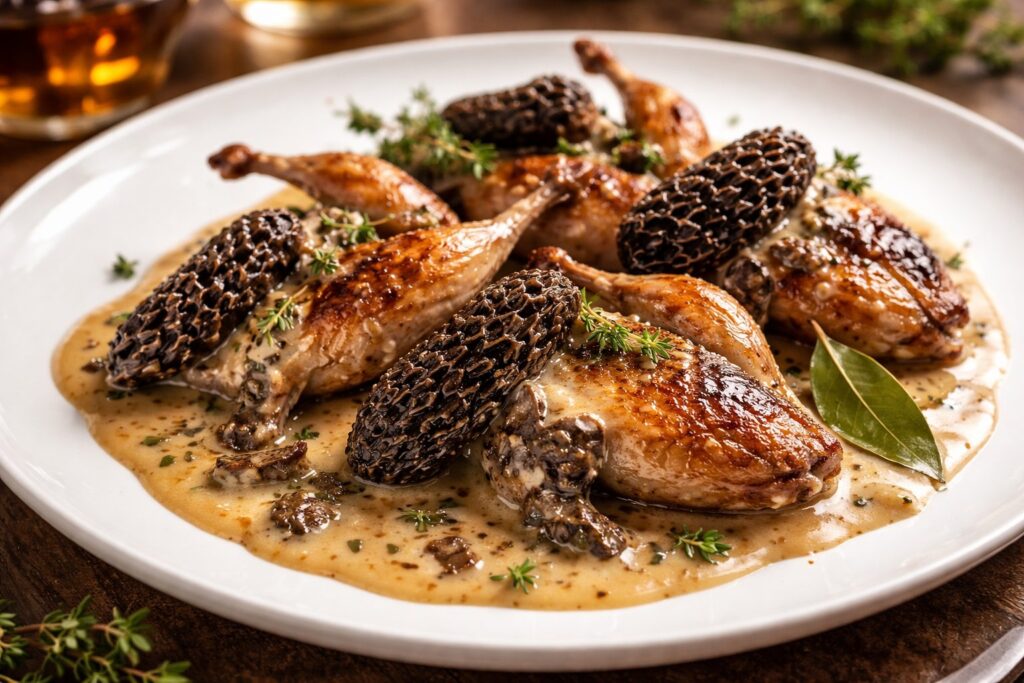
Description: Master this wild-harvested gourmet recipe. Tender quail breasts paired with a rich Morel and Cognac reduction—an umami-rich culinary masterpiece of hunting-lodge luxury.
In the historical hunting traditions of Continental Europe, the spring quail and the Morchella (Morel) are symbols of the transition from the scarcity of winter to the abundance of the new year. Quail, with its delicate, slightly gamey flesh, requires a sauce that can match its intensity without overwhelming its subtlety. This is where the King Morel excels. Historically, this dish was a hallmark of Belle Époque gastronomy, served in the gilded dining rooms of Paris to celebrate the peak of the foraging season.
This wild-harvested preparation relies on the "Flambé" technique to introduce a complex, oak-aged sweetness from the Cognac, which bridges the gap between the bird's iron-rich flavor and the mushroom's smoky depth. By using large, whole black morels, we create a visual and textural focal point that underscores the luxury of the ingredients. This is a dish designed to be savored slowly, echoing the ancestral rhythms of the forest harvest.
Sensory & Foraging Profiles: The Cognac-Wood Connection
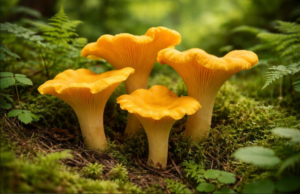
The Morchella is often found near decaying deciduous wood—particularly ash or oak—which imbues it with a chemical profile rich in tannins and lignin-derived volatiles. These are the exact same compounds found in French Cognac, which is aged in Limousin oak barrels. This shared chemical history creates a Molecular Link that makes the pairing instinctively harmonious.
Aroma & Texture: The aroma is a heady tapestry of roasted poultry, vanillic oak, and toasted nuts. The texture of the quail is buttery and soft, while the morel offers a spongy, juice-filled contrast that releases a burst of cognac-infused cream with every bite.
Microbiology: From a microbiological perspective, morels contain branched-chain amino acids that enhance the "gaminess" of the quail without it becoming unpleasant. When flambéed with alcohol, the esters in the cognac break down the surface proteins of the mushrooms, allowing the internal flavor molecules to merge with the heavy cream, resulting in a sauce with unmatched molecular density.
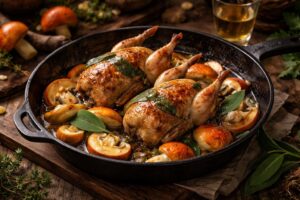
The Sear: Season the quails. In a heavy pan, melt half the butter and sear the birds for 3-4 minutes per side until the skin is mahogany. Remove and keep warm.
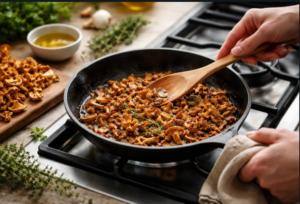
The Mushroom Sauté: In the same pan, add the Morchella and shallots. Sauté for 6-8 minutes until the mushrooms are slightly crisp on the outside.
The Flambé: Pour in the Cognac and carefully ignite with a long match. Let the alcohol burn off while shaking the pan gently.
The Reduction: Add the cream, thyme, and bay leaf. Bring to a slow simmer and let it reduce until the sauce has a "nappe" consistency (thick enough to coat a spoon).
The Resting: Return the quails to the sauce for 2 minutes to finish cooking through and absorb the aromatics.
Assembly: Plate the quail and spoon the whole morels and cream reduction generously over the breasts.
Pro Technique: The “Deglaçage” and Fond Integration
The secret to the depth of this sauce is the fond—the caramelized proteins left in the pan by the quail. By adding the Morchella directly into this fond before deglazing with Cognac, the mushrooms absorb the bird's essence into their honeycomb structures. This ensures that the mushroom doesn't just taste *of* itself, but becomes a concentrated carrier for the entire dish's flavor profile.
Amanita Caesarea Identification Guide
The culinary journey of the Caesar's Mushroom spans across continents. Whether you are foraging in the Balkans or dining in Italy, recognizing these regional names is essential for authentic mycological identification:
Language
Regional Names
Cultural Context
Bulgarian
Булка, Гъба Булка, Булница
Traditional Balkan delicacy.
Italian
Ovolo buono, Fungo Reale
Royal status in Italy.
French
Oronge, Oronge Vraie
Imperial French favorite.
Russian
Цезарский гриб, Царский гриб
Southern Russian treasure.
Japanese
Tamagotake (タマゴタケ)
"Egg mushroom" in Asia.
The Amanita caesarea, widely known as Caesar's Mushroom, is a rare find in the culinary world. Its presence in various European and Asian languages highlights its historical importance. By studying these names, chefs can better understand the cultural roots of pure umami flavors and professional mycological research.
To provide the best experiences, we use technologies like cookies to store and/or access device information. Consenting to these technologies will allow us to process data such as browsing behavior or unique IDs on this site. Not consenting or withdrawing consent, may adversely affect certain features and functions.
Functional
Always active
The technical storage or access is strictly necessary for the legitimate purpose of enabling the use of a specific service explicitly requested by the subscriber or user, or for the sole purpose of carrying out the transmission of a communication over an electronic communications network.
Preferences
The technical storage or access is necessary for the legitimate purpose of storing preferences that are not requested by the subscriber or user.
Statistics
The technical storage or access that is used exclusively for statistical purposes.The technical storage or access that is used exclusively for anonymous statistical purposes. Without a subpoena, voluntary compliance on the part of your Internet Service Provider, or additional records from a third party, information stored or retrieved for this purpose alone cannot usually be used to identify you.
Marketing
The technical storage or access is required to create user profiles to send advertising, or to track the user on a website or across several websites for similar marketing purposes.