Description: Master this wild-harvested gourmet recipe. A Macrolepiota procera culinary masterpiece featuring thick-cut stems and an umami-rich citrus glaze.
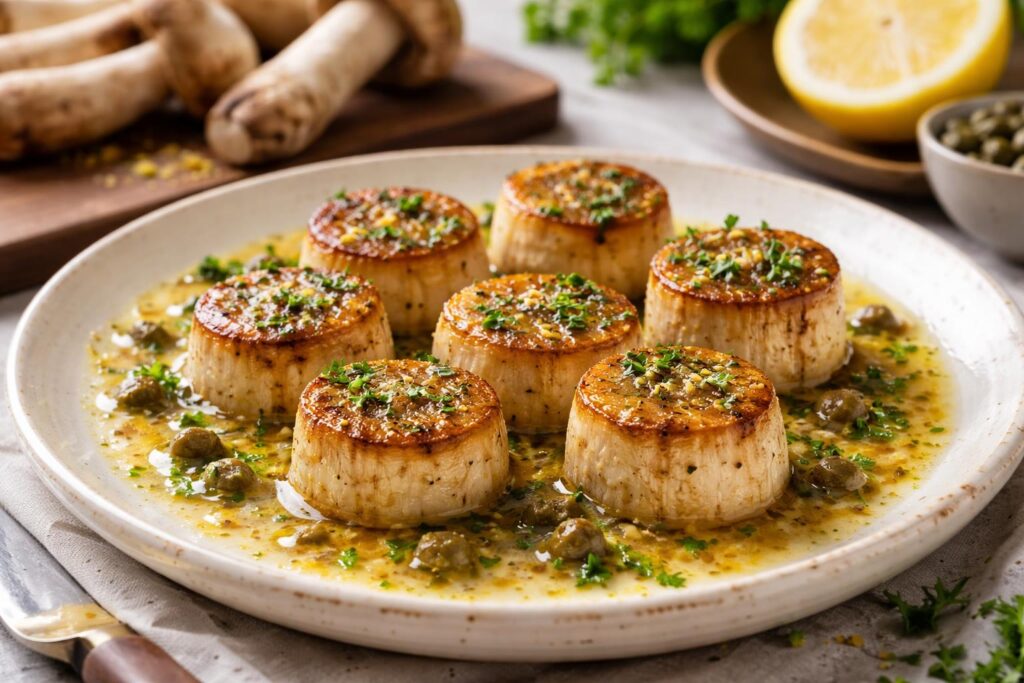
Parasol Mushroom “Scallops” in Lemon-Caper Butter
Culinary Alchemy: Turning the Woody Stem into Coastal Gold
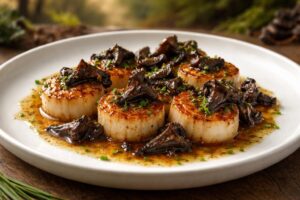
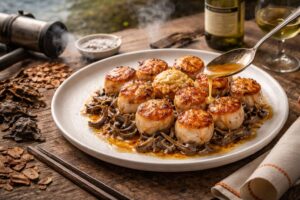
In many kitchens, the stem of the Macrolepiota procera is discarded as too fibrous. However, in the high-altitude villages of the Balkan Massif, savvy foragers know that the base of a young, thick stem holds a structural secret. When cross-cut and poached correctly, it mirrors the cylindrical elegance and tender-yet-firm bite of a sea scallop. This dish represents the ultimate "no-waste" philosophy of the European wilderness.
This wild-harvested gourmet recipe is a culinary masterpiece of texture conversion. By slow-poaching the "scallops" in a bath of lemon-infused butter and briny capers, we break down the tough chitinous fibers, leaving behind a succulent, umami-rich morsel. The regional spirit here is one of resourceful luxury—taking the least expected part of the mushroom and elevating it to a status usually reserved for the ocean's rarest treasures. It is a surprising, elegant, and profoundly sustainable way to honor the full scale of the Parasol.
🌲 EXCLUSIVE FOREST HARVEST OFFER 🌲
Master your own wild-harvested creations with our premium Parasols and Morels.
Sensory & Foraging Profiles: The Fibrous Transformation
The Macrolepiota procera stem is a marvel of biological engineering, designed to support a massive cap. It contains a high concentration of phenolic compounds and terpenes that give it a deeper, woodier scent than the cap. When cross-cut into "scallops," these internal structures become accessible to flavor infusion.
Microbiology & Chemistry: The stems are rich in insoluble polysaccharides. Chemically, the citric acid from the lemon acts as a gentle tenderizer, while the natural glutamates are brought to the forefront by the salt in the capers. This creates a lactic-fungal synergy where the butter carries the mushroom's volatile esters directly to the savory receptors of the tongue.
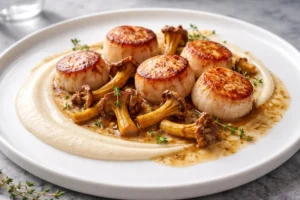
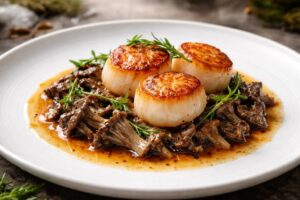
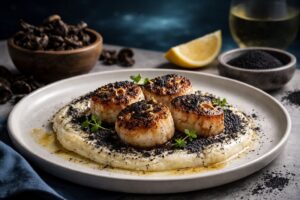
Texture Analysis: A perfect Parasol "scallop" should have a seared, golden exterior and a yielding, buttery heart. Unlike the cap, which is airy, the stem-scallop is dense and satisfying, providing the wild-harvested "muscle" texture that mimics high-end seafood.
The Master Recipe: Parasol Stem “Scallops”
Ingredients
6-8 Thick Stems of Fresh Wild-Harvested Macrolepiota procera (cut into 2cm cylinders)
50g High-quality Butter
1 tbsp Capers (drained)
Juice and zest of 1/2 Lemon
1 clove Garlic (smashed)
Fresh Parsley (finely chopped)
Sea salt and White Pepper
Culinary Steps
The Selection: Use only the tender top parts of the Macrolepiota procera stems (the part closest to the cap). Discard the very woody base.
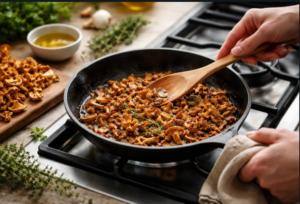
The Sear: In a skillet, melt half the butter over medium-high heat. Place the mushroom cylinders upright and sear for 3 minutes until the bottom is a deep golden brown.
The Flip: Carefully flip the "scallops." Add the remaining butter, garlic, and capers to the pan.
The Poach: Reduce heat to medium-low. Spoon the bubbling butter over the mushroom tops repeatedly (basting) for 5-7 minutes. This slow heat tenderizes the core.
The Deglaze: Add the lemon juice and zest. The butter will foam and emulsify with the umami-rich mushroom juices.
The Finish: Season with sea salt and white pepper. Garnish with parsley and serve immediately.
Pro Technique: The “Baste and Braise”
To master this gourmet recipe, you must focus on the Baste and Braise. Constant basting with lemon butter ensures the heat penetrates the center of the Macrolepiota procera stem without overcooking the exterior. This process essentially "braises" the fibers in fat, transforming the stem's characteristic "snap" into a wild-harvested silken melt.
The Umami Secret: Citric-Glutamate Amplification
The natural glutamates in the Macrolepiota procera are chemically amplified by citric acid. Acid lowers the threshold for salt and savory perception, meaning the lemon doesn't just add brightness—it actively makes the mushroom taste more "meaty." This umami-rich interaction, combined with the briny punch of the capers, creates a flavor profile that is strikingly similar to scallops a la Meunière.
The Art of the Pairing
A dish this delicate requires a Chablis or a Sancerre. The mineral, flinty notes of the wine mirror the forest floor origins of the mushroom. For a non-alcoholic pairing, a chilled sparkling water with a squeeze of fresh grapefruit provides a sharp, sophisticated citrus counterpoint to the Macrolepiota procera.
Ancestral Nutrition
The stems of Parasol mushrooms are particularly high in Chitinous Fiber, which acts as a powerful prebiotic. They are also a dense source of Potassium and Manganese. Historically, in the European wilderness, these "scallops" were valued as a low-calorie, mineral-dense food that supported digestive health and provided bioavailable minerals for mountain communities during the peak of the foraging season.
The Parasol Lexicon: Global Names for Macrolepiota procera
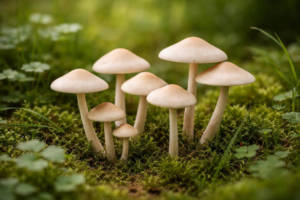
The Parasol Mushroom is one of the most elegant and easily recognized wild fungi. Its names across various cultures often refer to its majestic height and umbrella-like cap:
Language
Regional & Folk Names
Expert Notes
Bulgarian
Сърнела, Чадъреста гъба, Конска гъба, Кукувиче
"Sarnela" comes from "Sarna" (Roe Deer), due to the spotted cap.
English
Parasol Mushroom, Drumstick (young stage)
Named for its resemblance to a lady's parasol.
Italian
Mazza di tamburo, Ombrellone, Bubbola maggiore
"Mazza di tamburo" means "Drumstick".
French
Coulemelle, Lépiote élevée, Nez de chat
"Coulemelle" is the traditional culinary name in France.
Spanish / Catalan
Galamperna, Macrolepiota, Paloma, Apagallums
"Apagallums" (Catalan) means "Light extinguisher".
German
Parasol, Riesenschirmling, Paukenschläger
"Riesenschirmling" means "Giant Umbrella".
Russian / Polish
Гриб-зонтик / Kania, Sowa
"Kania" is one of the most beloved wild mushrooms in Poland.
Romanian / Greek
Burete șerpesc / Ζαρκάδι (Zarkadi)
"Zarkadi" also refers to a deer, similar to the Bulgarian name.
Portuguese / Turkish
Frade, Cogumelo guarda-sol / Turna Bacağı
"Turna Bacağı" (Turkish) means "Crane's Leg".
Hungarian / Czech
Nagy őzlábgomba / Bedla vysoká
Common and highly appreciated in Central European cuisine.
Scientific identification: Macrolepiota procera | Pure Umami Research 2026
To provide the best experiences, we use technologies like cookies to store and/or access device information. Consenting to these technologies will allow us to process data such as browsing behavior or unique IDs on this site. Not consenting or withdrawing consent, may adversely affect certain features and functions.
Functional
Always active
The technical storage or access is strictly necessary for the legitimate purpose of enabling the use of a specific service explicitly requested by the subscriber or user, or for the sole purpose of carrying out the transmission of a communication over an electronic communications network.
Preferences
The technical storage or access is necessary for the legitimate purpose of storing preferences that are not requested by the subscriber or user.
Statistics
The technical storage or access that is used exclusively for statistical purposes.The technical storage or access that is used exclusively for anonymous statistical purposes. Without a subpoena, voluntary compliance on the part of your Internet Service Provider, or additional records from a third party, information stored or retrieved for this purpose alone cannot usually be used to identify you.
Marketing
The technical storage or access is required to create user profiles to send advertising, or to track the user on a website or across several websites for similar marketing purposes.