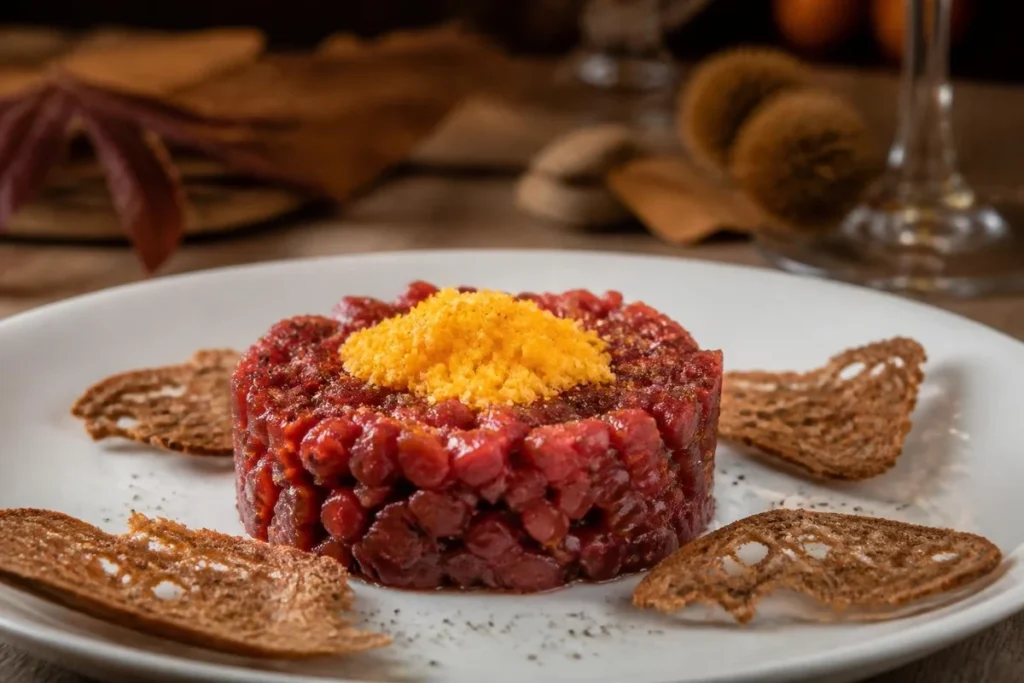
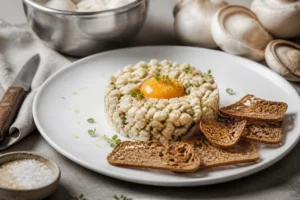
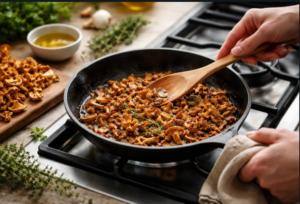
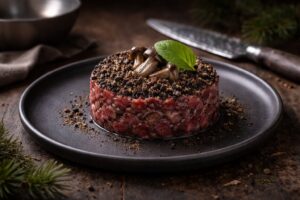
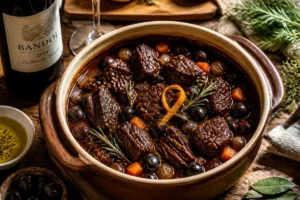
A technical manipulation of Fistulina hepatica through precision cubism and enzymatic stabilization. This preparation utilizes the mushroom's dense, fibrous cellular matrix to mimic the hand-chopped texture of Piedmontese Fassona beef, enriched by a 24-hour salt-cured egg yolk for maximum lipid-driven umami.
Piedmontese Beefsteak Fungus Tartare with Cured Yolk
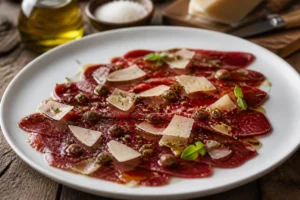
This technical protocol explores the mechanical and chemical reconstruction of Fistulina hepatica as a high-fidelity surrogate for raw beef. Unlike the laminar approach of a carpaccio, this tartare focuses on Structural Integrity. By hand-dicing the mushroom into uniform 3mm cubes, we expose a vast surface area of raw, tannin-rich fibers, which are then stabilized by an emulsion of cold-pressed lipids and the concentrated minerals of a salt-cured egg yolk.
The Culinary Physics of This Dish
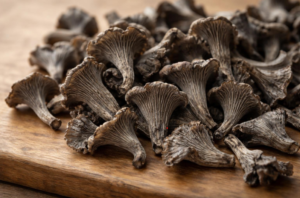
The Fistulina hepatica is uniquely characterized by its "bleeding" juice, which contains natural anthocyanins and oxalic acid. In this preparation, we utilize Enzymatic Preservation. The raw mushroom is kept chilled to 2°C to prevent the breakdown of its crisp texture. The cured egg yolk, having undergone 24 hours of osmotic dehydration, achieves a fudge-like viscosity. When mixed, the yolk's phospholipids bind with the mushroom's acids, creating a coating that prevents oxidation and mimics the mouthfeel of intramuscular fat found in high-grade beef.
Terroir Narrative
Inspired by the Langhe region of Piedmont, Italy—famed for its Carne Cruda all'Albese—this dish pays homage to the local reverence for raw ingredients. In the shadow of the Alps, foragers have long recognized the Beefsteak Fungus as a forest-derived "steak." This tartare elevates that rural recognition into a molecular composition, replacing the traditional Piedmontese beef with a sustainably foraged, mycological protein that captures the damp, earthy essence of the Italian autumn.
Prep Time
Curing Time
Complexity
Calories
Region
30 Mins
24 Hours
Grand Officier
210 kcal
Piedmont, Italy
Master Recipe (1:10 Rule)
400 g Fistulina hepatica (pristine, young, and firm)
1 Organic egg yolk (large)
100 g Fine sea salt / 50 g Sugar (for curing)
1 French shallot (finely brunoise)
10 ml Extra Virgin Olive Oil (ligurian or neutral)
5 g Dijon mustard (fine grain)
2 g Freshly grated horseradish (for a sharp finish)
Maldon salt & Black pepper
The Technique
1. The Yolk Cure: 24 hours prior, mix salt and sugar. Bury the yolk in a small container. Refrigerate. Once cured, rinse gently in cold water and pat dry. It should be firm enough to grate or small-dice.
2. Cold Precision: Chill the Fistulina hepatica in ice-cold water for 5 minutes to maximize turgidity. Pat dry and dice by hand into consistent 3mm cubes. Avoid food processors; they will "bruise" the cells and release too much liquid.
3. Aromatic Liaison: In a chilled stainless steel bowl, combine the mushroom cubes with shallots, mustard, and horseradish. Fold gently to avoid breaking the cubes.
4. Lipid Binding: Incorporate the olive oil slowly. The oil must coat every cube, locking in the natural red pigments and creating a glossy, meat-like appearance.
5. Assembly: Use a ring mold to plate the tartare. Create a small indentation in the center. Place the cured yolk (whole or grated) atop the tartare.
6. Service: Finish with a light dusting of black pepper. Serve with toasted rye crisps or thin sourdough wafers to provide a textural snap against the velvety mushroom.
Shop Integration
The raw, clean umami of a tartare serves as a magnificent starting point for a multi-course mycological menu. You can heighten the "forest" aromatics by adding a few drops of our truffle-infused Boletus edulis (Boletus edulis) oil. For a visual and textural contrast, serve with a side of pickled Cantharellus cibarius (Cantharellus cibarius). If you wish to expand the crudo experience, incorporate our raw Amanita caesarea (Amanita caesarea), which shares a similarly noble culinary status. For a warm accompaniment, consider our dried Morchella (Morchella conica) prepared as a crisp, deep-fried garnish.
The Umami Profile
This dish demonstrates Synergistic Nucleotide Bonding. The free glutamates in the Beefsteak Fungus are amplified by the high sodium content and lipids of the cured yolk. Because the mushroom is raw, its tannin structure is intact, providing a perceived "blood-iron" flavor that mimics the profile of wild game, leading to an intense and lingering umami satisfaction (kokumi).
Sommelier’s Choice
Dolcetto d'Alba: A classic Piedmontese red with low tannins and high fruit expression. Its notes of black cherry and licorice complement the mushroom's acidity, while its soft structure allows the delicate tartare to remain the protagonist of the palate.
THE ETYMOLOGICAL CHRONICLE
Italian:Lingua di bue – Reflecting the physical "tongue" shape and the red color of the fresh specimen.
French:Fistuline hépatique – Highlighting the resemblance to the liver, a cornerstone of traditional French charcuterie knowledge.
German:Leberreischling – A name used in the Black Forest, linking the mushroom's iron-rich profile to liver (Leber).
Spanish:Hígado de buey – In Spanish traditions, this refers to the "ox liver" appearance, particularly when the mushroom is young and moist.
To provide the best experiences, we use technologies like cookies to store and/or access device information. Consenting to these technologies will allow us to process data such as browsing behavior or unique IDs on this site. Not consenting or withdrawing consent, may adversely affect certain features and functions.
Functional
Always active
The technical storage or access is strictly necessary for the legitimate purpose of enabling the use of a specific service explicitly requested by the subscriber or user, or for the sole purpose of carrying out the transmission of a communication over an electronic communications network.
Preferences
The technical storage or access is necessary for the legitimate purpose of storing preferences that are not requested by the subscriber or user.
Statistics
The technical storage or access that is used exclusively for statistical purposes.The technical storage or access that is used exclusively for anonymous statistical purposes. Without a subpoena, voluntary compliance on the part of your Internet Service Provider, or additional records from a third party, information stored or retrieved for this purpose alone cannot usually be used to identify you.
Marketing
The technical storage or access is required to create user profiles to send advertising, or to track the user on a website or across several websites for similar marketing purposes.