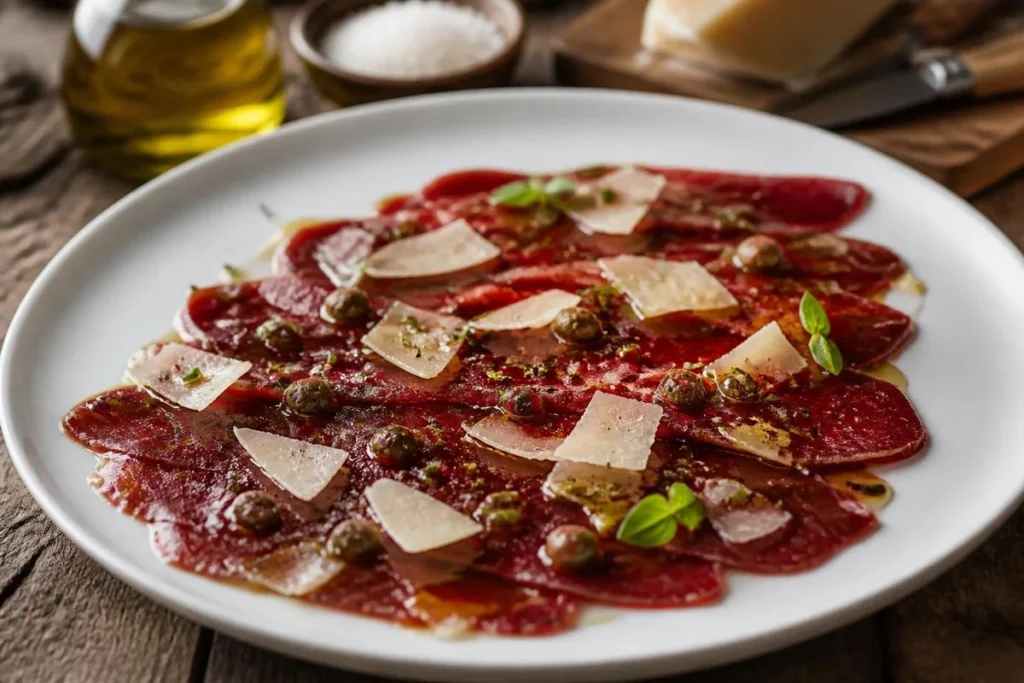
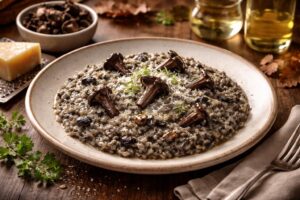
A technical exploration of raw Fistulina hepatica application through precision lamination and acid-neutralization. This preparation leverages the mushroom's natural moisture and "bleeding" color to create a visual and flavor illusion of beef carpaccio, balanced by dairy lipids and cold-pressed olive oil.
Tuscan Beefsteak Fungus Carpaccio with Pecorino
This culinary protocol focuses on Fistulina hepatica in its purest, raw form. The Beefsteak Fungus is among the few wild mushrooms that are not only safe for raw consumption but offer a superior sensory profile when left uncooked. Through the technique of Cold Maceration, we utilize the mushroom's natural oxalic acid to initiate a surface-level protein denaturation, mimicking the tenderness of the finest beef tenderloin.
The Culinary Physics of This Dish
Fistulina hepatica possesses a histology rich in water channels and tannins, which provide its characteristic deep red hue. When sliced into ultra-thin layers (less than 1mm), osmotic pressure allows the olive oil to penetrate the cell walls, mixing with the mushroom's red juice. This creates a natural Emulsion Emittance effect on the plate. Because the mushroom is naturally acidic (pH approx. 4.5), it acts as a chemical balancer for the alkaline and salty notes of the aged sheep's cheese (Pecorino), eliminating the need for lemon juice that would otherwise mask the delicate forest aromatics.
Terroir Narrative
Inspired by the Maremma hills of Tuscany, this dish reflects the Italian tradition of "crudo di bosco". In this region, where oak forests meet sheep pastures, the Beefsteak Fungus has historically been valued as "the meat of the poor." In our execution, we elevate this ingredient to high gastronomy, pairing it with Pecorino Toscano DOP, whose nutty profile highlights the mushroom's earthy base notes. It is a dish of contrasts—between the wild nature of the woods and the cultivated finesse of Tuscan craftsmanship.
Prep Time
Rest Time
Complexity
Calories
Region
25 Mins
5 Mins
Grand Officier
180 kcal
Tuscany, Italy
Master Recipe (1:10 Rule)
300 g Fistulina hepatica (young, firm, intense red color)
50 g Pecorino Toscano DOP (aged at least 12 months)
40 ml Extra Virgin Olive Oil (Tuscan, with a peppery finish)
10 g Chives (finely minced)
5 g Pantelleria Capers (desalinated and chopped)
Maldon Sea Salt flakes
Black Pepper (freshly cracked)
Micro-basil for garnish
The Technique
1. Preparation: Select only the freshest Beefsteak Fungus specimens. Clean with a soft brush. Do not wash the mushrooms, as water dilutes their precious internal juices.
2. Precision Lamination: Use a professional mandoline or an extremely sharp knife to slice the mushroom into semi-translucent longitudinal ribbons. The characteristic "marbled" muscle-like structure must remain visible.
3. The Arrangement: Arrange the slices on a chilled plate, overlapping slightly. The color of the plate (preferably white porcelain) will emphasize the mushroom's deep ruby red.
4. Lipid Infusion: Drizzle generously with the olive oil. Allow to rest for 5 minutes. During this time, the oil will merge with the mushroom's acidic juice, creating a natural vinaigrette.
5. The Accents: Scatter the capers and chives. Use a vegetable peeler to create thin, "shaved" ribbons of Pecorino over the mushrooms.
6. Finishing: Sprinkle with sea salt flakes and black pepper immediately before serving. The salt must remain crunchy and not dehydrate the mushroom excessively.
Shop Integration
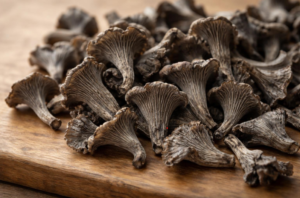
This raw dish is the perfect introduction to a broader forest tasting. You can add textural contrast by serving alongside marinated Cantharellus cibarius (Cantharellus cibarius) or thin slices of raw Amanita caesarea (Amanita caesarea). To intensify the earthy notes, a few drops of Boletus edulis (Boletus edulis) oil would enrich the flavor. For a more complex experience, consider our dried Morchella (Morchella conica), which, after rehydration, can be sautéed and served as a warm element to this cold carpaccio.
The Umami Profile
This dish features a "Fresh Umami" profile. While braised dishes offer "heavy" umami, raw Beefsteak Fungus is light and stimulating. The glutamic acid in the mushroom is activated by the salt, while the tannins interact with the cheese fats, creating a sensation of density (kokumi) usually associated with meat consumption.
Sommelier’s Choice
Vernaccia di San Gimignano: This Tuscan white wine, with its characteristic minerality and slight bitter almond finish, is the ideal partner for the carpaccio. It does not dominate the mushroom but cleanses the palate of the cheese's fat while emphasizing the fresh acidity of Fistulina hepatica.
THE ETYMOLOGICAL CHRONICLE
Italian:Lingua di bue – The primary name in Italy, reflecting reverence for the mushroom's "meaty" nature in regions like Tuscany.
French:Fistuline hépatique – The French name highlights the scientific aspect and the resemblance to liver (hépatique), prized in Périgord gastronomy.
Spanish:Lengua de buey – Traditional name in Spain, where the mushroom is often grilled like a true steak.
German:Leberreischling – The German name directly links it to the liver (Leber), suggesting its rich iron and vitamin content.
To provide the best experiences, we use technologies like cookies to store and/or access device information. Consenting to these technologies will allow us to process data such as browsing behavior or unique IDs on this site. Not consenting or withdrawing consent, may adversely affect certain features and functions.
Functional
Always active
The technical storage or access is strictly necessary for the legitimate purpose of enabling the use of a specific service explicitly requested by the subscriber or user, or for the sole purpose of carrying out the transmission of a communication over an electronic communications network.
Preferences
The technical storage or access is necessary for the legitimate purpose of storing preferences that are not requested by the subscriber or user.
Statistics
The technical storage or access that is used exclusively for statistical purposes.The technical storage or access that is used exclusively for anonymous statistical purposes. Without a subpoena, voluntary compliance on the part of your Internet Service Provider, or additional records from a third party, information stored or retrieved for this purpose alone cannot usually be used to identify you.
Marketing
The technical storage or access is required to create user profiles to send advertising, or to track the user on a website or across several websites for similar marketing purposes.