A technical study in Anthocyanin-Tannin Infusion and Mycelial Pigment Absorption, utilizing the reductive properties of Pinot Noir to transform the Parasol mushroom's texture into a succulent, wine-saturated protein analog.
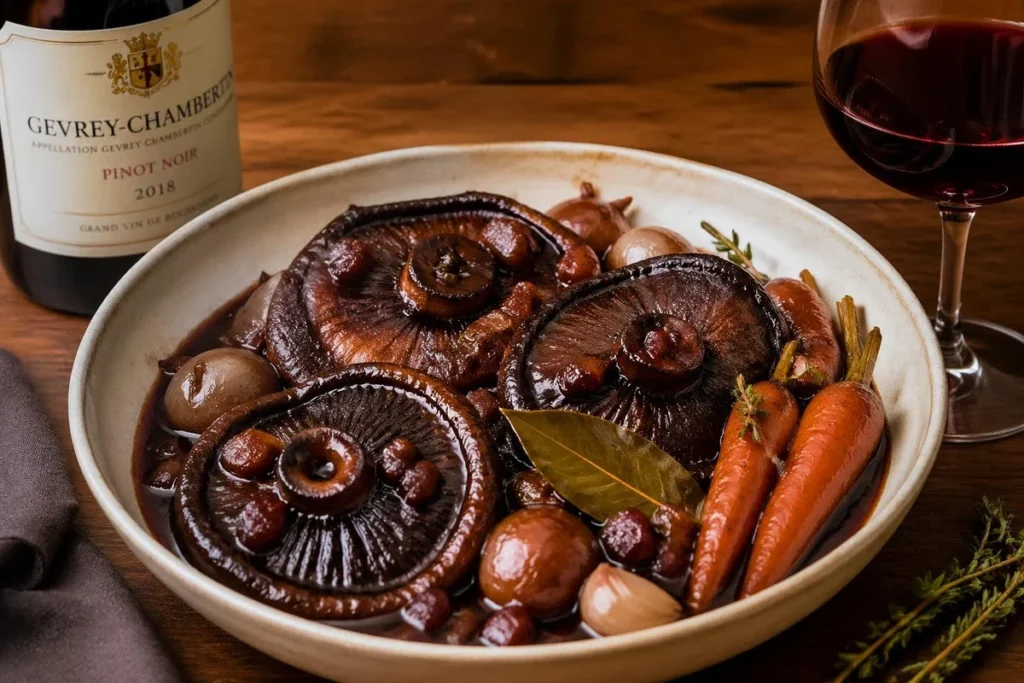
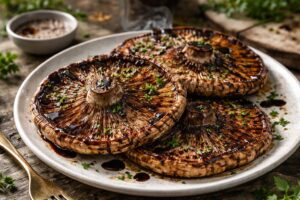
For our ninetieth technical formulation, we analyze Chromatographic Infusion and Phenolic Interaction. Macrolepiota procera (Parasol Mushroom), referred to as Macrolepiota procera in the Bulgarian highlands, possesses a porous gill structure that acts as a natural wick for acidic liquids. At pure-umami.cc, we utilize the classical Coq-au-Vin framework. By slow-braising the whole mushroom caps in a reduction of Pinot Noir, we facilitate the migration of anthocyanins (color pigments) and tannins into the fungal tissue, resulting in a dark, wine-stained "meat" that mimics the tender, braised collagen of a traditional rooster.
The Culinary Physics of This Dish
The engineering of this braise relies on Alcohol-Phase Volatilization and Tannin Softening. Molecularly, red wine contains organic acids and tannins that can toughen meat fibers but work differently on fungal chitin. As the wine reduces, the Anthocyanins (red pigments) bind to the mushroom's surface, while the Etanol acts as a solvent, extracting fat-soluble volatiles from the Macrolepiota procera that are normally inaccessible. The addition of pearl onions and carrots provides Glucose and Fructose, which balance the wine's tartaric acid, creating a high-viscosity "glaze" that encapsulates the mushroom during the final stages of reduction.
Terroir Narrative
This formulation is a tribute to Burgundy (Bourgogne), the spiritual home of Pinot Noir. We bridge the limestone "climat" of the Côte de Nuits with the Balkan deciduous forests. The terroir is expressed through the marriage of the forest's "wild" Macrolepiota procera and the sophisticated, red-fruit-driven acidity of Burgundy wine. This follows the same technical rigor we apply to our Boletus edulis (Porcini) and Craterellus cinereus (Grey Chanterelle), treating the braising liquid not as a sauce, but as a chemical environment for textural transformation.
Quick Info Bar
Braise Time
Wine Type
Complexity
Region
45 mins
Pinot Noir
Grand Officier
Burgundy, FR
Master Recipe (1:10 Rule)
6-8 Large Macrolepiota procera caps (Macrolepiota procera) – kept whole
500ml Red Burgundy Wine (Pinot Noir)
100g Smoked Tempeh or Lardons (for the Garniture)
12 Pearl Onions (peeled) + 2 Carrots (turned)
300ml Concentrated Fungal Stock
30g Butter + 20g Flour (for Beurre Manié)
Fresh Thyme, Bay Leaf, and 1 clove Garlic
Fleur de Sel and Black Pepper
The Technique
The Aromatic Foundation: Sauté the smoked lardons/tempeh until the fat renders. Remove and sauté the pearl onions and carrots in the same fat until caramelized. This builds the Lipid-Saccharide Base.
The Reductive Infusion: Add the **Macrolepiota procera** caps, gill-side down. Pour in the Pinot Noir and fungal stock. Add the herbs and garlic. Simmer gently (do not boil) for 35 minutes. Boisterous boiling would fracture the mushroom's delicate caps.
The Pigment Stabilization: During the braise, the wine will reduce by half. The mushrooms will turn a deep, royal purple. This is the Anthocyanin Uptake phase.
The Glossy Finish: Whisk in the Beurre Manié (butter and flour paste) to thicken the liquid into a mirror-like sauce. This emulsification "locks" the flavor compounds to the mushroom's surface.
Service: Serve the whole caps in a shallow bowl, surrounded by the onions and carrots, topped with the wine reduction.
Shop Integration
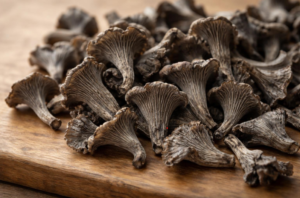
The Macrolepiota procera provides the central "meaty" mass, but its umami depth can be layered. We recommend adding a handful of dried Boletus edulis (Porcini) to the braise for a "darker," more animalistic earth tone. If you seek a brighter peppery contrast, serve with a side of sautéed Cantharellus cibarius (Chanterelle). For a luxury upgrade, finish the sauce with a few drops of Morchella conica (Morel) essence. If available, a side of raw Amanita caesarea (Caesar's mushroom) with a lemon-herb dressing will provide a necessary mineral acidity to reset the palate from the heavy red wine reduction. For a visual contrast, our Craterellus cinereus (Grey Chanterelle) can be added to the garniture for its smoky complexity.
The Umami Profile
This dish features **Poly-Phenolic Umami Synergy**. The Macrolepiota procera provides the guanylates, while the Pinot Noir contributes acidity that stimulates the T1R1/T1R3 receptors. The long reduction process creates Complex Esters—secondary flavor compounds that bridge the gap between the forest's earthiness and the wine's fruitiness. The result is a savory experience that is exceptionally deep, "dark," and velvety.
Sommelier’s Choice
A glass of the same **Pinot Noir (Gevrey-Chambertin)** used in the cooking. The wine's tannins have been "softened" by the mushrooms, and its natural acidity will harmonize perfectly with the wine-saturated fibers of the braised Parasol.
The Etymological Chronicle
The term Coq-au-Vin is **French**, meaning "rooster in wine." In **Italian**, this would be Mazza di Tamburo al Vino Rosso. In **German**, it is Parasolpilz in Rotwein-Schmorfont. In **Spanish**, it is Galamperna al Vino Tinto. Regardless of the language, the **Parasol mushroom** braised in red wine remains the definitive standard for technical viticultural-mycological fusion.
Pure Umami | Mycological Research & Culinary Arts | 2026
To provide the best experiences, we use technologies like cookies to store and/or access device information. Consenting to these technologies will allow us to process data such as browsing behavior or unique IDs on this site. Not consenting or withdrawing consent, may adversely affect certain features and functions.
Functional
Always active
The technical storage or access is strictly necessary for the legitimate purpose of enabling the use of a specific service explicitly requested by the subscriber or user, or for the sole purpose of carrying out the transmission of a communication over an electronic communications network.
Preferences
The technical storage or access is necessary for the legitimate purpose of storing preferences that are not requested by the subscriber or user.
Statistics
The technical storage or access that is used exclusively for statistical purposes.The technical storage or access that is used exclusively for anonymous statistical purposes. Without a subpoena, voluntary compliance on the part of your Internet Service Provider, or additional records from a third party, information stored or retrieved for this purpose alone cannot usually be used to identify you.
Marketing
The technical storage or access is required to create user profiles to send advertising, or to track the user on a website or across several websites for similar marketing purposes.