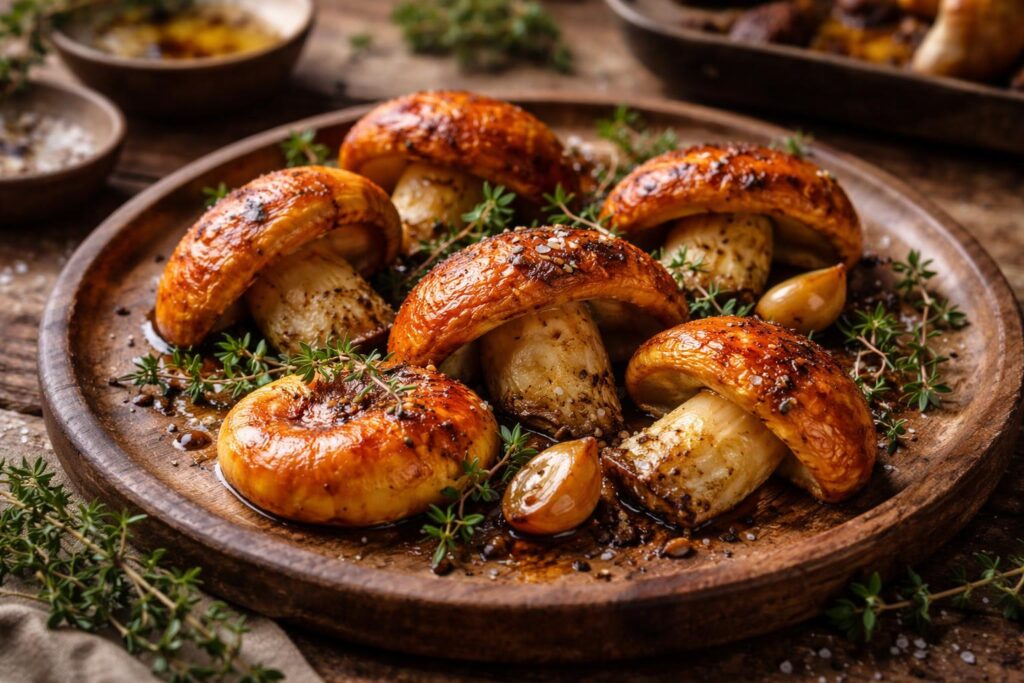
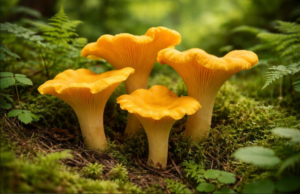
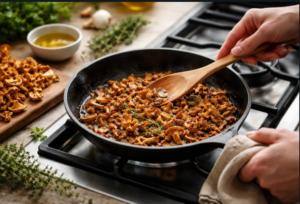
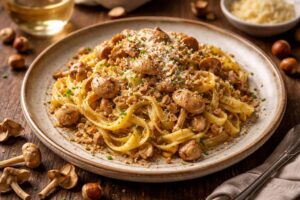
In the traditional kitchens of Southern France and the Balkan Peninsula, the Amanita caesarea is often subjected to a rapid, high-intensity roasting process. This technique differs fundamentally from sautéing; while the pan provides a surface sear, the dry heat of a hot oven or a wood-fired hearth causes a uniform dehydration that concentrates the mushroom's natural sugars. Historically, this was the preferred method for older, fully-opened "parasol" stage specimens, whose expansive gills could trap the resinous oils of wild herbs.
This wild-harvested gourmet recipe utilizes the synergy between Amanita caesarea and wild mountain thyme (Thymus serpyllum). The mushroom, which often grows in the same dry, rocky terrains as the herb, possesses a hidden floral depth that only emerges under intense thermal radiation. The result is a culinary masterpiece of texture—a crispy, parchment-like exterior giving way to a succulent, custardy interior. This dish captures the very essence of a parched forest clearing at the height of August.
🌲 EXCLUSIVE FOREST HARVEST OFFER 🌲
Elevate your kitchen with the rarest Amanita caesarea, Morels, and Porcini.
Sensory & Foraging Profiles: The Lignin and Resin Connection
The Amanita caesarea thrives in Mycorrhizal symbiosis with hardwoods. During the roasting process, the microbiology of the mushroom undergoes a transformation; the chitin walls partially break down, releasing guanylic acid. This compound, when paired with the thymol found in wild thyme, creates a sensory profile that mimics the scent of roasted chestnuts and aged leather.
Aroma & Chemistry: The heat triggers the release of volatile esters that are otherwise trapped in the mushroom's dense stipe. These esters are lipophilic, meaning they bond perfectly with the high-quality fats (olive oil or clarified butter) used during the roast. The addition of wild thyme introduces a "clean" resinous note that cuts through the mushroom's natural heaviness, balancing the overall flavor architecture.
Texture Analysis: Roasting creates a unique "leather-and-silk" texture. The cap becomes slightly chewy and intensely savory, while the thick, yellow stem remains moist, offering a bite that is remarkably similar to a slow-roasted piece of marrow or a fine cut of poultry.
The Master Recipe: Roasted Caesar & Wild Thyme
Ingredients
500g Wild-Harvested Amanita caesarea (halved or quartered depending on size)
4 tablespoons Extra Virgin Olive Oil (high polyphenol count)
6 sprigs of fresh Wild Thyme (or standard garden thyme)
Preparation: Preheat your oven (and a heavy cast-iron tray) to 220°C. A preheated tray is essential to start the sear the moment the Amanita caesarea makes contact.
Tossing: In a large bowl, toss the mushroom pieces with the olive oil, thyme sprigs, and crushed garlic. Ensure every surface of the mushroom is thinly coated in oil.
The Roast: Spread the mushrooms on the hot tray in a single layer. Do not crowd them, or they will steam instead of roasting.
Thermal Shock: Roast for 12-15 minutes. Halfway through, give the tray a sharp shake to rotate the pieces. The caps should begin to crinkle and turn a deep, burnished orange.
The Deglaze: Remove from the oven and immediately drizzle the balsamic vinegar over the hot mushrooms. The vinegar will sizzle and form a thin, tart glaze.
The Finish: Season with Fleur de Sel and black pepper. Serve warm as a centerpiece or an elegant side.
Pro Technique: The “High-Hearth” Mimicry
To achieve the authentic "wild-harvested" depth of a forest fire roast in a domestic oven, use the highest shelf and the convection (fan) setting. This mimics the rapid air movement of a wood-fired oven, accelerating the evaporation of the mushroom's surface moisture. This prevents the Amanita caesarea from becoming "slimy" and instead develops the much-coveted umami crust that is the signature of elite mycological cookery.
The Umami Secret: Concentration Through Dehydration
The Amanita caesarea is approximately 90% water. By roasting it at 220°C, we remove roughly 20-30% of that moisture. This doesn't just change the texture; it physically concentrates the natural glutamates and minerals. The addition of thyme—which contains its own savory phenolic compounds—creates a bridge that makes the mushroom's umami feel deeper and more "primitive" than in raw or boiled preparations.
The Art of the Pairing
The intense, roasted character of this dish pairs beautifully with a full-bodied Sangiovese (Chianti Classico Riserva) or a Spanish Tempranillo. The wine's tannins interact with the concentrated mushroom proteins to create a smooth, velvety finish. For a non-alcoholic pairing, a warm infusion of hibiscus and smoked black tea (Lapsang Souchong) provides the necessary acidity and smokiness to match the roasted Caesar.
Ancestral Nutrition
Roasted Amanita caesarea is a dense source of Potassium and Niacin (Vitamin B3). The high heat makes the Beta-glucans more accessible to the human digestive system, enhancing the mushroom's immunomodulatory properties. Historically, roasted wild mushrooms were a seasonal staple used to fortify the body with essential minerals before the autumn rains, ensuring a robust constitution for the coming winter.
Imperial Lexicon: Multi-Language Names for Amanita caesarea
The Caesar's Mushroom has a linguistic heritage as rich as its flavor. From the Roman "Boletus" to modern dialects, here is the most comprehensive regional guide for global identification:
To provide the best experiences, we use technologies like cookies to store and/or access device information. Consenting to these technologies will allow us to process data such as browsing behavior or unique IDs on this site. Not consenting or withdrawing consent, may adversely affect certain features and functions.
Functional
Always active
The technical storage or access is strictly necessary for the legitimate purpose of enabling the use of a specific service explicitly requested by the subscriber or user, or for the sole purpose of carrying out the transmission of a communication over an electronic communications network.
Preferences
The technical storage or access is necessary for the legitimate purpose of storing preferences that are not requested by the subscriber or user.
Statistics
The technical storage or access that is used exclusively for statistical purposes.The technical storage or access that is used exclusively for anonymous statistical purposes. Without a subpoena, voluntary compliance on the part of your Internet Service Provider, or additional records from a third party, information stored or retrieved for this purpose alone cannot usually be used to identify you.
Marketing
The technical storage or access is required to create user profiles to send advertising, or to track the user on a website or across several websites for similar marketing purposes.