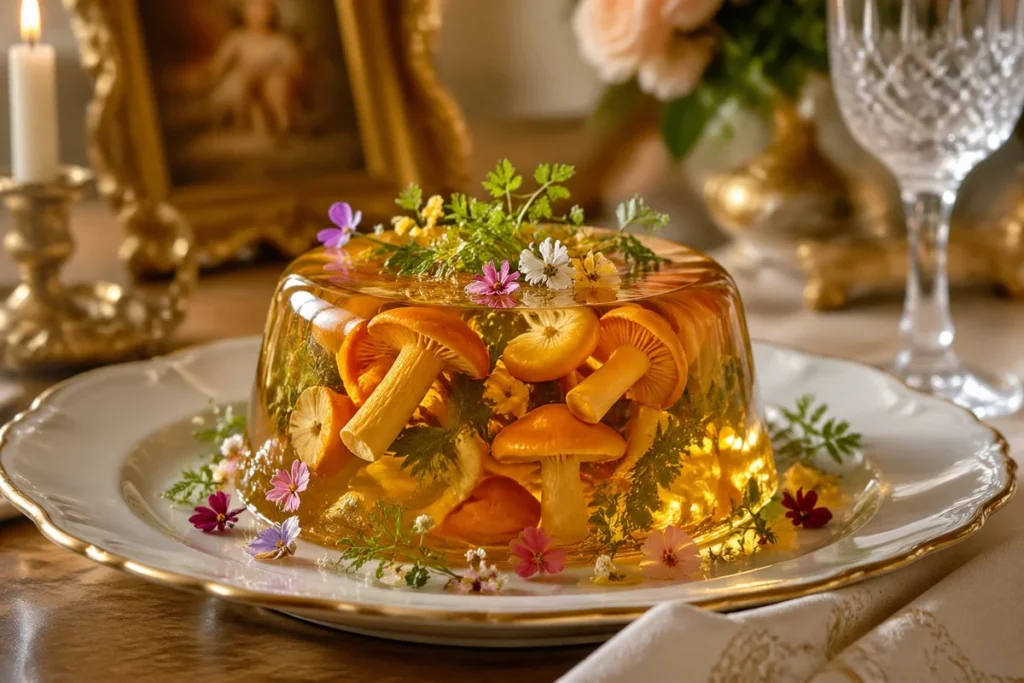
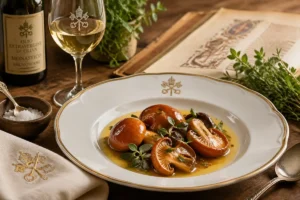
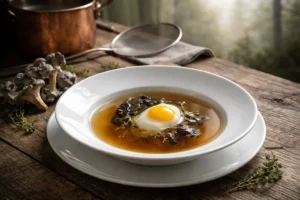
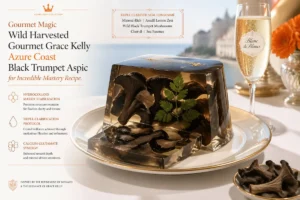
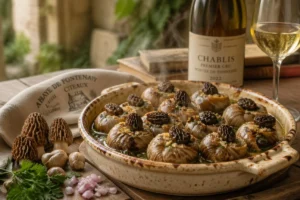
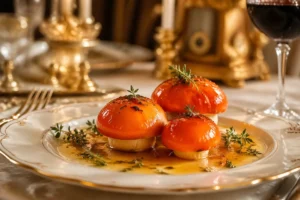
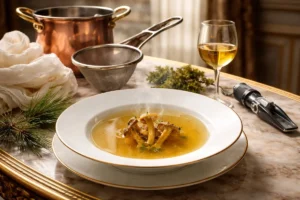
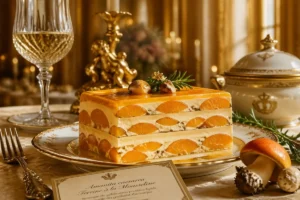
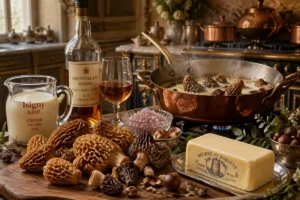
Elite Versailles heritage meets the gold of the forest in this Michelin-standard Madame de Pompadour Amanita aspic for ultimate perfection.
Sensational Cloistered Umami Madame de Pompadour Elegant Amanita Aspic for Ultimate Perfection
Why This Recipe Works
The technical excellence of this elite aspic dish is based on the Hydrocolloid-Umami Suspension Synergy process. The Caesar mushroom (Amanita caesarea) possesses extremely volatile aromatic compounds that are often lost during aggressive thermal processing. By encapsulating them in a purified collagen matrix (aspic), we achieve a "cold preservation" of the flavor profile. Here, a Thermal-Clarification Strategy is applied, in which a double-clarified poultry consommé acts as a neutral mediator for Ribonucleotide Synergism. When the jelly melts at palate temperature (37°C), it releases umami molecules instantly, creating a sensory experience impossible to achieve with hot soups. The professional value of the recipe lies in the ability to preserve the botanical integrity of the mushroom in a perfectly transparent medium, achieving a Michelin-standard vision and taste for total perfection.
The Historical Prelude
In the heart of Versailles, Madame de Pompadour was not just the official mistress of Louis XV, but the true architect of French taste during the 18th century. Her influence extended from philosophy and art to the finest details of the palace kitchen. Pompadour believed that "Cuisine Courtoise" (Courtly Cuisine) should be ethereal, intellectual, and visually stunning. It was under her patronage that Amanita caesarea ceased to be a mere forest find and was transformed into a Sensational Cloistered Umami symbol of the Enlightenment.
She frequently ordered this specific aspic for her "Petits Soupers" (small suppers), where the elite of France discussed the fate of Europe. The aspic was designed to look like a precious jewel caught in amber—a visual metaphor for her own role at court: delicate, yet highly structured. Chefs of the Pompadour era used Amanita caesarea for its imperial golden color, which shimmered under the light of thousands of candles at Versailles. This dish is the embodiment of the Rococo era—where nature is tamed and refined to a state of high art. Serving it today is an act of culinary archaeology, reviving the prestige of a woman who dictated the standards of beauty and taste for the entire Western world.
Time
Difficulty
Calories
Type
4 Hours (inc. chilling)
Master Class
120 kcal
Historical Aspic
Master Recipe (1:10 Rule)
500g fresh Amanita caesarea (or 50g dried/rehydrated Caesar mushroom)
The Double-Clarification Strategy: The consommé must be crystal clear. Use the "ice filtration" technique or a traditional "clarification cloud" with egg whites. Any cloudiness will compromise the visual prestige of the Amanita caesarea.
The Cold-Infusion Diffusion: Do not boil the mushrooms in the consommé. Instead, poach the Amanita caesarea slices in white wine at 75°C for exactly 3 minutes. This preserves the structural integrity of the hyphae and prevents the release of cloudy proteins into the main jelly.
The Geometric Suspension Technique: Pour the aspic in layers. Let the first 1 cm set, arrange the mushrooms and herbs with surgical precision, and only then pour over the remaining liquid. This ensures that the mushrooms look "frozen" in mid-air rather than fallen to the bottom.
The Umami Secret:Amanita caesarea contains a high density of L-Glutamate, which in a cold environment binds with the glycine in the gelatin. This creates a so-called "delayed" umami effect—the taste does not hit you immediately but unfolds gradually as the aspic melts on the tongue, simulating the Pure Umami effect.
A dish of such ethereality requires a wine with high acidity and a floral profile. We recommend Champagne Extra Brut (Vintage 2018)—the fine bubbles will agitate the gelatinous structure and emphasize the nutty notes of the mushroom. For a more traditional approach, a Sancerre from the Loire Valley will offer the necessary minerality to resonate with the purity of Madame de Pompadour's aspic.
Imperial Lexicon: Multi-Language Names for Amanita caesarea
The Caesar's Mushroom has a linguistic heritage as rich as its flavor. From the Roman "Boletus" to modern dialects, here is the most comprehensive regional guide for global identification:
To provide the best experiences, we use technologies like cookies to store and/or access device information. Consenting to these technologies will allow us to process data such as browsing behavior or unique IDs on this site. Not consenting or withdrawing consent, may adversely affect certain features and functions.
Functional
Always active
The technical storage or access is strictly necessary for the legitimate purpose of enabling the use of a specific service explicitly requested by the subscriber or user, or for the sole purpose of carrying out the transmission of a communication over an electronic communications network.
Preferences
The technical storage or access is necessary for the legitimate purpose of storing preferences that are not requested by the subscriber or user.
Statistics
The technical storage or access that is used exclusively for statistical purposes.The technical storage or access that is used exclusively for anonymous statistical purposes. Without a subpoena, voluntary compliance on the part of your Internet Service Provider, or additional records from a third party, information stored or retrieved for this purpose alone cannot usually be used to identify you.
Marketing
The technical storage or access is required to create user profiles to send advertising, or to track the user on a website or across several websites for similar marketing purposes.