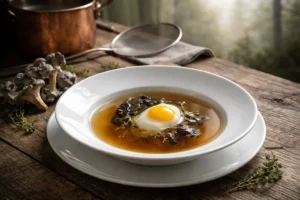
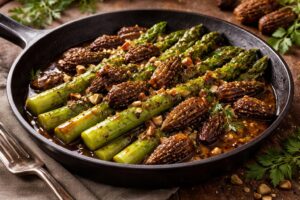
A technical study in Sulfur-Yolk Synergy, utilizing the aliphatic compounds of green asparagus and the lipid-dense egg yolk to create a molecular bridge for the peppery and stone-fruit esters of the Golden Chanterelle.
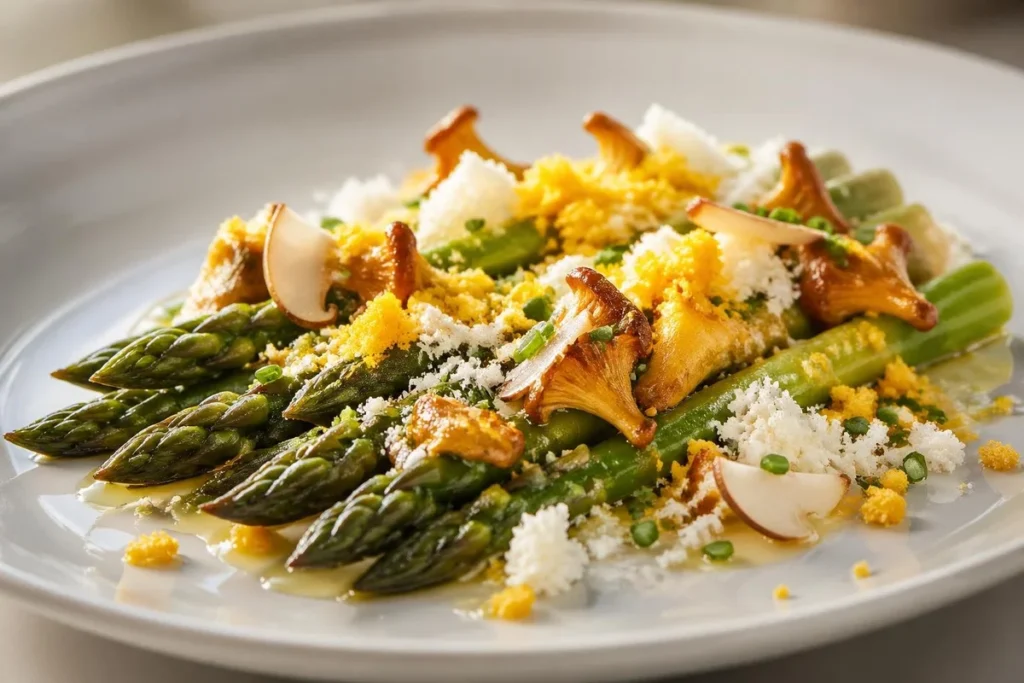
Asparagus & Chanterelle Mimosa
For our forty-fifth technical formulation, we analyze the **chemical affinity** between spring perennials and forest fungi. Cantharellus cibarius (Golden Chanterelle) contains specific esters that harmonize with the mercaptans (sulfur compounds) found in asparagus. The "Mimosa" technique—utilizing finely sieved hard-boiled eggs—provides a high-surface-area lipid coating that captures the mushroom's volatiles. At pure-umami.cc, we elevate this bistro classic by utilizing our premium Cantharellus cibarius as the primary savory driver, replacing traditional proteins with concentrated fungal umami.
The Culinary Physics of This Dish
The engineering of this dish relies on **Surface-Area Lipid Adsorption**. By sieving the egg yolk into micro-particles (mimosa style), we create millions of lipid "hooks." Molecularly, when the warm, sautéed Cantharellus cibarius is tossed with the egg and the blanched asparagus, the fat-soluble aromatics of the mushroom are absorbed into the egg particles. The asparagus, blanched to exactly 82°C to preserve its pectin structure, provides a mineral-rich, crunchy chassis that contrasts with the "sand-like" texture of the egg and the "velvet" texture of the chanterelles.
Terroir Narrative
This formulation is a tribute to the **Loire Valley** and the **Rhine** regions, where white and green asparagus fields often border the woodlands. The terroir is expressed through the use of high-quality rapeseed oil and a sharp white wine vinaigrette. This mirrors the technical rigor we apply to our Amanita caesarea (Caesar's mushroom) and Marasmius oreades preparations, focusing on the "verticality" of spring flavors—clean, mineral, and sharp.
Quick Info Bar
Blanch Time
Egg Texture
Complexity
Region
3 mins (Ice shock)
Sieved (Fine)
Grand Officier
Loire Valley, FR
Master Recipe (1:10 Rule)
Technical ratios for the "Sulfur-Lipid" assembly:
300g Green Asparagus (peeled at the base)
250g Fresh Cantharellus cibarius (Cantharellus cibarius) – small buttons
2 Hard-boiled Eggs (9-minute boil, then ice-shocked)
1 Shallot (finely brunoise)
20ml White Wine Vinegar (for the "acidic bridge")
40ml Rapeseed or Olive oil
Fresh Chives (finely minced)
The Technique
The Asparagus Shock: Blanch the asparagus in heavily salted water for 3 minutes. Immediately plunge into ice water to arrest the chlorophyll degradation. Pat dry—moisture is the enemy of the emulsion.
The Fungal Sauté: Cook the **Cantharellus cibarius** in a dry pan until they release their water, then add a drop of oil and the shallots. Sauté until the mushrooms are firm and glossy. Set aside to cool slightly.
The Mimosa Mechanical Step: Separate the egg whites and yolks. Pass each separately through a fine-mesh sieve or a micro-plane. This creates the "snow-like" texture.
The Vinaigrette: Whisk the vinegar and oil with salt and white pepper. Fold in the chives and the sautéed chanterelles.
The Assembly: Arrange the asparagus on a chilled plate. Spoon the chanterelle vinaigrette over the stalks. Top with the "clouds" of egg white and then the golden egg yolk. Serve immediately.
Shop Integration
The bright yellow hue of our Cantharellus cibarius perfectly matches the egg yolk, creating a monochromatic visual that hides the intense flavor density. For a more mineral profile, add 15% Craterellus cinereus (Grey Chanterelle). If you seek a garlic-baseline, our Marasmius oreades provides a spectacular contrast to the sulfurous asparagus. For an elite presentation, garnish with a few petals of raw Amanita caesarea (Caesar's mushroom). Avoid using Boletus edulis (Porcini) here, as its texture can be too slippery against the "dry" texture of the mimosa eggs.
The Umami Profile
This dish features **Alkaline-Savory Umami**. The alkalinity of the asparagus and egg is balanced by the sharp acidity of the vinegar, which allows the guanylates of the Cantharellus cibarius to stand out as the primary flavor note. The result is a clean, "high-frequency" savory experience that feels light but lingers on the palate.
Sommelier’s Choice
A classic **Sancerre** or a dry **Silvaner**. The "herbal-mineral" profile of these wines is the technical requirement to bridge the gap between the asparagus sulfur and the fungal esters.
The Etymological Chronicle
The term Mimosa is **French**, named after the yellow mimosa flower. In **Italian**, this would be Asparagi e Finferli alla Mimosa. In **German**, it is Spargel und Pfifferlinge nach Mimosen-Art. Regardless of the language, the **Chanterelle** mimosa remains the definitive standard for technical spring cookery.
Pure Umami | Mycological Research & Culinary Arts | 2026
To provide the best experiences, we use technologies like cookies to store and/or access device information. Consenting to these technologies will allow us to process data such as browsing behavior or unique IDs on this site. Not consenting or withdrawing consent, may adversely affect certain features and functions.
Functional
Always active
The technical storage or access is strictly necessary for the legitimate purpose of enabling the use of a specific service explicitly requested by the subscriber or user, or for the sole purpose of carrying out the transmission of a communication over an electronic communications network.
Preferences
The technical storage or access is necessary for the legitimate purpose of storing preferences that are not requested by the subscriber or user.
Statistics
The technical storage or access that is used exclusively for statistical purposes.The technical storage or access that is used exclusively for anonymous statistical purposes. Without a subpoena, voluntary compliance on the part of your Internet Service Provider, or additional records from a third party, information stored or retrieved for this purpose alone cannot usually be used to identify you.
Marketing
The technical storage or access is required to create user profiles to send advertising, or to track the user on a website or across several websites for similar marketing purposes.