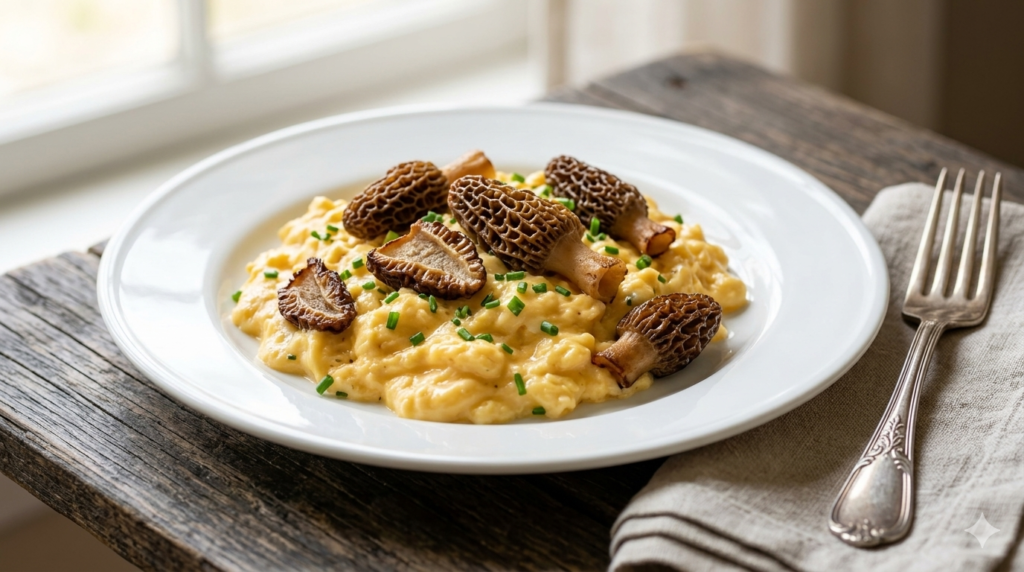
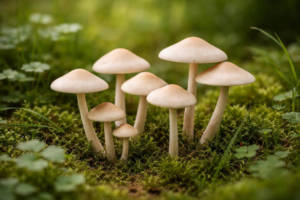
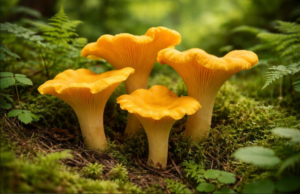
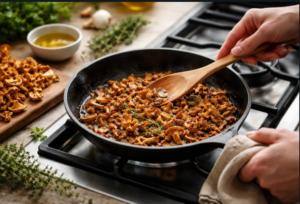
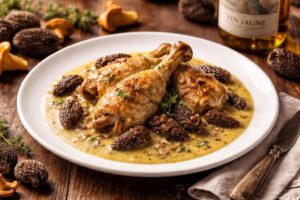
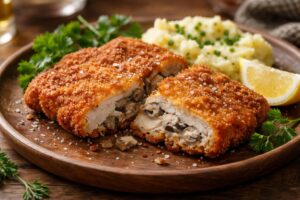
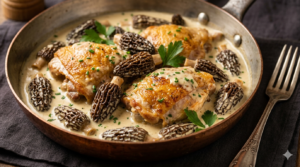
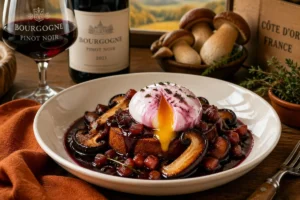
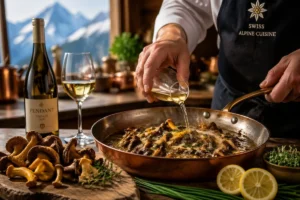
A sophisticated vernal breakfast featuring the silken texture of organic eggs and the smoky, nut-like depth of wild Morchella.
The Forager’s Morning Luxury
Slow-Cooked Organic Eggs with Wild Morels and Cultured Butter
The Historical Prelude
The integration of wild morels into the breakfast ritual is a legacy of the French Savoie and the Swiss Jura, where the first spring rains bring forth the *Morchella* from the damp forest floor. Historically, these scrambled eggs—known as Œufs Brouillés aux Morilles—were a prestigious seasonal offering in the grand hotels of the French Alps during the Belle Époque.
The great Auguste Escoffier considered scrambled eggs to be the ultimate test of a chef's temperament. Unlike the rustic omelette, the scrambled eggs of the aristocracy were cooked in a *bain-marie* to achieve a texture resembling a savory custard. When paired with morels, a mushroom that was once the exclusive property of the French crown, the dish became the "Breakfast of Kings," symbolizing the awakening of the land and the luxury of the terroir.
The objective is a "Small Curd" suspension. We avoid high-heat frying in favor of low-temperature coagulation. The morels are treated with the Infusion Method: we sauté them separately to concentrate their flavors and eliminate their natural moisture before folding them into the delicate egg matrix.
Sensory & Foraging Profile
Nomenclature:Morchella esculenta (Yellow Morel) and Gallus gallus domesticus (Pasture-Raised Eggs).
Terroir: The finest morels for breakfast are found in the Atlantic Fringes and the Black Forest. Their proximity to ash and elm trees provides a mineral-rich aroma with a distinct almond-like finish that perfectly complements the lactic notes of the butter.
Professional Protocol: Morels must be handled with care to preserve their honeycomb structure. We use the "Split and Brush" protocol—slicing each morel in half to ensure the hollow core is free of forest debris. In accordance with "Leave No Trace" ethics, we only harvest 20% of a colony to ensure a symbiotic future for the mycelium.
Essential Equipment
Heavy-Bottomed Non-Stick Pan: For precise heat regulation and preventing egg-skin formation.
Balloon Whisk & Fine Sieve: To aerate the eggs and ensure a molecularly smooth texture.
Silicone Spatula: To manage the delicate curds without tearing the morel caps.
If using the 20g Dried (200g Fresh equivalent), rehydrate in warm milk rather than water to enhance the lactic bond.
Sauté the morels in 15g of cultured butter with a pinch of fine salt until they are slightly golden and all moisture has evaporated.
Stage 2: The Egg Matrix
4 Large Organic, Pasture-Raised Eggs.
Whisk with 1 tablespoon of heavy cream and pass through a fine sieve. This removes the chalazae and ensures a uniform color.
Stage 3: The Slow Coagulation
Add 20g of cold butter to the pan over low heat. Pour in the eggs.
Stir constantly with the spatula, keeping the eggs moving to prevent large curds.
When the eggs are 70% set (the *baveuse* stage), fold in the 200g sautéed Morels (or 20g rehydrated equivalent).
Remove from heat immediately. The residual heat will finish the cooking. Finish with a shower of fresh chives.
The Umami Secret: The 1:10 Lipid Bridge
The "Pure Umami" of this dish relies on the 1:10 Molecular Extraction. Morels are rich in guanylates which are fat-soluble. By rehydrating 20g of dried morels directly in the cream used for the eggs, you create a "flavor bridge." The lipids in the eggs capture the mushroom's smoky volatiles, ensuring the entire dish tastes of forest morels, even in the bites where no mushroom is present.
Pro Technique: The “Cold-Butter Mount”
To achieve a 3-star Michelin texture, add a small "nut" of ice-cold butter right before taking the eggs off the heat. This lowers the temperature of the pan instantly, stopping the cooking process and creating a glossy, reflective finish.
The Art of Pairing
Sommelier's Choice: A Champagne Blanc de Noirs. the Pinot Noir base provides the structural "red fruit" notes that stand up to the morels, while the bubbles refresh the palate from the rich eggs.
Non-Alcoholic: A warm infusion of White Tea with a hint of toasted pine nuts.
Ancestral Nutrition
Morels are a legendary source of Iron and Vitamin D. In the traditional folk medicine of the Pyrenees, this breakfast was given to mountain guides to provide "sustained fire" for the blood during the cold spring climbs.
Micro-FAQ
Q: Why is the 1:10 ratio so important for breakfast? A: Because 20g of dried morels provides the exact aromatic intensity of 200g of fresh ones without adding excess water, which is the enemy of creamy scrambled eggs.
Q: Can I use regular button mushrooms? A: No. Button mushrooms lack the porous structure and specific umami nucleotides required to produce this "Gourmet Forest" profile.
To provide the best experiences, we use technologies like cookies to store and/or access device information. Consenting to these technologies will allow us to process data such as browsing behavior or unique IDs on this site. Not consenting or withdrawing consent, may adversely affect certain features and functions.
Functional
Always active
The technical storage or access is strictly necessary for the legitimate purpose of enabling the use of a specific service explicitly requested by the subscriber or user, or for the sole purpose of carrying out the transmission of a communication over an electronic communications network.
Preferences
The technical storage or access is necessary for the legitimate purpose of storing preferences that are not requested by the subscriber or user.
Statistics
The technical storage or access that is used exclusively for statistical purposes.The technical storage or access that is used exclusively for anonymous statistical purposes. Without a subpoena, voluntary compliance on the part of your Internet Service Provider, or additional records from a third party, information stored or retrieved for this purpose alone cannot usually be used to identify you.
Marketing
The technical storage or access is required to create user profiles to send advertising, or to track the user on a website or across several websites for similar marketing purposes.