A technical examination of chitinous-crustacean synergy and the stabilization of marine-lipid emulsions using the alveolar architecture of Morchella.
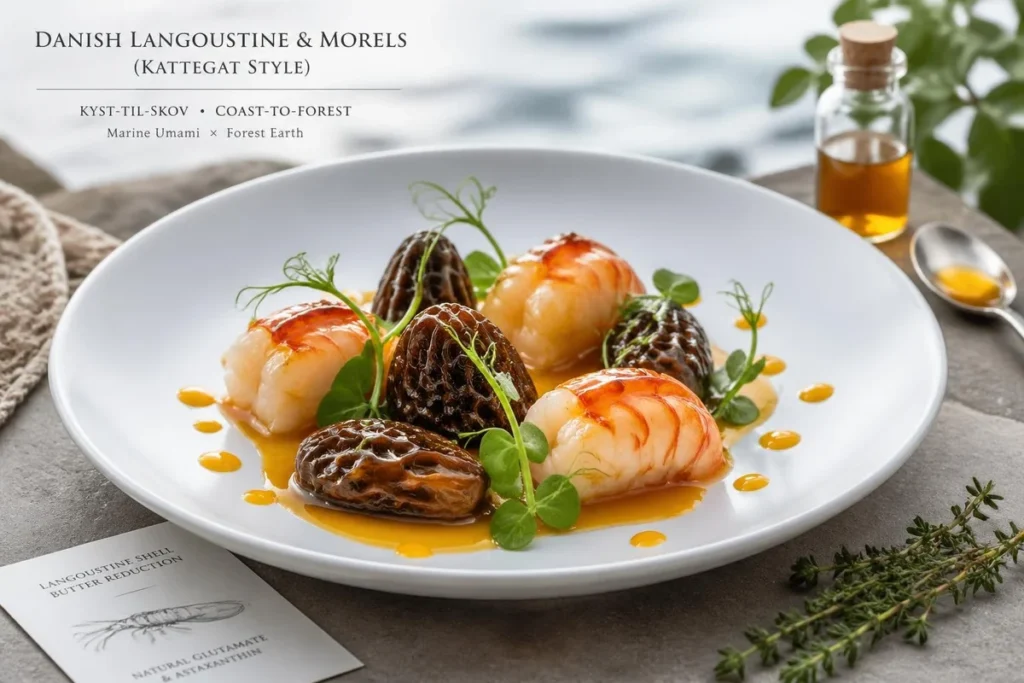
Danish Langoustine & Morels (Kattegat Style)
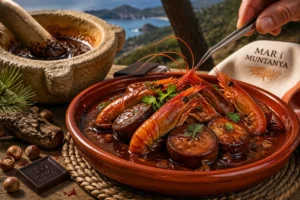
In the high-concept kitchens of Scandinavia, the pairing of Langoustine (Jomfruhummer) and Morels is a technical masterclass in "Surf & Turf" molecular alignment. Both species share a high concentration of chitin and specific amino acids that resonate at the same savory frequency. This dish utilizes the morel's hollow interior as a vessel to capture the sweet, iodine-rich juices of the langoustine, creating a unified flavor profile that bridges the saline depths of the North Sea with the earthy floor of the Danish forests.
The Culinary Physics of This Dish
The core scientific principle is Nucleotide-Lipid Transference. Morels are rich in guanylate, which exponentially boosts the perceived sweetness of the langoustine's glycine-rich meat. By butter-poaching the langoustine tails alongside the morels, we facilitate a lipid exchange: the marine oils permeate the mushroom's honeycomb pits, while the mushroom's smoky terpenes infuse the delicate crustacean protein. The result is a hybrid umami that feels structurally integrated rather than layered.
Furthermore, the Maillard reaction is applied precisely to the langoustine shells to create a concentrated "bisque-butter." This liquid, high in astaxanthin (the red pigment), is used to glaze the morels. The mushroom's hygroscopic nature allows it to drink in this marine essence, transforming the fungi into "land-based crustaceans" in terms of flavor density and mouthfeel.
Terroir Narrative
The Kattegat strait, separating Denmark and Sweden, is home to some of the world's finest cold-water shellfish. In the short Danish spring, the coastal forests of Zealand produce morels just as the langoustine season reaches its peak. This dish represents the "Kyst-til-Skov" (Coast-to-Forest) philosophy—a culinary dialogue between two of Denmark's most prestigious wild ingredients. It is a celebration of a landscape where the salt spray of the sea literally reaches the roots of the trees where the morels grow.
Prep Time
Cook Time
Complexity
Calories
Region
40 min
10 min
Grand Officier
290 kcal
Kattegat, Denmark
Master Recipe (1:10 Rule)
In this delicate maritime preparation, we follow the 1:10 rule of aromatic weight: the amount of reduced langoustine-shell butter used to glaze the morels should be precisely calibrated to ensure the sea's brine supports, but does not drown, the mushroom's forest scent.
8 Large Danish Langoustines (shelled, heads reserved)
300 g Fresh Morels (uniform size, kept whole)
100 g Cultured Butter (high-fat, unsalted)
1 Sprig of Lemon Thyme
50 ml Dry Apple Cider (Danish style)
To garnish Sea buckthorn juice (for acidity) and Beach pea shoots
The Technique
The Shell Butter: Sauté the langoustine heads and shells in half the butter until bright red and fragrant. Add the cider, reduce to a syrup, and strain. This is your "Marine Gold."
The Fungal Sear: In a separate pan, sauté the Morels in the remaining butter. Use medium-high heat to achieve a light crispness on the ridges.
The Fusion: Add the "Marine Gold" to the morel pan. The mushrooms will immediately absorb the red, shell-infused butter into their honeycomb cells.
The Poach: Add the langoustine tails to the pan. Butter-poach them gently for only 2-3 minutes. The protein must remain translucent in the center (glassig) to maintain its delicate sweetness.
Assembly: Plate the langoustine and morels together. Finish with a few drops of sea buckthorn juice—the sharp acidity provides the technical balance to the heavy marine lipids.
"In Denmark, we don't look for contrast; we look for kin. The langoustine and the morel are brothers born of different worlds." – Head Chef, Odsherred
The Umami Profile
The umami profile of Morchella is uniquely transformed by the iodine and oceanic salts of the langoustine. This interaction creates a "bright" savory profile that is cleaner and more mineral than land-based pairings. Pure Umami offers the highest quality wild-harvested specimens for your coastal culinary experiments.
Experience the precision of the North Sea with our Nordic-Grade Morels, selected for their aromatic clarity and structural resilience.
Sommelier’s Choice
A wine with high salinity and electric acidity is required. A Muscadet Sèvre et Maine or a Chablis (1er Cru) offers the mineral backbone to match the langoustine. For a local Danish alternative, choose a cold-climate Solaris; its green apple notes and high acidity resonate perfectly with the sea buckthorn and morels.
The Etymological Chronicle
In the Danish tradition (Post B), the langoustine is called Jomfruhummer (Virgin Lobster). Historically, morels found near the coast were called "Strandmorkler" (Beach Morels). This dish represents a linguistic and culinary reunion—pairing the "Virgin Lobster" with the "Beach Morel" in a technical celebration of the Danish spring.
To provide the best experiences, we use technologies like cookies to store and/or access device information. Consenting to these technologies will allow us to process data such as browsing behavior or unique IDs on this site. Not consenting or withdrawing consent, may adversely affect certain features and functions.
Functional
Always active
The technical storage or access is strictly necessary for the legitimate purpose of enabling the use of a specific service explicitly requested by the subscriber or user, or for the sole purpose of carrying out the transmission of a communication over an electronic communications network.
Preferences
The technical storage or access is necessary for the legitimate purpose of storing preferences that are not requested by the subscriber or user.
Statistics
The technical storage or access that is used exclusively for statistical purposes.The technical storage or access that is used exclusively for anonymous statistical purposes. Without a subpoena, voluntary compliance on the part of your Internet Service Provider, or additional records from a third party, information stored or retrieved for this purpose alone cannot usually be used to identify you.
Marketing
The technical storage or access is required to create user profiles to send advertising, or to track the user on a website or across several websites for similar marketing purposes.