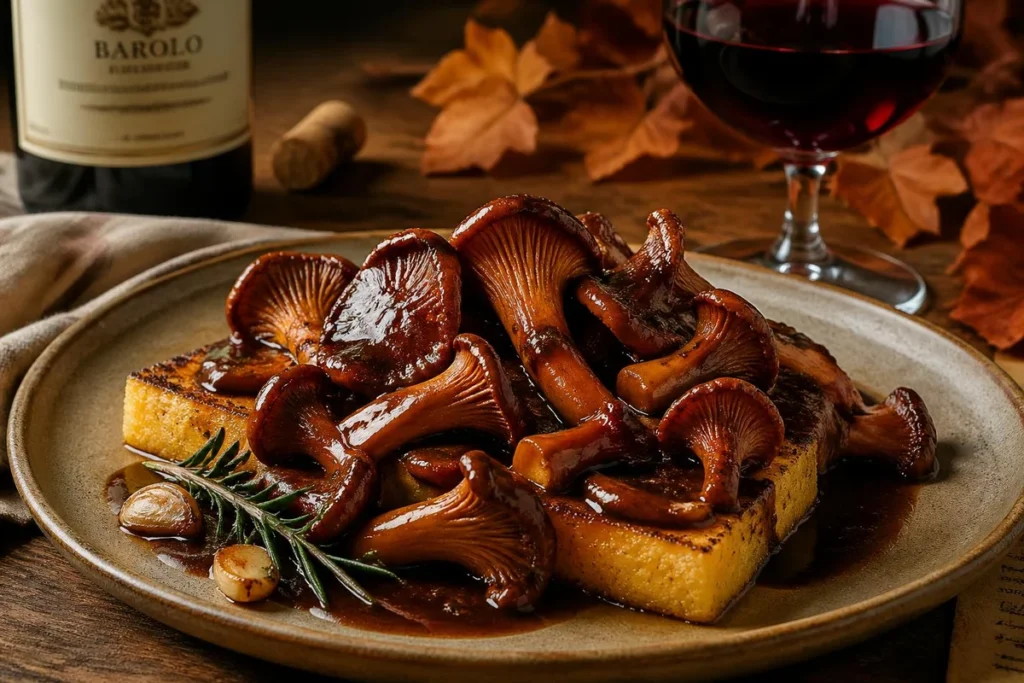
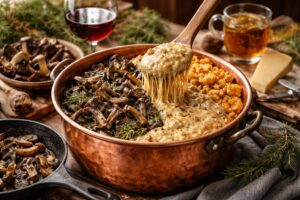
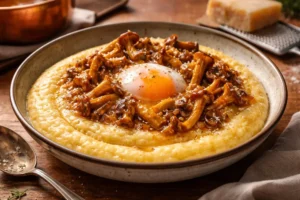
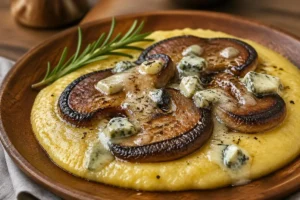
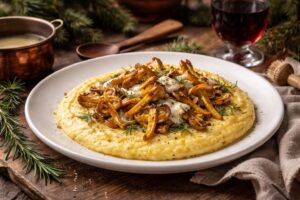
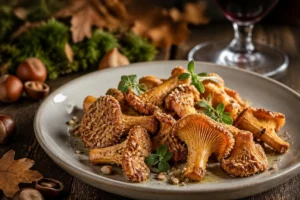
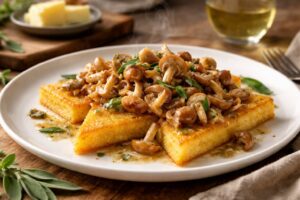
A monumental synthesis of the Langhe terroir, utilizing the structural resilience of the Golden Chanterelle to withstand a slow reduction in tannin-rich Nebbiolo wine, served over stone-ground Bramata polenta.
Barolo-Braised Golden Ridges on Toasted Polenta
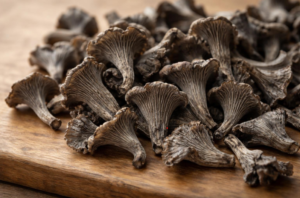
For our fifth formulation, we return to the fog-shrouded hills of Piedmont to explore the synergy between "The King of Wines" and the "Gold of the Forest." The Cantharellus cibarius (Golden Chanterelle) is one of the few fungi capable of maintaining its textural integrity when subjected to a long, acidic braise in a high-tannin environment like Barolo. This recipe is an exercise in Chiaroscuro—the contrast between the dark, brooding notes of the Nebbiolo grape and the bright, apricot-scented parenchyma of our premium Cantharellus cibarius. At pure-umami.cc, we view this dish as the ultimate expression of northern Italian rustic nobility.
The Culinary Physics of This Dish
The technical core of this dish is Polyphenolic Bonding. Barolo wine is rich in tannins and anthocyanins; when chanterelles are braised in this medium, the tannins bind with the fungal proteins, slightly "curing" the exterior and preventing the mushroom from becoming mushy. Molecularly, the acidity of the wine acts as a catalyst for the release of the chanterelle's internal esters. By reducing the braising liquid to a glace, we concentrate the umami compounds (guanylates) into a thick syrup that coats the mushrooms, while the toasted polenta provides a porous, alkaline base that balances the wine's acidity through structural contrast.
Terroir Narrative
In the Langhe region, the transition from summer to autumn is marked by the scent of woodsmoke and fermenting grapes. Chanterelles harvested from the steep, marl-rich slopes of Serralunga or La Morra possess a distinct minerality that stands up to the power of the Nebbiolo vine. This dish honors the contadino tradition of slow-cooking, where stone-ground cornmeal (Bramata) is stirred for an hour over a copper pot to achieve the perfect "tooth." It is the same terroir that yields our celebrated Boletus edulis and Amanita caesarea, here reimagined through the lens of a slow-cooked reduction.
The Polenta Base: Cook the polenta in salted water (4:1 ratio) for 45-50 minutes, stirring constantly. Once set, pour into a tray, let cool, cut into rectangles, and sear in a dry pan until a crust forms.
The Aromatic Foundation: Sauté the whole chanterelles in a small amount of oil with garlic and rosemary just until they start to "sweat."
The Braise: Pour the Barolo over the mushrooms. Bring to a boil, then reduce to a simmer. Add the consommé gradually. The liquid should cover the mushrooms halfway.
The Glazing Phase: Continue to simmer uncovered until the wine has reduced by 80%, forming a dark, lustrous glaze (syrup stage).
Mantecatura: Whisk in the cold butter cubes to create a glossy emulsion. Adjust the seasoning and serve immediately over the toasted polenta rectangles.
Shop Integration
The structural strength of our Cantharellus cibarius is essential here; lesser mushrooms would disintegrate in the wine's acidity. To deepen the color profile, we recommend a 15% inclusion of Craterellus cinereus (Grey Chanterelle), which takes on an almost black, truffle-like appearance when reduced in Barolo. For a more varied forest plate, consider adding a few Marasmius oreades for their almond-like aroma, which complements the toasted corn. In the height of autumn, a crown of seared Boletus edulis (Porcini) or a few petals of Amanita caesarea (Caesar's Mushroom) will elevate this dish to a royal banquet standard.
The Umami Profile
This dish features "Tannic Umami." The bitterness of the Barolo tannins provides a counterpoint that makes the natural sweetness and savory depth of the chanterelles pop. As the liquid reduces, the guanylate concentration reaches its peak, resulting in a flavor intensity that mimics slow-braised meat without the need for animal protein dominance.
Sommelier’s Choice
Naturally, an aged Barolo or Barbaresco. Look for a vintage with at least 5-7 years of age, where the tannins have softened into notes of leather, dried cherry, and forest floor (sous-bois), which will dance harmoniously with the braised Cantharellus cibarius.
The Etymological Chronicle
The term Barolo is Italian, named after the village in Piedmont. In French, this dish would be described as Chanterelles Braisées au Vin Rouge. In German, it is Pfifferlinge in Rotwein-Reduktion, and in Spanish, Rebozuelos al Vino Tinto. Regardless of the language, the Chanterelle remains the undisputed protagonist of this trans-Alpine heritage.
Pure Umami | Mycological Research & Culinary Arts | 2026
To provide the best experiences, we use technologies like cookies to store and/or access device information. Consenting to these technologies will allow us to process data such as browsing behavior or unique IDs on this site. Not consenting or withdrawing consent, may adversely affect certain features and functions.
Functional
Always active
The technical storage or access is strictly necessary for the legitimate purpose of enabling the use of a specific service explicitly requested by the subscriber or user, or for the sole purpose of carrying out the transmission of a communication over an electronic communications network.
Preferences
The technical storage or access is necessary for the legitimate purpose of storing preferences that are not requested by the subscriber or user.
Statistics
The technical storage or access that is used exclusively for statistical purposes.The technical storage or access that is used exclusively for anonymous statistical purposes. Without a subpoena, voluntary compliance on the part of your Internet Service Provider, or additional records from a third party, information stored or retrieved for this purpose alone cannot usually be used to identify you.
Marketing
The technical storage or access is required to create user profiles to send advertising, or to track the user on a website or across several websites for similar marketing purposes.