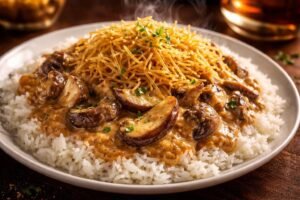
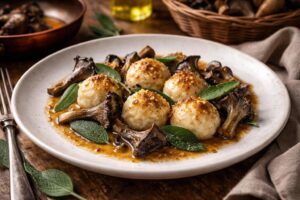
A technical study in High-Temperature Lipid Maillardization and Alcohol-Sugar Glaze Stabilization, utilizing the Parasol mushroom's expansive gills to anchor a molten layer of salty sheep's milk cheese and a flammable grape-spirit reduction.
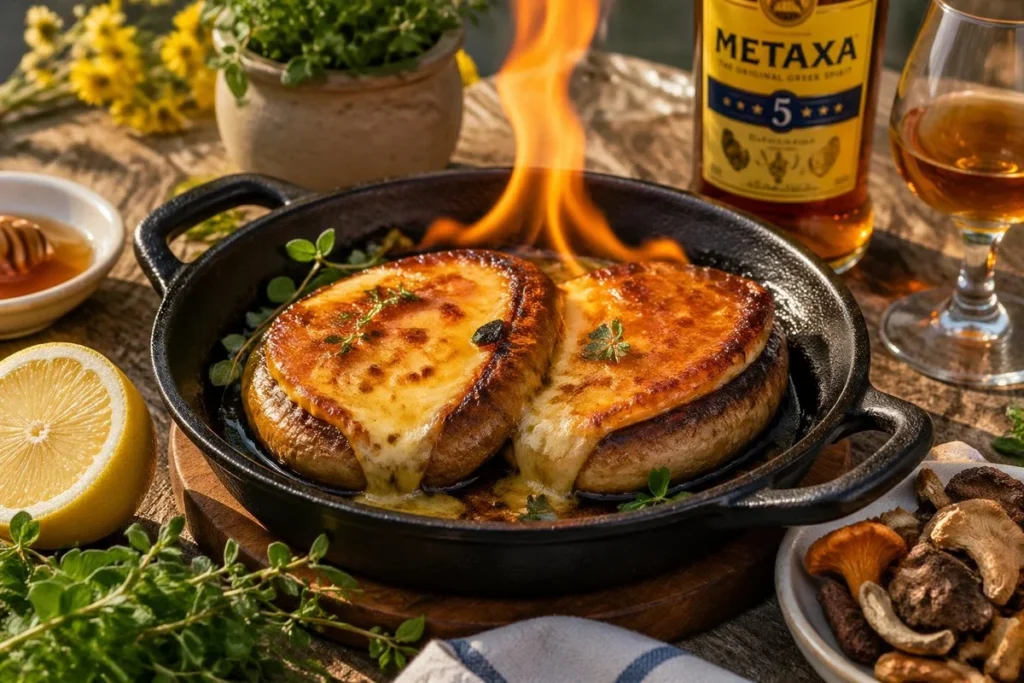
Greek-style Parasol “Saganaki” with Metaxa
For our 107th technical formulation, we analyze Thermal Protein Denaturation and Ethanol-Phase Volatilization. Macrolepiota procera (Parasol Mushroom), locally identified as Macrolepiota procera, serves as the perfect substrate for Saganaki—a technique defined by searing food in a small, two-handled pan. At pure-umami.cc, we utilize the high-heat properties of Macrolepiota procera to support a crust of Greek cheese, which is then flambéed with Metaxa (a Greek grape spirit) and drizzled with honey to create a complex, multi-layered "Agrodolce" effect.
The Culinary Physics of This Dish
The engineering of this saganaki relies on Saccharide-Alcohol Integration and Lipid Crusting. Molecularly, the hard Greek cheese (Kefalograviera or Graviera) has a high melting point, allowing it to form a Maillard Crust before losing its structural integrity. The **Macrolepiota procera** acts as an Absorbent Thermal Anchor; as the cheese melts, its salty lipids migrate into the mushroom's gills. When the Metaxa is ignited (flambéed), the high-temperature combustion (approx. 200°C) flash-caramelizes the surface honey and drives the spirit's oak-aged esters into the mushroom tissue, resulting in a persistent, smoky-sweet profile.
Terroir Narrative
This formulation is a tribute to Greece (Hellas) and the vibrant taverna culture of the Cyclades. We bridge the sun-drenched, rocky landscapes of the Aegean with the Balkan highland meadows. The terroir is expressed through the marriage of the forest's "wild" Macrolepiota procera and the sharp, saline intensity of mountain sheep cheeses. This follows the same technical rigor we apply to our Boletus edulis (Porcini) and Amanita caesarea (Caesar's mushroom), treating the flambé as a precision-controlled aromatic event.
Quick Info Bar
Spirit Catalyst
Cheese Variety
Complexity
Region
Metaxa (5* or 7*)
Kefalograviera
Grand Officier
Aegean, GR
Master Recipe (1:10 Rule)
2-4 Large Macrolepiota procera caps (Macrolepiota procera) – whole
150g Kefalograviera or Saganaki cheese (sliced 1cm thick)
30ml Metaxa (Greek Spirit)
1 tbsp Thyme Honey
1 Lemon (for the Citric Stabilization)
Fresh Oregano and Olive Oil
Flour (for dredging the cheese)
The Technique
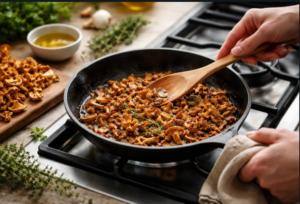
The Fungal Sear: Sear the **Macrolepiota procera** caps in olive oil in a heavy skillet until golden. Remove and set aside.
The Cheese Crust: Dip the cheese slices in water, then dredge in flour. Fry in the same skillet until a golden-brown crust forms on both sides. This is the Starch-Protein Matrix phase.
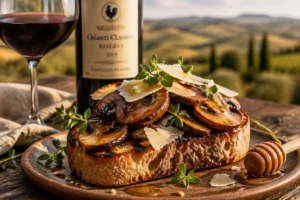
The Integration: Place the seared mushrooms back in the pan and top with the hot cheese. Drizzle with honey.
The Pyrotechnic Flambé: Pour the Metaxa over the mushrooms and cheese. Carefully ignite with a long match. Let the flames subside naturally—this facilitates Ethanol Volatilization.
Service: Immediately squeeze fresh lemon juice over the top to extinguish any remaining embers and balance the honey's sweetness. Serve sizzling in the pan.
Shop Integration
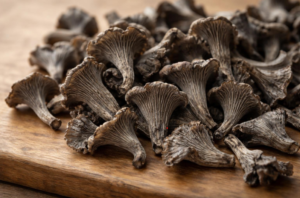
The Macrolepiota procera provides the essential nutty volume, but its umami depth can be layered. We recommend adding a few dried Boletus edulis (Porcini) slices to the pan during the cheese sear for a meatier aromatic base. If you seek a brighter peppery contrast, garnish with sautéed Cantharellus cibarius (Chanterelle). For a luxury upgrade, finish the honey with a few drops of Morchella conica (Morel) oil. If available, raw shavings of Amanita caesarea (Caesar's mushroom) with a simple olive oil and sea salt dressing provides a necessary mineral "reset." For a smoky baseline, our Craterellus cinereus (Grey Chanterelle) can be sautéed with the mushrooms for its dark flavor depth.
The Umami Profile
This dish features **Saline-Sweet Synergistic Umami**. The Macrolepiota procera provides the necessary fungal guanylates, while the aged cheese introduces a high concentration of free glutamates. The honey and Metaxa introduce Maillard-Derived Furans and Vanillin Esters, which harmonize with the mushroom's natural almond notes. The result is a savory experience that is exceptionally vibrant, moving between salt, smoke, and forest-earthiness.
Sommelier’s Choice
A glass of **Assyrtiko (Santorini)** or a chilled **Ouzo**. The high acidity and volcanic minerality of the Assyrtiko are the technical requirement to cut through the rich fried cheese and match the intensity of the Metaxa-flambéed Parasol mushroom.
The Etymological Chronicle
The term Saganaki is **Greek**, referring to the small pan (sagani). In **French**, this would be a Coulemelle à la Grecque Flambée au Metaxa. In **German**, it is Griechischer Parasolpilz-Saganaki. In **Spanish**, it is Saganaki de Galamperna. Regardless of the language, the **Parasol mushroom** Saganaki remains the definitive standard for technical spirit-based mycological engineering.
Pure Umami | Mycological Research & Culinary Arts | 2026
To provide the best experiences, we use technologies like cookies to store and/or access device information. Consenting to these technologies will allow us to process data such as browsing behavior or unique IDs on this site. Not consenting or withdrawing consent, may adversely affect certain features and functions.
Functional
Always active
The technical storage or access is strictly necessary for the legitimate purpose of enabling the use of a specific service explicitly requested by the subscriber or user, or for the sole purpose of carrying out the transmission of a communication over an electronic communications network.
Preferences
The technical storage or access is necessary for the legitimate purpose of storing preferences that are not requested by the subscriber or user.
Statistics
The technical storage or access that is used exclusively for statistical purposes.The technical storage or access that is used exclusively for anonymous statistical purposes. Without a subpoena, voluntary compliance on the part of your Internet Service Provider, or additional records from a third party, information stored or retrieved for this purpose alone cannot usually be used to identify you.
Marketing
The technical storage or access is required to create user profiles to send advertising, or to track the user on a website or across several websites for similar marketing purposes.