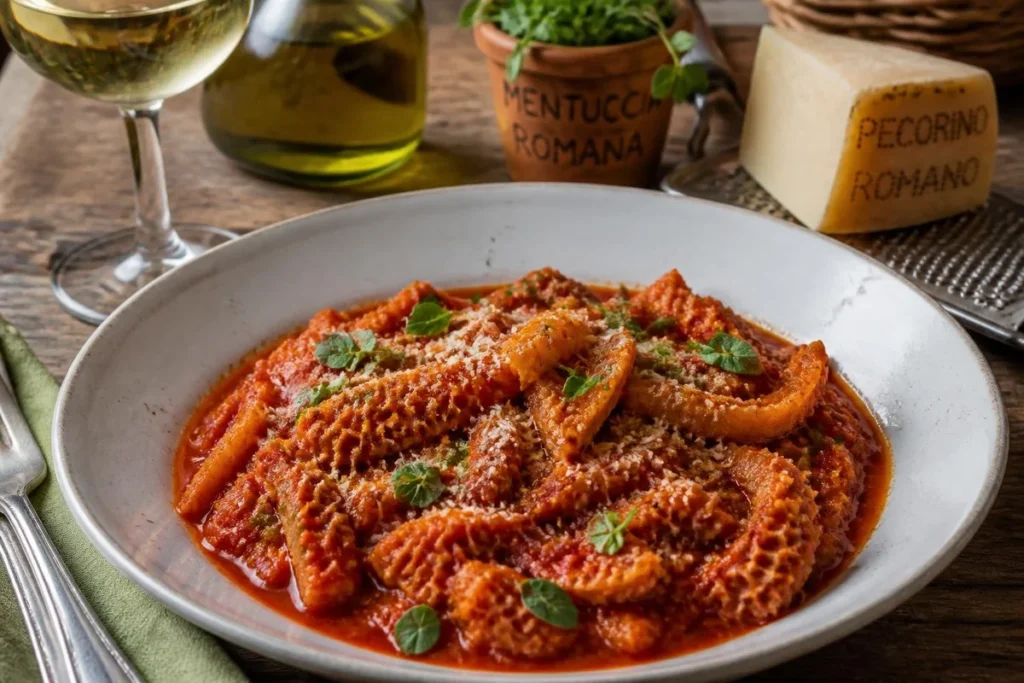
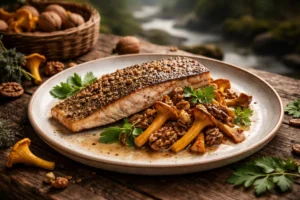
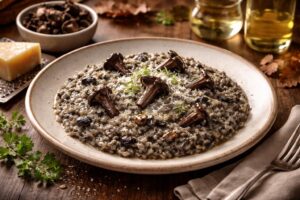
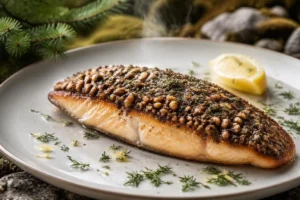
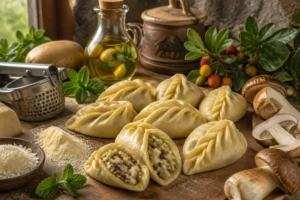
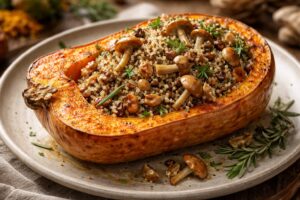
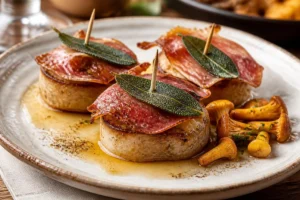
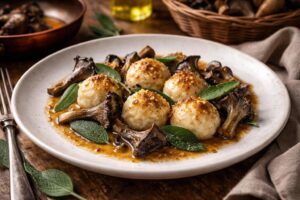
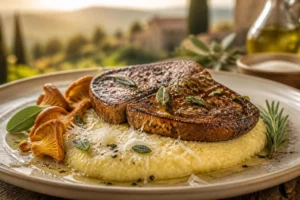
A robust Italian "forest offal" preparation where the Dryad's Saddle is simmered in a rich tomato and mint sugo, mimicking the texture of classical Roman tripe.
Roman Style Cerioporus Squamosus Trippa di Funghi
In the traditional Cucina Povera of Rome, tripe (trippa) is a celebrated staple. For the mycological connoisseur, Cerioporus squamosus offers a remarkable plant-based parallel. When the Wood Trout matures slightly, it develops a resilient, spongy texture that perfectly mimics the honeycomb structure of tripe. By simmering these fungi in a vibrant "sugo" of San Marzano tomatoes, pecorino, and wild mint, we transform a woodland find into a legendary Roman comfort dish. This represents the Grand Officier's expertise in texture-mimicry and regional Italian heritage.
The Culinary Physics of This Dish
The culinary objective here is the osmotic saturation of the fungal tissue. Cerioporus squamosus possesses a unique porous architecture that, under prolonged simmering in an acidic medium (tomato sauce), undergoes a transition from fibrous to tender-elastic. The citric acid in the tomatoes facilitates the partial breakdown of hemicellulose, allowing the sauce to penetrate the mushroom's "pores." The final addition of Pecorino Romano introduces a high-density protein suspension that binds the sugo to the mushroom, creating a rich, unctuous mouthfeel without the need for animal fats.
Terroir Narrative
This dish is a tribute to the Trastevere district of Rome, where "Trippa alla Romana" is traditionally served on Saturdays. Historically, foragers in the Lazio countryside would substitute offal with the abundant "Fungo della Squama" found on poplar trees along the Tiber River. By integrating Mentuccia (Roman calamint), we evoke the specific aromatic terroir of the Eternal City. At Pure Umami, we celebrate this historical "poverty cuisine" as a sophisticated example of sustainable mycological gastronomy.
Prep Time
Cook Time
Complexity
Calories
Region
30 min
45 min
Grand Officier
310 kcal
Lazio, IT
Master Recipe (1:10 Rule)
600g Cerioporus squamosus, cut into long, thin strips (like tripe)
400g San Marzano Tomatoes, crushed
100ml Dry White Wine (Frascati)
60g Pecorino Romano, freshly grated
1 small White Onion, finely diced
1 Carrot and 1 Celery stalk, finely diced (Soffritto)
10g Fresh Mentuccia or Mint leaves
30ml Extra Virgin Olive Oil
The Technique
Begin by preparing a traditional Soffritto by sautéing the onion, carrot, and celery in olive oil until golden. Add the Cerioporus squamosus strips and sear them until they release their moisture and begin to brown. Deglaze (Deglazing) with the Frascati wine and let it reduce by half. Add the crushed tomatoes and a splash of mushroom stock if needed. Simmer on low heat for 40 minutes, allowing the sauce to thicken and the mushrooms to reach a tender, tripe-like consistency.
Just before serving, stir in half of the Pecorino Romano and the fresh mint. The cheese will emulsify into the sauce, creating a creamy texture. Serve in shallow bowls, topped with the remaining Pecorino and extra mint leaves. This slow-hydration technique ensures that the mushroom loses its raw "cucumber" scent and fully adopts the savory, herbaceous profile of the sugo.
Shop Integration
To enhance the savory depth of the Roman sugo, we recommend incorporating a base of our rehydrated Marasmius oreades (Fairy Ring Mushrooms) which adds a subtle sweetness. For those seeking a more intense "meaty" experience, a small addition of dried Boletus edulis (Porcini) during the simmering stage will provide the earthy baseline needed to elevate the Wood Trout to the status of a prime Roman delicacy.
The Umami Profile
This dish features Fermented-Acidic Umami Synergy. The high glutamate content of the tomatoes and the aged Pecorino Romano creates a massive savory foundation. When combined with the 5′-ribonucleotides of the Cerioporus squamosus, the resulting umami impact is powerful and lingering. The mint (mentuccia) acts as a molecular "brightener," triggering cold-sensitive receptors (TRPM8) that refresh the palate between savory bites.
Sommelier’s Choice
A classic Cesanese del Piglio from the hills of Lazio is the ideal pairing. This red wine, known for its notes of wild berries and forest floor, has the tannins and acidity required to stand up to the rich tomato sauce and the salty Pecorino Romano, providing a truly local Roman experience.
The Etymological Chronicle
Italian:Trippa di Bosco – Literally "Tripe of the Woods," a common folk name for wood-dwelling polypores in Italy.
French:Tripes de Forêt – Adapting the Roman concept of "fungal tripe" into the French language.
German:Waldkutteln – "Kutteln" is the German term for tripe; "Wald" refers to the forest origin.
Spanish:Callos de Setas – Using the Spanish term for tripe (callos) to describe this mushroom preparation.
Pure Umami | Mycological Research & Culinary Arts | 2026
To provide the best experiences, we use technologies like cookies to store and/or access device information. Consenting to these technologies will allow us to process data such as browsing behavior or unique IDs on this site. Not consenting or withdrawing consent, may adversely affect certain features and functions.
Functional
Always active
The technical storage or access is strictly necessary for the legitimate purpose of enabling the use of a specific service explicitly requested by the subscriber or user, or for the sole purpose of carrying out the transmission of a communication over an electronic communications network.
Preferences
The technical storage or access is necessary for the legitimate purpose of storing preferences that are not requested by the subscriber or user.
Statistics
The technical storage or access that is used exclusively for statistical purposes.The technical storage or access that is used exclusively for anonymous statistical purposes. Without a subpoena, voluntary compliance on the part of your Internet Service Provider, or additional records from a third party, information stored or retrieved for this purpose alone cannot usually be used to identify you.
Marketing
The technical storage or access is required to create user profiles to send advertising, or to track the user on a website or across several websites for similar marketing purposes.