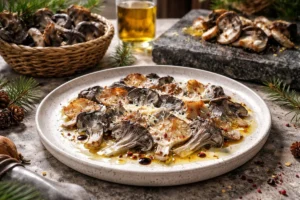
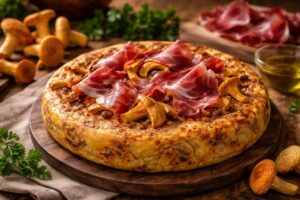
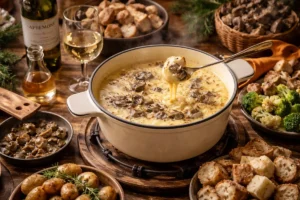
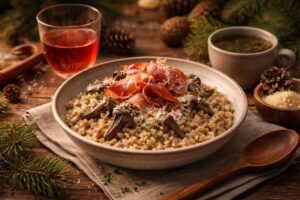
Rustic King Porcini Sautéed with Wild Alliums and Fine Herbs
The Historical Prelude
The "Village-Style" sauté is a culinary archetype that traces its lineage to the deep-wooded regions of the French Savoie and the Italian Dolomites. For centuries, this was the primary method for mountain dwellers to enjoy the *Boletus edulis* (King Porcini) immediately after a successful harvest. While the courts of Paris were busy pureeing and masking the mushroom's texture, the rural villages celebrated the Porcini as a "Forest Steak."
Historically, this preparation was the centerpiece of the Fête des Champignons—the mushroom festivals that marked the arrival of autumn. It was a dish of communal survival and celebration, where the only additions were what could be found in the kitchen garden: garlic, parsley, and high-fat butter. This "Cucina Povera" style was later championed by the legendary Paul Bocuse, who argued that the most sophisticated way to treat a noble ingredient like the Porcini was to interfere as little as possible with its natural essence.
The village style is defined by "High Heat, Low Movement." We seek to create a caramelized exterior that seals in the mushroom's moisture, preventing it from becoming slimy. The garlic and herbs are added at the very end—the dernier instant—to ensure their volatile oils perfume the dish without burning.
Sensory & Foraging Profile
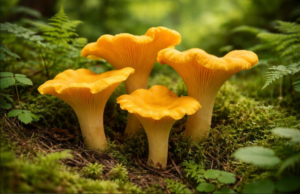
Nomenclature:Boletus edulis (King Porcini) and Petroselinum crispum (Flat-leaf Parsley).
Terroir: The finest Porcini for a rustic sauté are those found in the Black Forest or the Atlantic Fringes. These regions provide a mushroom with a slightly higher density, allowing the cap to maintain its "meatiness" under the intense heat of the skillet.
Professional Protocol: We emphasize the "Dry-Brush" cleaning method. In village traditions, washing a Porcini is considered a culinary sin, as the porous gills act like a sponge, ruining the potential for a crisp sear. We only select young "Cèpes Bouchons" (button-sized) for the most tender results.
Essential Equipment
Heavy Steel or Cast Iron Pan: Crucial for maintaining the high temperature required for caramelization.
Natural Bristle Mushroom Brush: To remove every microscopic particle of forest floor without damaging the skin.
Linen Towel: To pat the mushrooms perfectly dry before they hit the oil.
Master Recipe
Stage 1: The Precision Cut
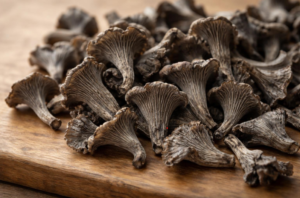
500g Fresh King Porcini (or 50g Dried Porcini, rehydrated and thoroughly dried).
Slice the 500g Fresh Porcini (or 50g rehydrated equivalent) into 1cm thick vertical slices, ensuring each piece contains a portion of both the cap and the stem.
Stage 2: The High-Heat Sear
Heat 2 tablespoons of neutral oil (grapeseed) in the pan until it begins to shimmer.
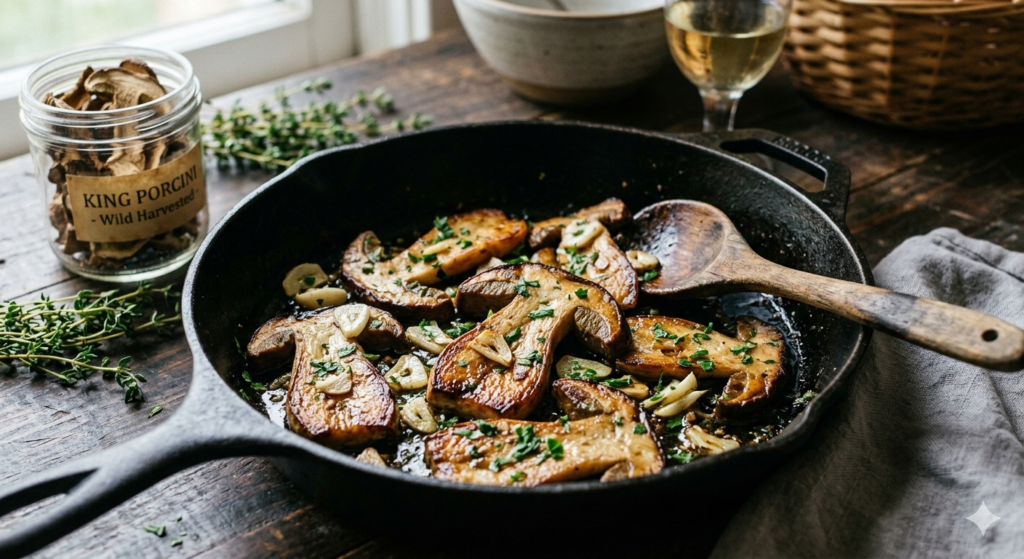
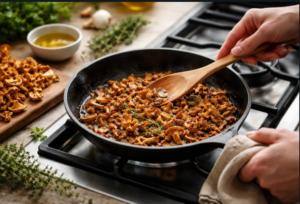
Place the Porcini in a single layer. Do not crowd the pan. Leave them undisturbed for 3 minutes until a dark, mahogany crust forms. Flip and repeat for 2 minutes.
Stage 3: The Village Finish
Reduce heat to medium. Add 30g of cold, cultured butter.
Toss in 3 cloves of smashed garlic and a large handful of chopped flat-leaf parsley.
Baste the mushrooms with the foaming butter for 60 seconds. Season with *Fleur de Sel* and a crack of black pepper. Serve immediately.
The Umami Secret: The 1:10 Maillard Boost
To achieve a professional "Pure Umami" depth in a village dish, use the 1:10 Fortification. Take 5g of dried Porcini, pulverize them into a coarse "grit," and sprinkle it over the fresh mushrooms during the final butter-basting stage. This grit acts as a magnet for the butter and garlic, creating a savory "crust" that mimics the flavor intensity of 50g of fresh mushrooms concentrated into every bite.
Pro Technique: The “Squeak” Test
A perfectly sautéed village-style Porcini should "squeak" slightly when pressed. This indicates that the exterior is crisp while the internal cellular structure remains hydrated and firm. If the mushroom feels soft, the heat was too low.
The Art of Pairing
Sommelier's Choice: A rustic Beaujolais (Cru) or a Barbera d'Alba. These wines possess the bright acidity and fruit-forward notes needed to cut through the garlic butter while respecting the mushroom's earthiness.
Non-Alcoholic: A sparkling infusion of wild juniper berries and rosemary.
Ancestral Nutrition
Porcini are a vital source of Vitamin D and B-complex vitamins. In the traditional lore of the Pyrenees, this sauté was known as "The Forager's Strength," often consumed with a slice of sourdough bread to provide a complete protein and mineral profile for a long day of wood-splitting or harvesting.
Micro-FAQ
Q: Why do I add the garlic at the end? A: High heat is required to sear the Porcini, but that same heat would turn garlic bitter and acrid in seconds. Adding it at the end allows it to perfume the butter safely.
Q: Can I use the 1:10 ratio with dried thyme instead of parsley? A: Yes, but use thyme sparingly (1:20 ratio), as its flavor is much more aggressive and can mask the delicate apricot notes of the King Porcini.
To provide the best experiences, we use technologies like cookies to store and/or access device information. Consenting to these technologies will allow us to process data such as browsing behavior or unique IDs on this site. Not consenting or withdrawing consent, may adversely affect certain features and functions.
Functional
Always active
The technical storage or access is strictly necessary for the legitimate purpose of enabling the use of a specific service explicitly requested by the subscriber or user, or for the sole purpose of carrying out the transmission of a communication over an electronic communications network.
Preferences
The technical storage or access is necessary for the legitimate purpose of storing preferences that are not requested by the subscriber or user.
Statistics
The technical storage or access that is used exclusively for statistical purposes.The technical storage or access that is used exclusively for anonymous statistical purposes. Without a subpoena, voluntary compliance on the part of your Internet Service Provider, or additional records from a third party, information stored or retrieved for this purpose alone cannot usually be used to identify you.
Marketing
The technical storage or access is required to create user profiles to send advertising, or to track the user on a website or across several websites for similar marketing purposes.