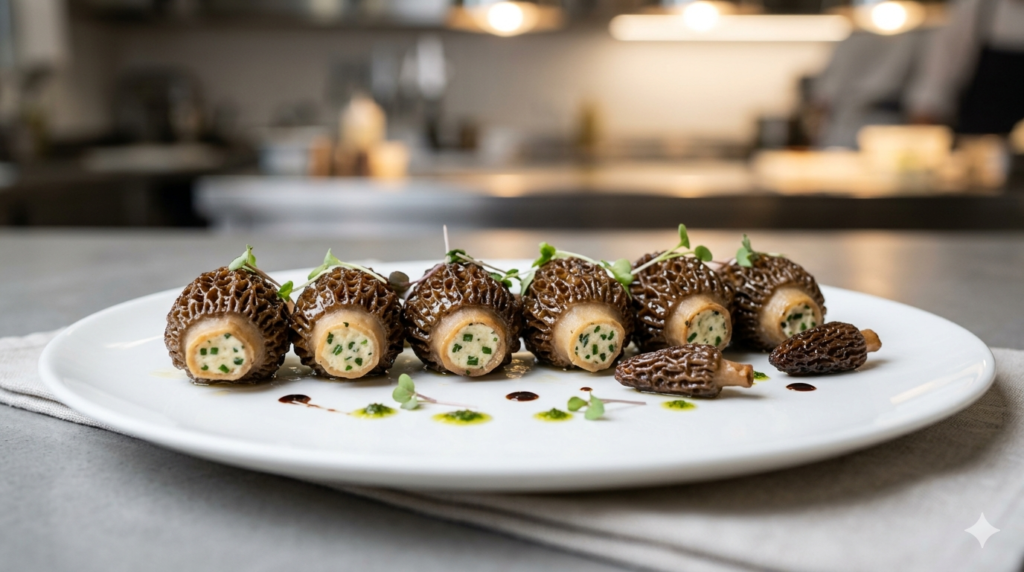
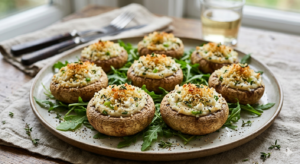
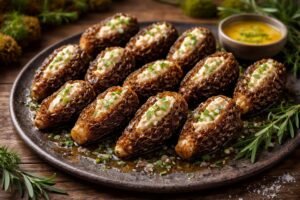
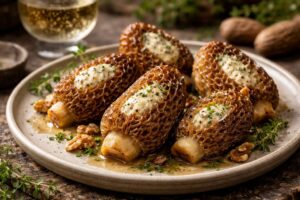
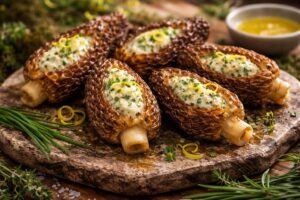
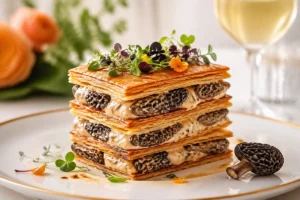
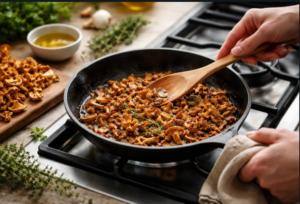
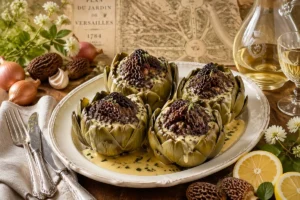
An opulent spring masterpiece featuring the honeycomb-textured Morchella filled with a silken, aromatic mousse and gratinated to perfection.
The Vernal Crown
Gratinated Morels Filled with an Artisanal Shallot and Fine Herb Mousse
The Historical Prelude
The Morchella, or Morel, is a hollow architectural miracle of the mycological world, a characteristic that made it the darling of the 17th-century French High Baroque kitchens. While commoners often dried morels for winter survival, the royal chefs at the Court of Versailles recognized the mushroom as a natural "terroir-vessel." They began the tradition of stuffing these caps with intricate farces (fillings) made of cream, minced game, and early spring herbs.
Legend has it that King Louis XV was particularly fond of morels stuffed with a delicate poultry mousse, a dish that signaled the official start of the spring season at court. This technique was later codified by Auguste Escoffier, who emphasized that the stuffing must never overshadow the morel's own smoky, nut-like profile. In his view, the stuffing was meant to "echo" the forest floor, using lipids to carry the mushroom's volatile aromas directly to the palate. Today, the stuffed morel remains the ultimate test of a saucier's finesse and a forager's patience.
The Morel is a "Structural Sponge." Its honeycomb exterior and hollow interior are designed to trap flavor. Our philosophy treats the morel as a flavor reservoir. By stuffing the mushroom and then slow-cooking it in a butter-emulsion, we allow the filling to expand and the mushroom cap to shrink, creating a pressurized environment that fuses the two components into a single "Pure Umami" bite.
Sensory & Foraging Profile
Nomenclature:Morchella esculenta (Yellow Morel) and Morchella elata (Black Morel).
Terroir: The finest specimens for stuffing are found in the Atlantic Fringes and the Black Forest. The soil must be alkaline and rich in wood-ash minerals. These morels develop a thick, elastic cell wall that can withstand the internal pressure of a mousse without tearing.
Professional Protocol: We only harvest morels that have reached at least 6cm in height for stuffing purposes. We use the "Base-Cut" method, leaving the subterranean mycelial network intact. In accordance with "Leave No Trace" ethics, we never harvest after a heavy frost, as the cellular integrity of the morel is compromised.
Essential Equipment
Precision Piping Bag: With a 3mm plain tip for filling the delicate hollow cavities.
Surgical-Grade Tweezers: For handling the fragile morels during the cleaning and stuffing phase.
Heavy Steel Sauté Pan: To achieve a uniform gratin without burning the delicate tips.
Master Recipe
Stage 1: The Mushroom Preparation
350g Large Fresh Morels (or 35g Dried Morels, rehydrated).
Clean the fresh mushrooms with a soft brush. Use a small knife to cut a tiny opening at the base of the stem, but keep the cap whole.
If using 35g Dried (350g Fresh equivalent), rehydrate in warm milk for 40 minutes, then drain and pat bone-dry.
Stage 2: The Herb-Infused Mousse
150g Fresh Ricotta or softened Chèvre.
1 egg yolk (for structural stability).
2 finely minced shallots sautéed in butter, mixed with chopped Chives and Chervil.
Fold the ingredients together and pass through a fine sieve to ensure a molecularly smooth texture for the piping bag.
Stage 3: The Infusion & Gratin
Pipe the mousse into the hollow center of the 350g Fresh Morels (or 35g rehydrated equivalent). Do not overfill; the mousse will expand.
Heat 40g of clarified butter in a pan. Place the morels in the pan and add 50ml of dry Madeira.
Bake in the oven at 180°C for 12 minutes, basting once with the pan juices. The morels should look glazed and the filling should be set.
The Umami Secret: The 1:10 Extraction Glaze
To achieve a 3-star Michelin depth, utilize the 1:10 Molecular Extraction. If you are using fresh morels, take 5g of dried morel powder (the equivalent of 50g fresh) and whisk it into the Madeira reduction in the pan. This powder provides a concentrated "bass note" of smoke and earth that bridges the gap between the fresh mushroom skin and the creamy herb filling.
Pro Technique: The “Internal Steam” Method
When cooking stuffed morels, the moisture from the mousse steams the mushroom from the inside out. To maximize this, ensure the morels are placed upright or slightly tilted in the pan. This prevents the filling from leaking and ensures the honeycomb pits on the outside are roasted while the interior remains succulent.
The Art of Pairing
Sommelier's Choice: A Savennières (Chenin Blanc) or a vintage Champagne. The wine's oxidative notes and high acidity are required to cut through the creamy stuffing while echoing the morel's nuttiness.
Non-Alcoholic: A cold-brewed Pu-erh Tea, which provides the same earthy, fermented profile as the Madeira wine.
Ancestral Nutrition
Morels are an exceptional source of Vitamin D and Iron. Historically, in the French Savoie, stuffed morels were served to the local nobility as a "spring tonic" to restore vitality after the metabolic dormancy of winter.
Micro-FAQ
Q: Why is the 1:10 ratio so important for stuffing? A: Because dried morels (35g) have ten times the flavor concentration of fresh ones (350g). When rehydrated in milk, they provide a much sturdier structure for the mousse than fresh morels, which can sometimes collapse if they are too watery.
Q: Can I use regular garlic instead of shallots? A: It is not recommended. Garlic can be too aggressive and may mask the delicate hazelnut volatiles of the Morchella.
The Morel Lexicon: Regional Names for Morchella
The Morel is the undisputed queen of the spring forest. Its honeycomb structure and deep earthy aroma have earned it legendary status in cuisines from the Himalayas to the Appalachian Mountains:
Language
Regional & Folk Names
Cultural Context
English
Morel, Yellow Morel, Sponge Mushroom, Dryland Fish
"Dryland fish" is a popular folk name in the American South.
French
Morille, Morille blonde, Morille ronde
A staple of classic French haute cuisine.
German
Speisemorchel, Rund-Morchel
Highly valued in Alpine culinary traditions.
Bulgarian
Смърчкула, Пумпалка, Корминка, Мрежовка
"Pumpalka" refers to its spinning-top shape.
Romanian
Zbârciog, Ciuciulete, Попеască
"Zbârciog" is the most common term in Romanian folklore.
Russian / Polish
Сморчок (Smorchok) / Smardz jadalny
Considered a sign of the real spring's arrival.
Italian / Spanish
Spugnola / Colmenilla, Morilla
"Spugnola" (Italy) and "Colmenilla" (Spain) refer to the sponge/honeycomb look.
Turkish
Kuzu Göbeği Mantarı
Literally "Lamb's Belly" mushroom, a gourmet export of Turkey.
Japanese / Chinese
Amigasa-take (アミガサタケ) / Yangdujun
In China, it is highly valued for its medicinal properties.
Nordic (SE/NO/DK)
Toppmurkla / Rund morkel
A highly anticipated spring find in Scandinavia.
Scientific identification: Genus: Morchella | Pure Umami Research 2026
To provide the best experiences, we use technologies like cookies to store and/or access device information. Consenting to these technologies will allow us to process data such as browsing behavior or unique IDs on this site. Not consenting or withdrawing consent, may adversely affect certain features and functions.
Functional
Always active
The technical storage or access is strictly necessary for the legitimate purpose of enabling the use of a specific service explicitly requested by the subscriber or user, or for the sole purpose of carrying out the transmission of a communication over an electronic communications network.
Preferences
The technical storage or access is necessary for the legitimate purpose of storing preferences that are not requested by the subscriber or user.
Statistics
The technical storage or access that is used exclusively for statistical purposes.The technical storage or access that is used exclusively for anonymous statistical purposes. Without a subpoena, voluntary compliance on the part of your Internet Service Provider, or additional records from a third party, information stored or retrieved for this purpose alone cannot usually be used to identify you.
Marketing
The technical storage or access is required to create user profiles to send advertising, or to track the user on a website or across several websites for similar marketing purposes.