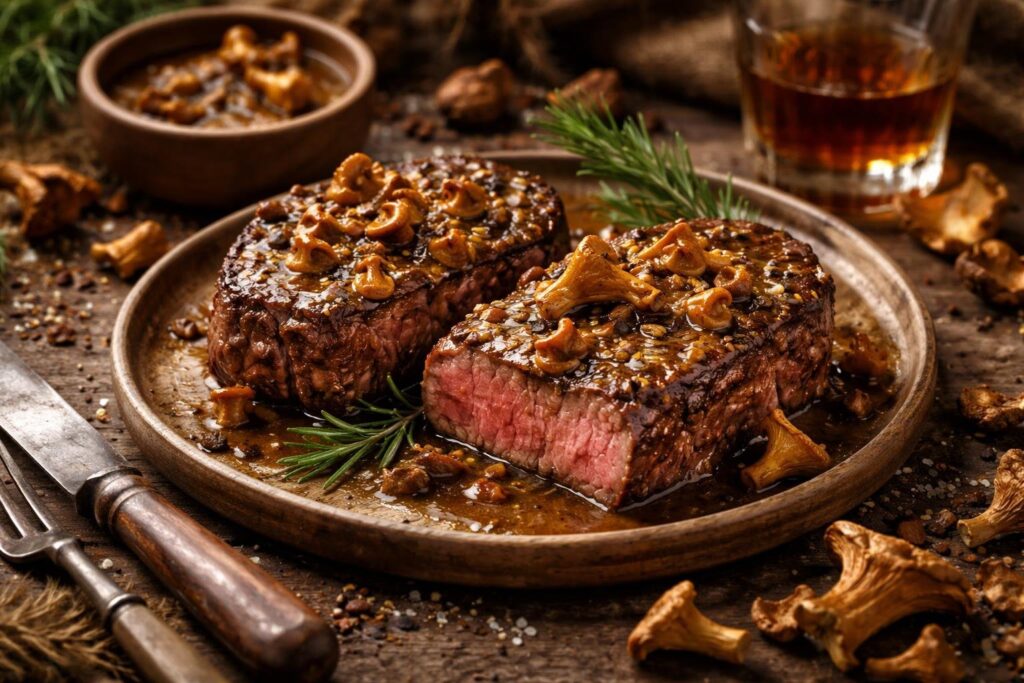
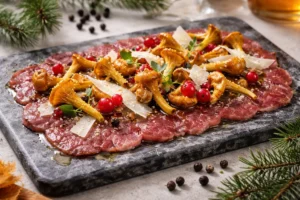
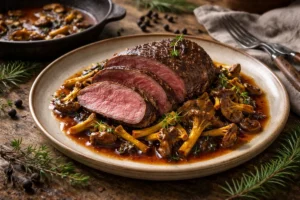
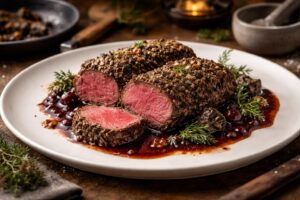
A primal, high-aroma masterpiece pairing the lean, iron-rich elegance of wild venison with the golden, apricot-scented Cantharellus cibarius in a robust peppercorn reduction.
The Wilderness Steak
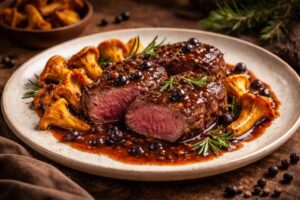
Wild Venison Loin with Golden Chanterelles and a Crushed Green Peppercorn Reduction
The Historical Prelude
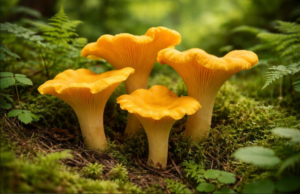
The pairing of Venison and Chanterelles is the ultimate culinary expression of the Hercynian Forest and the Balkan High Pastures. Historically, this was the "Hunter's Bounty," a dish that could only be prepared during the brief window when the deer were at their prime and the Cantharellus cibarius (Golden Chanterelle) carpeted the mossy forest floor.
In the royal hunting lodges of the Austro-Hungarian Empire, this dish was celebrated for its "Primal Harmony." Venison, being exceptionally lean and iron-dense, requires a fat-rich accompaniment to carry its flavor. The Chanterelle, with its unique apricot-and-pepper volatiles, provides a bright, fruity counterpoint to the deep, "metallic" profile of game meat. By the 19th century, French master sauciers refined this rustic pairing into a Grand Cuisine staple, utilizing reduction techniques to bond the mushroom's esters with the concentrated juices of the wild.
The objective is Nucleotide Synchronization. Venison is rich in Inosinates, while Chanterelles are packed with Guanylates. Our philosophy focuses on Pan-Bonding: we sear the venison first, creating a *fond* of browned proteins, then use the Chanterelles to "mop up" these savory molecules. The addition of green peppercorns provides a "bright" frequency that cuts through the richness, ensuring a balanced, "Wilderness" profile.
Sensory & Foraging Profile
Nomenclature:Cervus elaphus (Red Deer) and Cantharellus cibarius (Golden Chanterelle).
Terroir: The finest Chanterelles for game are harvested from the acidic, coniferous soils of the Atlantic Fringes and the Rhodope Mountains. These regions produce specimens with a higher concentration of peppery terpenes, which are necessary to stand up to the robust flavor of wild venison.
Professional Protocol: We clean the mushrooms with a soft brush, never water, to preserve their ability to sear. In accordance with "Leave No Trace" ethics, we only harvest mushrooms with a flared edge, ensuring sporal dispersal. The venison must be dry-aged for at least 14 days to relax the fibers and concentrate the umami.
Essential Equipment
Heavy Cast Iron Skillet: For achieving the intense Maillard reaction required for game meat.
Digital Probe Thermometer: Critical for venison, which becomes tough if cooked past 54°C (Medium-Rare).
Wide Fish Spatula: To handle the delicate Chanterelle caps during the sauté.
Master Recipe
Stage 1: The Maillard Sear
400g Venison Loin (Room Temp). Pat bone-dry.
Sear in a scorching pan with grapeseed oil for 3 minutes per side until a dark crust forms. Aim for an internal temp of 52°C. Remove and rest for 10 minutes (mandatory).
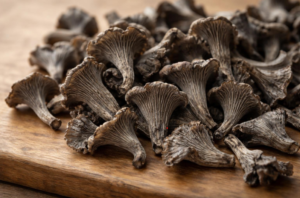
If using 30g Dried (300g Fresh equivalent), rehydrate in warm water and reserve the "Golden Nectar."
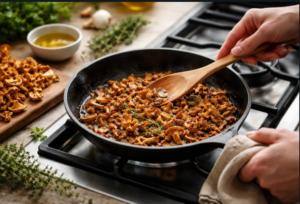
In the same venison pan, add 20g of butter and the 300g Fresh (or 30g rehydrated) mushrooms. Sauté until they "squeak" and absorb the meat *fond*.
Stage 3: The Peppery Reduction
Add 1 tablespoon of crushed green peppercorns and 50ml of dry Gin or Brandy. Flambé carefully.
Add 100ml of heavy cream and any reserved "Golden Nectar." Reduce by half until the sauce is glossy and thick.
Slice the venison and pour the sauce generously over the meat. Finish with a few fresh thyme leaves.
The Umami Secret: The 1:10 Terroir Synergy
The "Pure Umami" of the Wilderness Steak is achieved through the 1:10 Molecular Extraction. Dried Chanterelles contain ten times the density of guanylates compared to fresh ones. By rehydrating 30g of dried mushrooms and using the resulting nectar in the reduction, you create a "savory bridge" that physically bonds the meat's proteins to the mushroom's aromatics. This concentration ensures that the "Forest" flavor is present in every molecule of the sauce.
Pro Technique: The “Cold-Butter Mount”
To achieve a 3-star Michelin finish, whisk in a small knob of ice-cold butter right after the cream has reduced. This Monter au Beurre technique provides a reflective, mirror-like sheen to the sauce and adds a final layer of lactic sweetness to balance the peppery bite of the Chanterelles.
The Art of Pairing
Sommelier's Choice: A structured Syrah (Northern Rhône) or a Mavrotragano. The wine's black pepper notes and dark fruit are structural mirrors to the venison and the Chanterelles.
Non-Alcoholic: A cold-brewed Forest Fruit Tea with a dash of black pepper syrup.
Ancestral Nutrition
Venison is a superior source of Iron and B12, while Chanterelles provide high levels of Vitamin D. Historically, in the French Alps, this was known as the "Hunter's Strength Meal," served to prepare the body for the metabolic demands of the autumn frost.
Micro-FAQ
Q: Why use the 1:10 ratio for game meat? A: Because Venison is powerful. 30g of dried Chanterelles provide the aromatic volume of 300g of fresh ones, ensuring the mushroom's delicate notes aren't completely eclipsed by the robust flavor of the game.
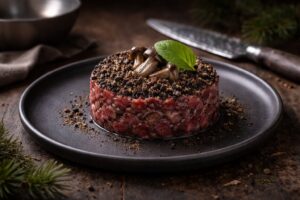
Q: Can I use beef instead of venison? A: Yes, a lean Fillet or Hanger steak is a good substitute, but you will miss the specific "wild" mineral profile that only venison provides.
To provide the best experiences, we use technologies like cookies to store and/or access device information. Consenting to these technologies will allow us to process data such as browsing behavior or unique IDs on this site. Not consenting or withdrawing consent, may adversely affect certain features and functions.
Functional
Always active
The technical storage or access is strictly necessary for the legitimate purpose of enabling the use of a specific service explicitly requested by the subscriber or user, or for the sole purpose of carrying out the transmission of a communication over an electronic communications network.
Preferences
The technical storage or access is necessary for the legitimate purpose of storing preferences that are not requested by the subscriber or user.
Statistics
The technical storage or access that is used exclusively for statistical purposes.The technical storage or access that is used exclusively for anonymous statistical purposes. Without a subpoena, voluntary compliance on the part of your Internet Service Provider, or additional records from a third party, information stored or retrieved for this purpose alone cannot usually be used to identify you.
Marketing
The technical storage or access is required to create user profiles to send advertising, or to track the user on a website or across several websites for similar marketing purposes.