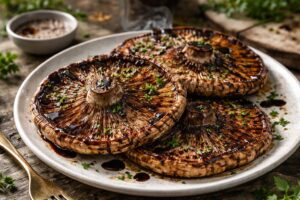
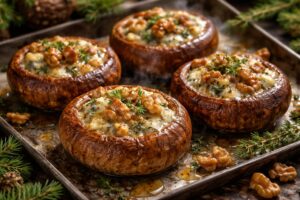
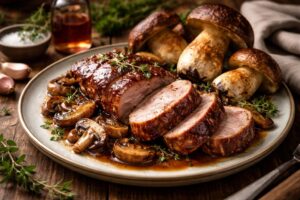
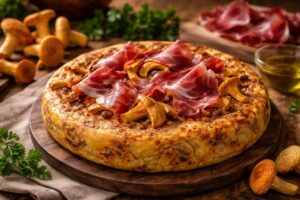
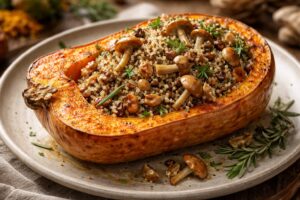
An advanced technical study in "Pyrolytic Flavor Profiling," utilizing the high-thermal energy of open flame to induce rapid Maillard-caramelization on the Parasol mushroom's exterior, while infusing the tissue with lacto-fermented capsicum and allicin-derived volatiles.
Wood-Fired Macrolepiota with Wild Garlic and Fermented Chili
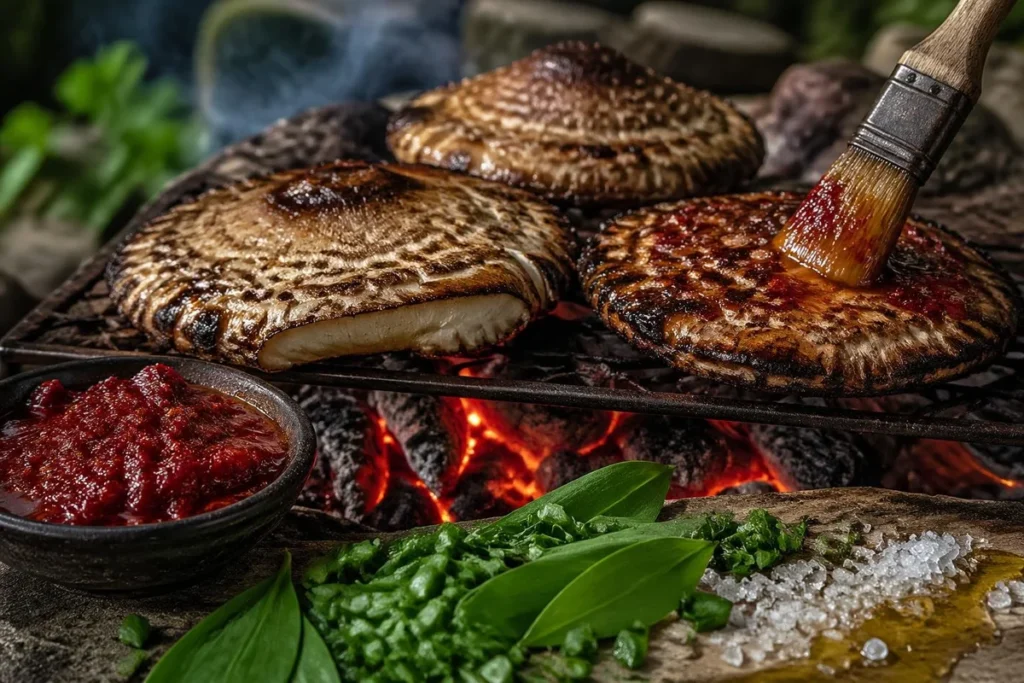
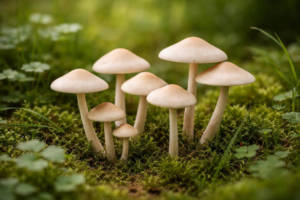
For our sixtieth technical formulation, we return to the most elemental of culinary forces: Open-Flame Pyrolysis. Macrolepiota procera (Parasol Mushroom), referred to as Macrolepiota procera in the Bulgarian highlands, is biologically engineered for high-heat exposure. Its large surface area allows for lightning-fast moisture evaporation, which is the prerequisite for the Maillard reaction. At pure-umami.cc, we utilize the high-kinetic energy of a wood fire to "char" the exterior of the cap, creating a smoky, crisp perimeter while the interior remains succulent, protected by the mushroom's own cellular humidity.
The Culinary Physics of This Dish
The engineering of this dish relies on Radiant Heat Transfer and Acidic Contrast. Unlike a standard pan-sear, a wood fire (approx. 400°C–500°C) subjects the Macrolepiota procera to intense infrared radiation. Molecularly, this causes the polysaccharides in the mushroom skin to break down into aromatic furanones (caramel notes). By applying a "Fermented Chili Mash" as a post-heat glaze, we introduce lactic acid and capsaicin. The acidity serves as a surfactant, breaking down the smoky carbon residues on the tongue and amplifying the fungal guanylates through a pH-driven flavor release.
Terroir Narrative
This formulation is a tribute to the Southern Rhodopes and the Aspromonte mountains of Italy, where shepherds and foragers traditionally cook Macrolepiota procera over small fires made from oak and beech wood. The terroir is expressed through the choice of hardwood smoke and wild garlic (Allium ursinum), which grows in the same shaded humidities as the Parasol. This mirrors the technical rigor we apply to our Boletus edulis (Porcini) and Craterellus cinereus (Grey Chanterelle), treating the "smoke" as an ingredient with its own chemical profile of phenols and guaiacol.
Quick Info Bar
Heat Source
Cook Time
Complexity
Aromatic Key
Oak/Beech Embers
4 mins
Grand Officier
Smoke & Lactic Acid
Master Recipe (1:10 Rule)
Technical ratios for the "Fire & Ferment" assembly:
4 Large Macrolepiota procera caps (Macrolepiota procera)
50ml Extra Virgin Olive Oil (high smoke point stability)
20g Fermented Chili Paste (Lacto-fermented for 2 weeks)
15g Wild Garlic (Levurda) or Garlic scapes, finely minced
10ml Lemon Juice (to brighten the smoky phenols)
Smoked Sea Salt (Maldon)
The Technique
The Ember Preparation: Build a fire using hardwood. Wait until the flames die down and you have a bed of glowing red embers. This provides the "Radiant Heat" necessary for a controlled char.
The Lipid Barrier: Brush the Macrolepiota procera caps generously with olive oil. This acts as a thermal conductor, ensuring the heat is distributed evenly across the mushroom's irregular surface.
The High-Intensity Sear: Place the caps on a grate directly over the embers. Cook for 2 minutes per side. The goal is "Leopard-Spotting"—small charred spots that provide a bitter-smoky contrast to the sweet fungal context.
The Glazing Phase: While the mushrooms are still at peak thermal energy (immediately after removal from the fire), brush them with the mixture of fermented chili, minced wild garlic, and lemon juice. The residual heat will "flash-cook" the garlic, removing its raw sulfur bite.
The Resting Phase: Let the mushrooms rest for 60 seconds. This allows the juices to redistribute and the smoke-derived phenols to bond with the chili's capsaicin. Finish with smoked sea salt.
Shop Integration
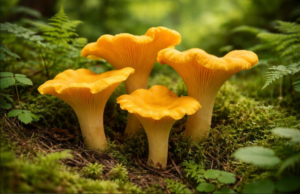
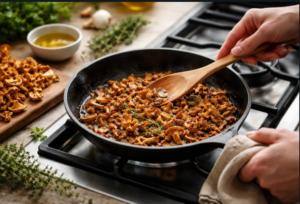
The Macrolepiota procera is the structural star here, but its smoky profile can be amplified by our other forest offerings. For an even deeper "earthy" finish, we recommend dusting the mushrooms with a pinch of our dried Boletus edulis (Porcini) before grilling. If you seek a brighter peppery contrast, garnish with whole seared Cantharellus cibarius (Chanterelle). For an elite textural bridge, serve the wood-fired caps with a side of sautéed Marasmius oreades (Fairy Ring) finished in wild garlic butter. For a luxury upgrade, a few drops of Morchella conica (Morel) oil can be added to the fermented chili glaze. If serving as a gourmet rustic plate, raw slices of Amanita caesarea (Caesar's mushroom) provided as a side will offer a clean, mineral contrast to the smoke.
The Umami Profile
This dish features **Pyrolytic-Fermented Umami**. The wood fire generates carbon compounds that mimic the savory depth of grilled meat, while the Macrolepiota procera provides the necessary fungal guanylates. The fermented chili introduces "Lactic Umami," which creates a lingering, tingly savory sensation on the tongue. The result is a bold, high-contrast flavor profile that is both rustic and technologically sophisticated.
Sommelier’s Choice
A structured **Etna Rosso (Nerello Mascalese)** or a smoky **Bulgarian Broad-Leaved Melnik**. These wines share the "volcanic" or "smoky" notes of the fire and possess enough tannin to handle the spice of the fermented chili glaze.
The Etymological Chronicle
The term Wood-Fired refers to the ancient technique of Cuisiner au Feu de Bois in **French**. In **Italian**, this would be Mazza di Tamburo alla Brace. In **German**, it is Holzgefeuerter Parasol. In **Spanish**, it is Galamperna a la Brasa. Regardless of the language, the **Parasol** mushroom on the embers remains the definitive standard for technical "primitive" mycological cookery.
Pure Umami | Mycological Research & Culinary Arts | 2026
To provide the best experiences, we use technologies like cookies to store and/or access device information. Consenting to these technologies will allow us to process data such as browsing behavior or unique IDs on this site. Not consenting or withdrawing consent, may adversely affect certain features and functions.
Functional
Always active
The technical storage or access is strictly necessary for the legitimate purpose of enabling the use of a specific service explicitly requested by the subscriber or user, or for the sole purpose of carrying out the transmission of a communication over an electronic communications network.
Preferences
The technical storage or access is necessary for the legitimate purpose of storing preferences that are not requested by the subscriber or user.
Statistics
The technical storage or access that is used exclusively for statistical purposes.The technical storage or access that is used exclusively for anonymous statistical purposes. Without a subpoena, voluntary compliance on the part of your Internet Service Provider, or additional records from a third party, information stored or retrieved for this purpose alone cannot usually be used to identify you.
Marketing
The technical storage or access is required to create user profiles to send advertising, or to track the user on a website or across several websites for similar marketing purposes.