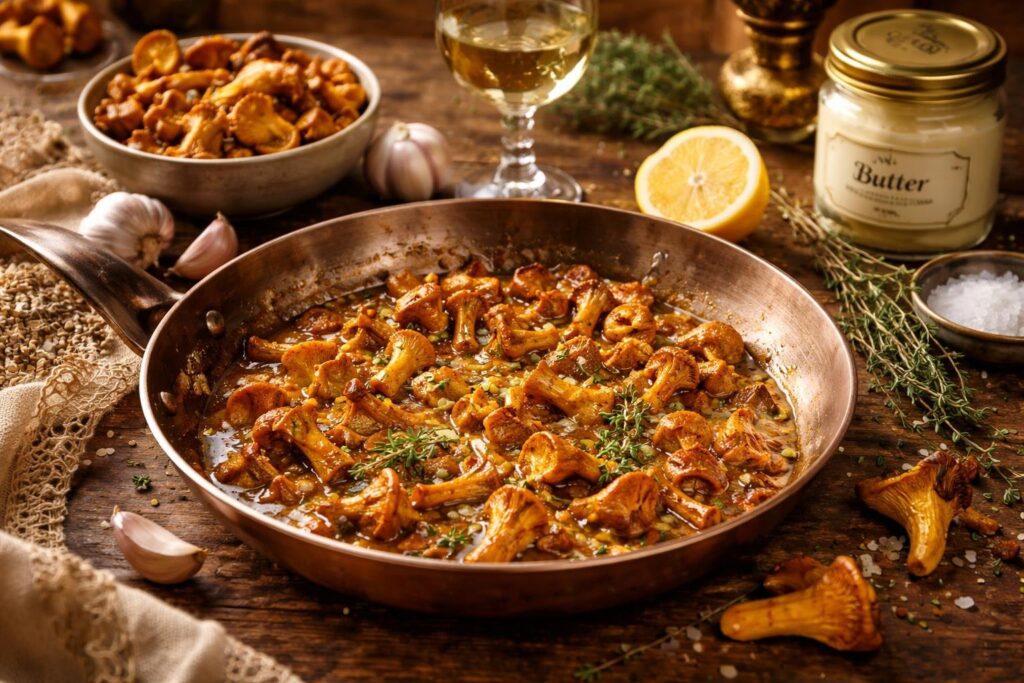
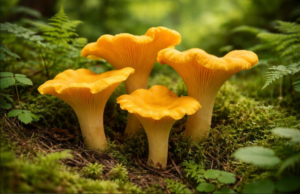
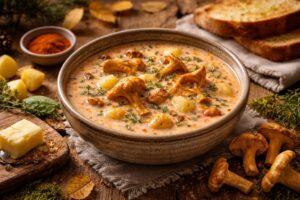
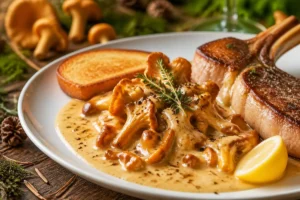
A luminous, high-aroma masterpiece featuring the apricot-scented Cantharellus cibarius, glazed in a silken, herb-infused butter emulsion.
The Golden Age Sauté
Wild Golden Chanterelles Glazed in Cultured Thyme-Butter and Dry Vermouth
The Historical Prelude
The Cantharellus cibarius, or Golden Chanterelle, has been the "Gold of the Forest" for the European aristocracy since the 16th century. Historically, its appearance in the mossy clearings of the Black Forest and the Scandinavian Highlands was so celebrated that it was often reserved for the tables of the House of Vasa and the Bourbons.
Known as the Girolle in France, this mushroom represents the "Golden Age" of mycological gastronomy. In the 18th century, it was the primary choice for royal sauciers because its unique, peppery-apricot aroma could stand up to the rich, lactic intensity of the period's butter-heavy cuisine. Unlike the morel, which thrives in the spring shadows, the Chanterelle is the child of the summer sun and rain, symbolizing the peak of the seasonal harvest.
The Chanterelle is a "Dense-Flesh" fungus. Our philosophy focuses on Controlled Evaporation. Chanterelles hold a surprising amount of internal moisture; we utilize a "Dry-Pan Start" to release this liquid and concentrate the mushroom's natural esters before introducing fats. This ensures the mushroom remains firm and "meaty" rather than becoming rubbery or boiled in its own juices.
Terroir: The finest Chanterelles are found in the Atlantic Fringes and the coniferous forests of the French Savoie. The mossy, acidic soil of these regions produces specimens with a high concentration of octen-3-ol, the molecule responsible for their signature fruity, apricot-like fragrance.
Professional Protocol: We never wash Chanterelles, as their "false gills" act like sponges. We use a natural-hair brush for cleaning. In accordance with "Leave No Trace" ethics, we only harvest mushrooms that have already "flared" their edges, ensuring they have reached maturity and dispersed the maximum amount of spores back into the terroir.
Essential Equipment
Heavy Stainless Steel Sauté Pan: For high-precision heat control and Maillard development.
Soft Bristle Brush: For surgical cleaning of the intricate ridges.
Wide Fish Spatula: To turn the mushrooms gently without fracturing the delicate "Trumpet" edges.
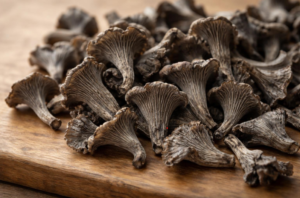
If using 40g Dried (400g Fresh equivalent), rehydrate in warm water for 20 minutes and pat bone-dry.
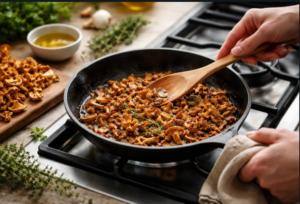
Place the 400g Fresh (or 40g rehydrated equivalent) into a medium-hot, dry pan. Cook until the moisture is released and then completely evaporates. The mushrooms will begin to "squeak" in the pan.
Stage 2: The Infused Glaze
Add 40g of cultured butter and 2 sprigs of fresh thyme.
Sauté for 3-4 minutes until the butter foams and the mushrooms turn a deep, burnished gold.
Stage 3: The Vermouth Deglaze
Deglaze the pan with 50ml of Dry Vermouth (or a crisp Chablis).
Reduce until the liquid forms a thick, golden emulsion that coats each mushroom.
Finish with a sprinkle of Fleur de Sel and a whisper of fresh parsley.
The Umami Secret: The 1:10 Nucleotide Synergy
The "Pure Umami" of the Golden Age Sauté is achieved through the 1:10 Molecular Extraction. Chanterelles are rich in Guanylate, which is intensified tenfold during the drying process. Even when using fresh mushrooms, adding 4g of dried Chanterelle powder (the equivalent of 40g fresh) into the butter creates a "flavor bridge." This ensures that the apricot-and-pepper volatiles are physically bonded to the lipids, resulting in a flavor that lingers significantly longer on the palate.
Pro Technique: The “Squeak-and-Butter” Rule
To achieve a 3-star Michelin texture, listen for the "squeak." When the mushrooms start to squeak against the pan, it means the cellular water has left and they are ready to absorb the butter. Adding fat before this moment will result in a greasy mushroom; adding it at the squeak ensures the fat enters the cellular structure, making them incredibly succulent.
The Art of Pairing
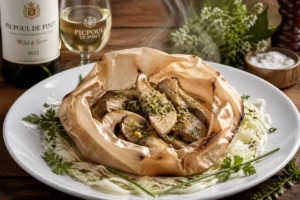
Sommelier's Choice: A dry Riesling or a Viognier. The wine's stone-fruit notes (peach/apricot) are a structural mirror to the Chanterelle's own fragrance.
Non-Alcoholic: A cold-steeped Oolong Tea, which provides a sophisticated floral and mineral counterpoint.
Ancestral Nutrition
Chanterelles are one of the highest plant-based sources of Vitamin D and Iron. Historically, in the Scandinavian Highlands, this sauté was considered "Liquid Sunlight," served to prepare the body for the dark winter months by providing a massive metabolic and immune system boost.
Micro-FAQ
Q: Why is the 1:10 ratio critical for Chanterelles? A: Because Chanterelles have a very high water content (90%). 40g of dried mushrooms provides the exact aromatic intensity of 400g of fresh ones, but in a concentrated form that allows for a much more stable emulsion in the butter-sauce.
Q: Can I use garlic? A: We recommend against it. Garlic is too aggressive and will mask the delicate, fruity apricot notes of the Girolle. Use shallots if you require an allium base.
To provide the best experiences, we use technologies like cookies to store and/or access device information. Consenting to these technologies will allow us to process data such as browsing behavior or unique IDs on this site. Not consenting or withdrawing consent, may adversely affect certain features and functions.
Functional
Always active
The technical storage or access is strictly necessary for the legitimate purpose of enabling the use of a specific service explicitly requested by the subscriber or user, or for the sole purpose of carrying out the transmission of a communication over an electronic communications network.
Preferences
The technical storage or access is necessary for the legitimate purpose of storing preferences that are not requested by the subscriber or user.
Statistics
The technical storage or access that is used exclusively for statistical purposes.The technical storage or access that is used exclusively for anonymous statistical purposes. Without a subpoena, voluntary compliance on the part of your Internet Service Provider, or additional records from a third party, information stored or retrieved for this purpose alone cannot usually be used to identify you.
Marketing
The technical storage or access is required to create user profiles to send advertising, or to track the user on a website or across several websites for similar marketing purposes.