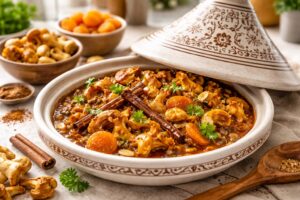
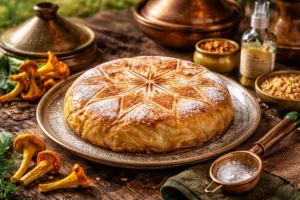
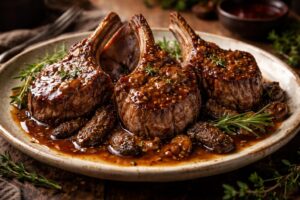
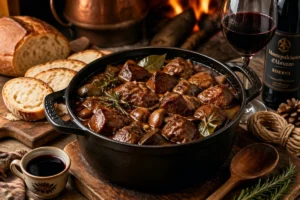
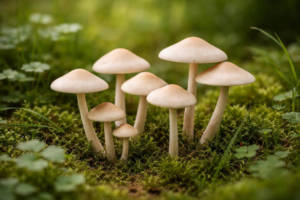
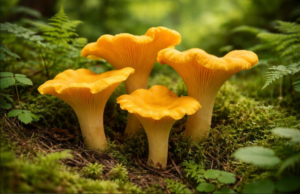
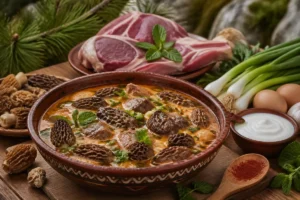
A prestigious high-precision masterpiece featuring the "King of the Forest" in a vibrant North African reduction, inspired by the aromatic spice markets of the Maghreb and the rugged mountain traditions of the Balkans.
Incredible Marrakesh Express
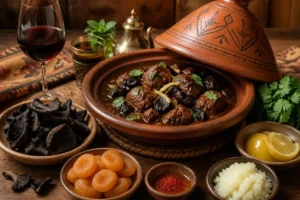
Thick-Cut Boletus Edulis with Ras el Hanout, Preserved Lemon, and Saffron-Honey Infusion
The Historical Prelude
The Marrakesh Express is a culinary "Silk Road" bridge between the ancient *Berber* clay-pot traditions of North Africa and the primeval oak forests of the Balkans. Historically, the Boletus edulis (Manatarka or Porcini) has been treated as "Forest Gold." While Maghrebi cuisine traditionally utilizes lamb or chicken in the tajine, the high-altitude foragers of the Rila and Rhodope mountains discovered that the meaty, nutty profile of the Porcini acts as a biological conductor for the complex spice arrays of the Orient.
In the 18th-century trade routes connecting the Ottoman Empire to Western Europe, spices like Saffron and Ras el Hanout met the wild fungi of the high pastures. The Porcini's specific concentration of guanylates provides a savory "bass note" that grounds the citrusy "high notes" of Preserved Lemon. This dish represents a masterclass in Trans-Continental Umami, where the sweetness of dried apricots and honey bonds molecularly with the mushroom's earthy protein.
This dish represents the "Moorish-Balkan" school of Exotic Slow-Cooking. It is a study in Aqueous Aromatic Infusion. Historically, it was served to signal the union of luxury and the wild. It is a dish that demands an elite understanding of the Spice Bloom—an incredible experience that captures the olfactory essence of a Moroccan spice bazaar within the heart of a Bulgarian forest, refined through the technical excellence of Heritage Gastronomy.
Terroir: The most prestigious Porcini for a Tajine are "Firm Kings" harvested from the mineral-heavy soils of the Atlantic Fringes and the Balkan Massif. These specimens have a structural density that allows them to absorb the spice-infused steam without becoming overly soft.
Leave No Trace Protocol: In accordance with Bulgarian and Mediterranean forest ethics, we utilize surgical-grade knives to harvest, leaving the mycelium undisturbed. We strictly avoid over-mature specimens to ensure the "Ultimate" structural integrity of the mushroom chunks in the clay-pot reduction.
Essential Equipment
Clay Tajine or Heavy Dutch Oven: Essential for the conical steam-recirculation required to tenderize the mushrooms in spice-vapor.
Mortar and Pestle: For the high-precision bruising of the saffron threads and toasted spices.
Stainless Steel Sauté Pan: For the initial "Maillard Flash-Sear" of the Porcini before the slow-simmer phase.
Master Recipe
Stage 1: The Maillard Sizzle
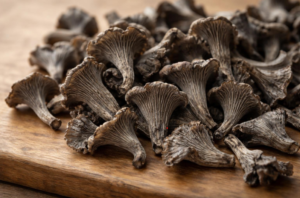
Select 500g fresh Porcini (or 50g dried/rehydrated). Cut into large 3cm cubes to mimic the texture of lamb.
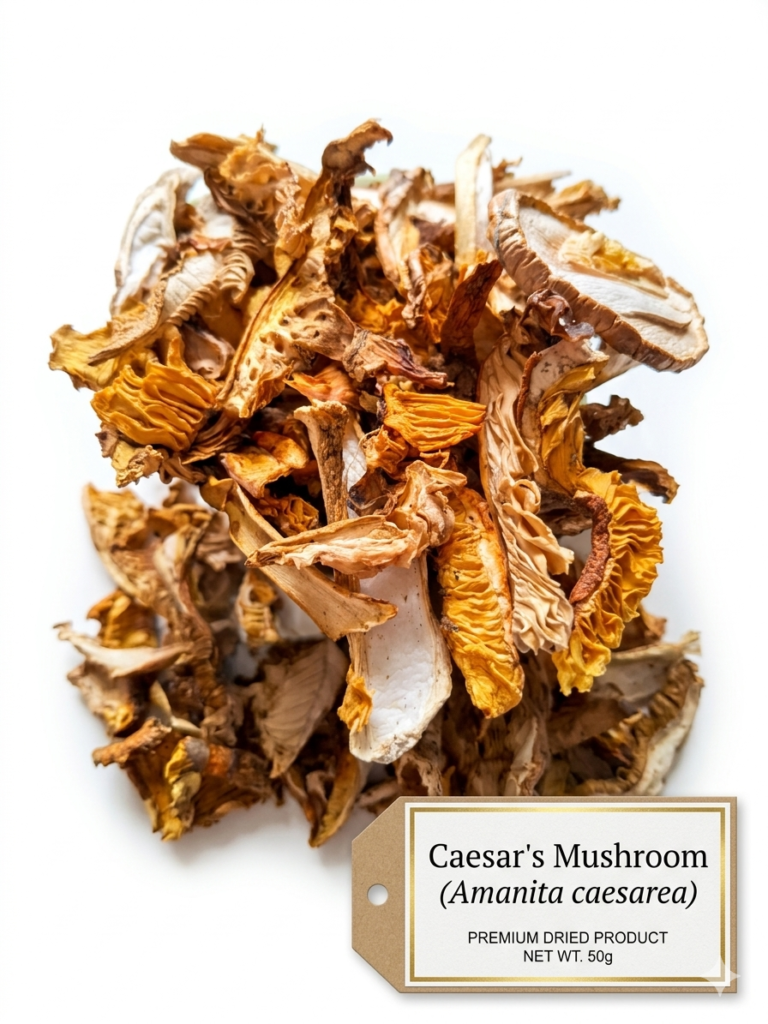
If using the 1:10 dried equivalent, rehydrate in warm water with a pinch of saffron for 3 hours.
In a hot pan with olive oil, sear the Porcini until they are deeply caramelized. Set aside.
Stage 2: The Aromatic Foundation
In the Tajine, sauté 1 sliced red onion, 2 cloves of garlic, and 1 tbsp Ras el Hanout.
Add 100g of Dried Apricots, 1 tbsp Preserved Lemon (finely sliced), and 300ml of mushroom stock.
Stage 3: The Marrakesh Slow-Steam
Add the seared Porcini to the Tajine. Drizzle with 1 tbsp of Wildflower Honey.
Cover and simmer on the lowest possible heat for 30 minutes. The conical shape will circulate the mushroom's almond-and-oak volatiles back into the sauce.
Finish with fresh cilantro, toasted almonds, and a dusting of Saffron. Serve over fluffy couscous.
The Umami Secret: The 1:10 Lipid-Saffron Bridge
The "Incredible Umami" of this tajine is achieved through Terpene-Nucleotide Synergy. Porcini are rich in guanylates. By utilizing the 1:10 rule (50g dried to 500g fresh equivalent), you concentrate these savory compounds. The safranal in the Saffron acts as a "molecular bridge," lifting the mushroom's heavy earthiness into a floral, exotic dimension. The honey and preserved lemon act as "Frequency Tuners," balancing the umami-depth with bright acidity and natural sweetness.
Pro Technique: The “Saffron-Bloom”
To achieve a 3-star Michelin finish, never add raw saffron to the tajine. Grind the threads with a pinch of salt and dissolve in a tablespoon of warm water for 10 minutes. This "Ultimate" technique releases the water-soluble pigments and aromatics, ensuring the Porcini are dyed a "Royal Gold" and infused with the spice's deepest olfactory essence.
The Art of Pairing
Sommelier's Choice: A Moroccan Syrah or a full-bodied Bulgarian Viognier. The wine's stone-fruit and spice notes provide a structural mirror to the apricots and saffron.
Non-Alcoholic: A hot Maghrebi Mint Tea with extra sugar.
Substitutions & Variations
Luxury Alternative: Add a micro-thin shaving of Black Summer Truffle over the tajine just before serving for an "Imperial" musk profile.
Hearty Variant: Incorporate 100g of chickpeas for a more "Traditional" texture and extra protein density.
Storage & Reheating
Tajine is a "Resting" dish; the flavors intensify over 24 hours. Reheat gently in the clay pot with a splash of water to restore the "Exotic" steam. Never microwave, as it will dry out the apricots and cause the Porcini to become rubbery.
Ancestral Nutrition
Porcini and Saffron are premier sources of Vitamin D and Crocin (a potent neuroprotective antioxidant). Historically, in both Balkan and North African mountain lore, this combination was served to provide "Light for the Mind," ensuring metabolic vitality and emotional clarity during the sunless months.
Micro-FAQ
Q: Why use Porcini in a tajine? A: Their ability to absorb complex aromatics while maintaining a firm, "lamb-like" bite makes them the most prestigious mushroom choice for slow-steaming.
Q: Can I use the stems? A: Absolutely. The stems of the Boletus edulis are exceptionally savory. Slice them into 2cm medallions and treat them exactly like the caps.
Q: Is the 1:10 rule mandatory? A: Yes. 50g of dried provides the same savory volume as 500g of fresh, ensuring the "Incredible" depth of flavor isn't lost in the aggressive spice profile.
To provide the best experiences, we use technologies like cookies to store and/or access device information. Consenting to these technologies will allow us to process data such as browsing behavior or unique IDs on this site. Not consenting or withdrawing consent, may adversely affect certain features and functions.
Functional
Always active
The technical storage or access is strictly necessary for the legitimate purpose of enabling the use of a specific service explicitly requested by the subscriber or user, or for the sole purpose of carrying out the transmission of a communication over an electronic communications network.
Preferences
The technical storage or access is necessary for the legitimate purpose of storing preferences that are not requested by the subscriber or user.
Statistics
The technical storage or access that is used exclusively for statistical purposes.The technical storage or access that is used exclusively for anonymous statistical purposes. Without a subpoena, voluntary compliance on the part of your Internet Service Provider, or additional records from a third party, information stored or retrieved for this purpose alone cannot usually be used to identify you.
Marketing
The technical storage or access is required to create user profiles to send advertising, or to track the user on a website or across several websites for similar marketing purposes.