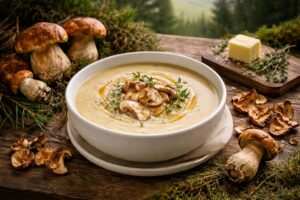
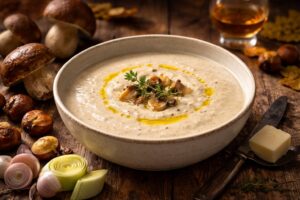
This recipe utilizes the high protein-to-water ratio of Russula cyanoxantha to create a naturally emulsified, silken soup. By incorporating roasted hazelnuts from the Piedmont region, we highlight the mushroom's latent nutty characteristics through a shared molecular profile of pyrazines and lipids, resulting in a sophisticated liquid umami experience.
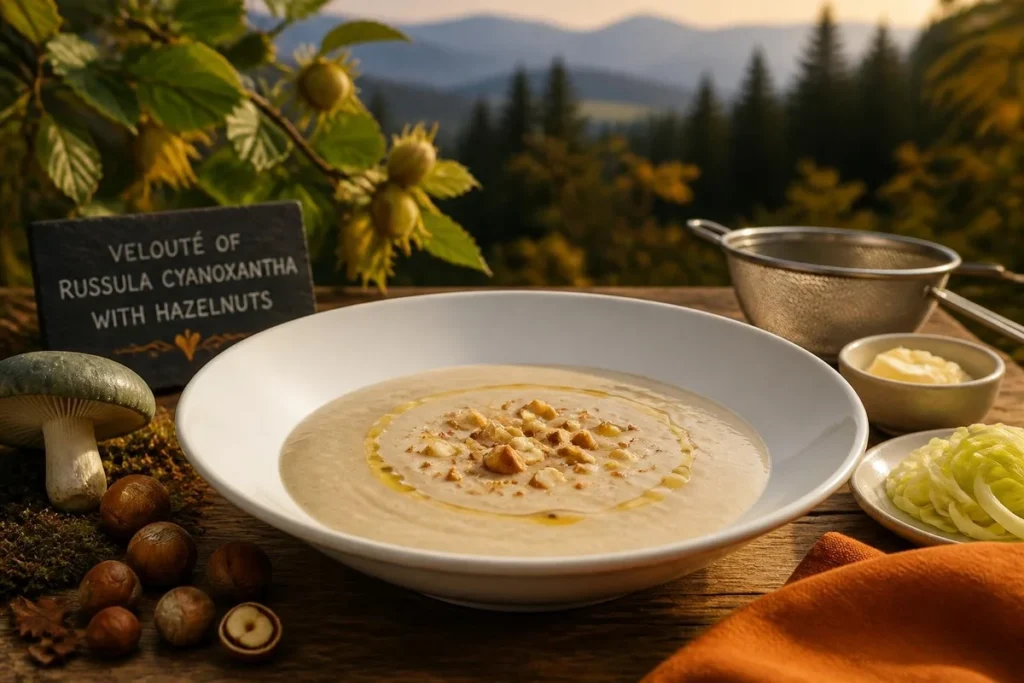
Velouté of Russula Cyanoxantha with Hazelnuts
This recipe utilizes the high protein-to-water ratio of Russula cyanoxantha to create a naturally emulsified, silken soup. By incorporating roasted hazelnuts from the Piedmont region, we highlight the mushroom's latent nutty characteristics through a shared molecular profile of pyrazines and lipids, resulting in a sophisticated liquid umami experience.
The Culinary Physics of This Dish
The Russula cyanoxantha contains a specific concentration of structural proteins that, when blended after a gentle poach, act as natural thickening agents. Unlike many other mushrooms that turn "slimy" when pureed, the flexible gills of the Charcoal Burner provide a stable micro-suspension. This allows for a Velouté that requires significantly less roux or heavy cream, preserving the pure mycological essence. The inclusion of hazelnuts introduces filbertone, which synergizes with the mushroom's earthy volatiles to amplify the perceived richness on the palate.
Terroir Narrative
This dish is an homage to the alpine borderlands between Savoie, France and Piedmont, Italy. In these high-altitude mixed forests, the Charcoal Burner is often found growing beneath hazelnut trees (Corylus avellana). This "biological proximity" is reflected in the flavor profile of the dish—a true representation of the forest floor's vertical integration. It is a transitionary dish, perfect for the cool mist of a late-summer evening in the mountains.
Prep Time
Cook Time
Complexity
Calories
Region
25 Mins
30 Mins
Grand Officier
210 kcal
Savoie, France
Master Recipe (1:10 Rule)
600 g Russula cyanoxantha (Cleaned and roughly chopped)
100 g Toasted hazelnuts (skins removed)
1 l Light vegetable bouillon (low sodium)
150 ml Double cream (35% fat)
2 White leeks (whites only, finely sliced)
40 g Cultured butter
5 g Fine sea salt
1 dash White truffle oil (optional garnish)
The Technique
1. The Suer (Sweating): Melt the butter in a heavy pot over low heat. Add the leeks and a pinch of salt. Cook until translucent (do not brown). This forms the aromatic base.
2. Mycological Extraction: Increase the heat slightly and add the Russula cyanoxantha. Sauté for 5 minutes until the mushrooms release their liquid and begin to reabsorb it, intensifying their flavor.
3. The Simmer: Add the bouillon. Bring to a gentle simmer for 15 minutes. High heat will break the delicate flavor molecules, so keep it at a bare "smile" on the surface.
4. Emulsification: Add the cream and half of the roasted hazelnuts. Use a high-speed immersion blender to process the soup for at least 2 minutes. The extended blending is key to achieving the "Velouté" (velvet) texture.
5. Refinement: Pass the soup through a fine-mesh chinois or sieve to remove any remaining fibers. This step is what separates a rustic soup from a Grand Officier preparation.
6. Garnish: Serve in warmed bowls. Top with the remaining crushed hazelnuts and a few drops of white truffle oil for an olfactory finale.
Shop Integration
The Charcoal Burner's creamy potential is unmatched, but our shop offers several mushrooms that can deepen this velouté. Adding a small portion of Boletus edulis (Boletus edulis) will introduce a classic forest scent, while our Marasmius oreades (Marasmius oreades) can provide a sweet, almond-like undertone. For a visual and textural contrast, consider serving this soup alongside sautéed Cantharellus cibarius (Cantharellus cibarius) or the rare Amanita caesarea (Amanita caesarea). For winter variations, the smoky notes of Craterellus cornucopioides (Craterellus cinereus) or the complexity of Morchella (Morchella conica) are highly recommended.
The Umami Profile
The pureeing process maximizes the surface area of the mushroom particles, ensuring that every drop of liquid is saturated with glutamates. When paired with the nucleotides in the vegetable bouillon, the umami sensation is physically felt as a weight on the tongue. The fats in the cream and hazelnuts act as the delivery vehicle, ensuring these flavors linger long after the soup is consumed.
Sommelier’s Choice
Vin de Savoie (Chignin-Bergeron): This local white wine, made from the Roussanne grape, has the necessary body and notes of apricot and honey to balance the creamy texture and nutty finish of the velouté.
THE ETYMOLOGICAL CHRONICLE
French:Russule charbonnière – Named for the "coal-man" hues, ranging from deep purple to slate gray.
Italian:Colombina maggiore – Referencing the "Greater Dove," reflecting its size and the soft, feather-like colors of the cap.
German:Frauentäubling – A reference to the mushroom's gentle nature; "Frauen" (lady) and "Täubling" (little dove).
Spanish:Carbonera – A name derived from the charcoal burners of the forest who highly valued this non-brittle Russula.
To provide the best experiences, we use technologies like cookies to store and/or access device information. Consenting to these technologies will allow us to process data such as browsing behavior or unique IDs on this site. Not consenting or withdrawing consent, may adversely affect certain features and functions.
Functional
Always active
The technical storage or access is strictly necessary for the legitimate purpose of enabling the use of a specific service explicitly requested by the subscriber or user, or for the sole purpose of carrying out the transmission of a communication over an electronic communications network.
Preferences
The technical storage or access is necessary for the legitimate purpose of storing preferences that are not requested by the subscriber or user.
Statistics
The technical storage or access that is used exclusively for statistical purposes.The technical storage or access that is used exclusively for anonymous statistical purposes. Without a subpoena, voluntary compliance on the part of your Internet Service Provider, or additional records from a third party, information stored or retrieved for this purpose alone cannot usually be used to identify you.
Marketing
The technical storage or access is required to create user profiles to send advertising, or to track the user on a website or across several websites for similar marketing purposes.